

Infrastructure policy should aim at effective delivery of infrastructure services of
high quality compatible with low cost to the country’s households and firms. Such
infrastructure policies may be deemed to have been successful when the end-users
can compare the quality and quantity with respect to prices favourably against global
norms.
Sustainable economic growth can only be achieved if quality infrastructure
services can be provided at reasonable cost. This is certainly the challenge of
many countries to improve the quality of services and the delivery system through
an adequate infrastructure investment.
Infrastructure investment implies investing highly during a short period, high
risks of failure or delays to reap benefits, a low return associated with a long recovery
period. Such constraints affect the outlook of governments on possible efficient
delivery of infrastructure services. It is certainly useful for governments to consider
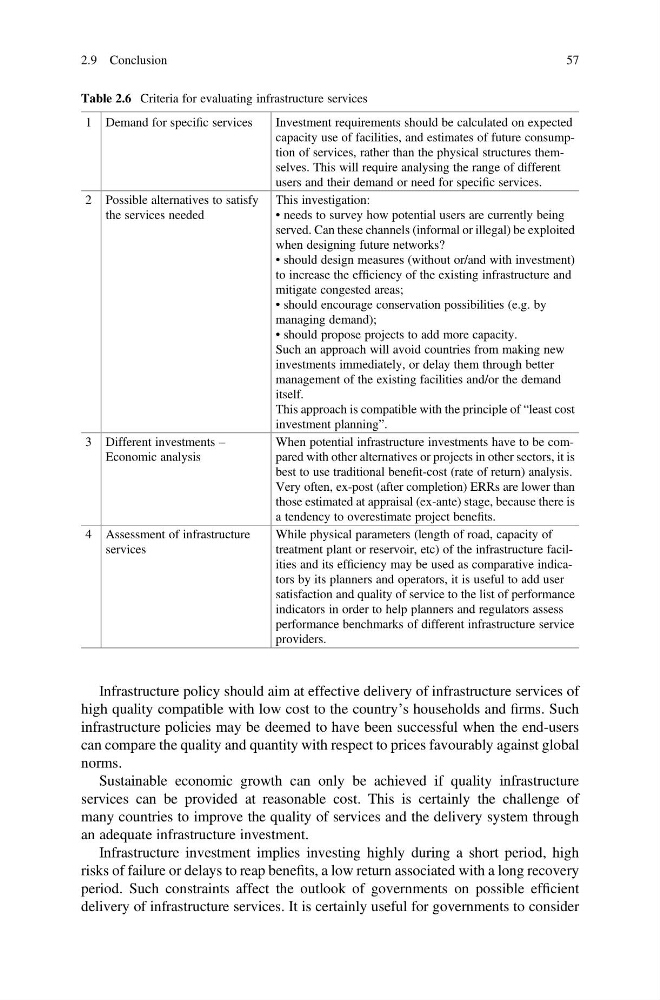
Table 2.6 Criteria for evaluating infrastructure services
1 Demand for specific services
Investment requirements should be calculated on expected
capacity use of facilities, and estimates of future consumption of services, rather than the physical structures themselves. This will require analysing the range of different
users and their demand or need for specific services.
2 Possible alternatives to satisfy
the services needed
This investigation:
• needs to survey how potential users are currently being
served. Can these channels (informal or illegal) be exploited
when designing future networks?
• should design measures (without or/and with investment)
to increase the efficiency of the existing infrastructure and
mitigate congested areas;
• should encourage conservation possibilities (e.g. by
managing demand);
• should propose projects to add more capacity.
Such an approach will avoid countries from making new
investments immediately, or delay them through better
management of the existing facilities and/or the demand
itself.
This approach is compatible with the principle of “least cost
investment planning”.
3 Different investments –
Economic analysis
When potential infrastructure investments have to be compared with other alternatives or projects in other sectors, it is
best to use traditional benefit-cost (rate of return) analysis.
Very often, ex-post (after completion) ERRs are lower than
those estimated at appraisal (ex-ante) stage, because there is
a tendency to overestimate project benefits.
4 Assessment of infrastructure
services
While physical parameters (length of road, capacity of
treatment plant or reservoir, etc) of the infrastructure facilities and its efficiency may be used as comparative indicators by its planners and operators, it is useful to add user
satisfaction and quality of service to the list of performance
indicators in order to help planners and regulators assess
performance benchmarks of different infrastructure service
providers.
2.9 Conclusion
57
high quality compatible with low cost to the country’s households and firms. Such
infrastructure policies may be deemed to have been successful when the end-users
can compare the quality and quantity with respect to prices favourably against global
norms.
Sustainable economic growth can only be achieved if quality infrastructure
services can be provided at reasonable cost. This is certainly the challenge of
many countries to improve the quality of services and the delivery system through
an adequate infrastructure investment.
Infrastructure investment implies investing highly during a short period, high
risks of failure or delays to reap benefits, a low return associated with a long recovery
period. Such constraints affect the outlook of governments on possible efficient
delivery of infrastructure services. It is certainly useful for governments to consider
Table 2.6 Criteria for evaluating infrastructure services
1 Demand for specific services
Investment requirements should be calculated on expected
capacity use of facilities, and estimates of future consumption of services, rather than the physical structures themselves. This will require analysing the range of different
users and their demand or need for specific services.
2 Possible alternatives to satisfy
the services needed
This investigation:
• needs to survey how potential users are currently being
served. Can these channels (informal or illegal) be exploited
when designing future networks?
• should design measures (without or/and with investment)
to increase the efficiency of the existing infrastructure and
mitigate congested areas;
• should encourage conservation possibilities (e.g. by
managing demand);
• should propose projects to add more capacity.
Such an approach will avoid countries from making new
investments immediately, or delay them through better
management of the existing facilities and/or the demand
itself.
This approach is compatible with the principle of “least cost
investment planning”.
3 Different investments –
Economic analysis
When potential infrastructure investments have to be compared with other alternatives or projects in other sectors, it is
best to use traditional benefit-cost (rate of return) analysis.
Very often, ex-post (after completion) ERRs are lower than
those estimated at appraisal (ex-ante) stage, because there is
a tendency to overestimate project benefits.
4 Assessment of infrastructure
services
While physical parameters (length of road, capacity of
treatment plant or reservoir, etc) of the infrastructure facilities and its efficiency may be used as comparative indicators by its planners and operators, it is useful to add user
satisfaction and quality of service to the list of performance
indicators in order to help planners and regulators assess
performance benchmarks of different infrastructure service
providers.
2.9 Conclusion
57