

moving away from this traditional role of services provider to one of facilitating and
regulation in order to ensure proper delivery of infrastructure services.
The institutions, the regulations, and the enforcing laws constitute the infrastructure of an economy, and determine to what extent individuals are prepared to invest
in capital, to develop skills, and adopt technology, associated with long-term
economic success. Countries where the government provides the proper environment conducive to production are very dynamic and successful. Countries where the
government uses its power to allow diversion are certainly less successful.
In the same vein, some countries carried out revolutions to give more liberty or
rights to its citizens with the result that they successfully developed or adopted the
relevant institutions and the infrastructure ancillaries.
This theory explains how some countries such as Singapore, Hong Kong, and
Japan have changed from being relatively poor to being relatively rich over a short
time span of only four decades. Conversely, countries like Argentina or Venezuela
can move backwards.
Appendix 2.1: “Constant Return to Scale”
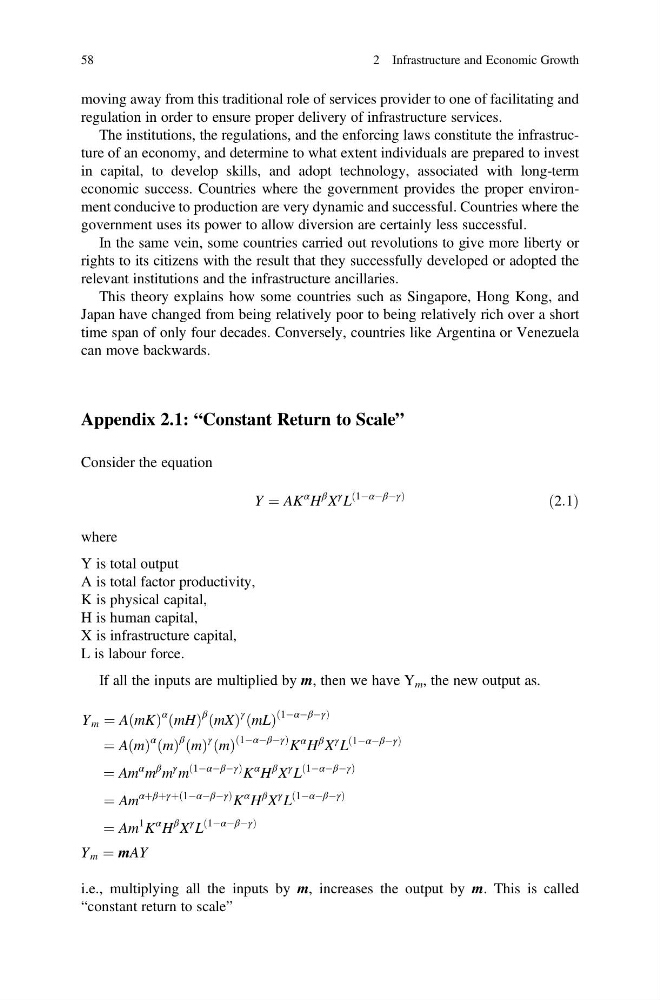
Consider the equation
Y ¼ AK
α H
β X
γ L
1ÀαÀβÀγ
ð
Þ
ð2:1Þ
where
Y is total output
A is total factor productivity,
K is physical capital,
H is human capital,
X is infrastructure capital,
L is labour force.
If all the inputs are multiplied by m, then we have Y m , the new output as.
Y m ¼ A mK
ð Þ
α mH
ð Þ
β mX
ð Þ
γ mL
ð Þ
1ÀαÀβÀγ
ð
Þ
¼ A m
ð Þ
α m
ð Þ
β m
ð Þ
γ m
ð Þ
1ÀαÀβÀγ
ð
Þ K
α H
β X
γ L
1ÀαÀβÀγ
ð
Þ
¼ Am
α m
β m
γ m
1ÀαÀβÀγ
ð
Þ K
α H
β X
γ L
1ÀαÀβÀγ
ð
Þ
¼ Am
αþβþγþ 1ÀαÀβÀγ
ð
Þ K
α H
β X
γ L
1ÀαÀβÀγ
ð
Þ
¼ Am
1 K
α H
β X
γ L
1ÀαÀβÀγ
ð
Þ
Y m ¼ mAY
i.e., multiplying all the inputs by m, increases the output by m. This is called
“constant return to scale”
58
2 Infrastructure and Economic Growth
regulation in order to ensure proper delivery of infrastructure services.
The institutions, the regulations, and the enforcing laws constitute the infrastructure of an economy, and determine to what extent individuals are prepared to invest
in capital, to develop skills, and adopt technology, associated with long-term
economic success. Countries where the government provides the proper environment conducive to production are very dynamic and successful. Countries where the
government uses its power to allow diversion are certainly less successful.
In the same vein, some countries carried out revolutions to give more liberty or
rights to its citizens with the result that they successfully developed or adopted the
relevant institutions and the infrastructure ancillaries.
This theory explains how some countries such as Singapore, Hong Kong, and
Japan have changed from being relatively poor to being relatively rich over a short
time span of only four decades. Conversely, countries like Argentina or Venezuela
can move backwards.
Appendix 2.1: “Constant Return to Scale”
Consider the equation
Y ¼ AK
α H
β X
γ L
1ÀαÀβÀγ
ð
Þ
ð2:1Þ
where
Y is total output
A is total factor productivity,
K is physical capital,
H is human capital,
X is infrastructure capital,
L is labour force.
If all the inputs are multiplied by m, then we have Y m , the new output as.
Y m ¼ A mK
ð Þ
α mH
ð Þ
β mX
ð Þ
γ mL
ð Þ
1ÀαÀβÀγ
ð
Þ
¼ A m
ð Þ
α m
ð Þ
β m
ð Þ
γ m
ð Þ
1ÀαÀβÀγ
ð
Þ K
α H
β X
γ L
1ÀαÀβÀγ
ð
Þ
¼ Am
α m
β m
γ m
1ÀαÀβÀγ
ð
Þ K
α H
β X
γ L
1ÀαÀβÀγ
ð
Þ
¼ Am
αþβþγþ 1ÀαÀβÀγ
ð
Þ K
α H
β X
γ L
1ÀαÀβÀγ
ð
Þ
¼ Am
1 K
α H
β X
γ L
1ÀαÀβÀγ
ð
Þ
Y m ¼ mAY
i.e., multiplying all the inputs by m, increases the output by m. This is called
“constant return to scale”
58
2 Infrastructure and Economic Growth