

2.8 Implications for Infrastructure Planning and Policy
The discussion above suggests that several conditions are required for infrastructure
to impact favourably on economic development.
Four main criteria to evaluate infrastructure services are given in Table 2.6.
2.9 Conclusion
With the exception of small localised markets, infrastructure is required to satisfy the
basic needs of suppliers and consumers. Means of communications (roads, for a
start) are necessary besides other requirements of modern society. High quality
service may require even more dependable (reliable) technology.
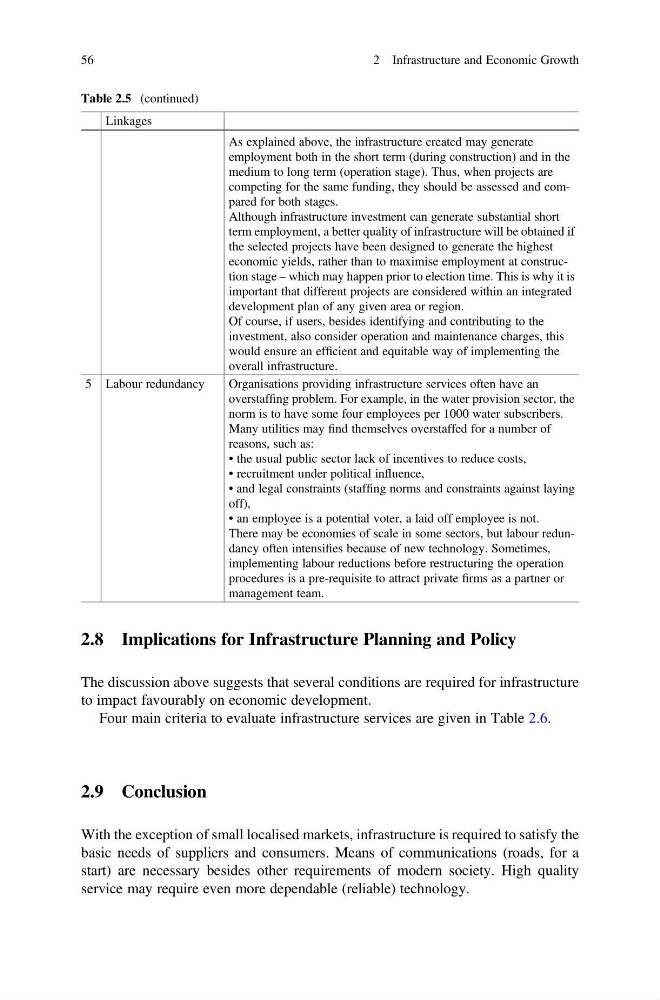
Table 2.5 (continued)
Linkages
As explained above, the infrastructure created may generate
employment both in the short term (during construction) and in the
medium to long term (operation stage). Thus, when projects are
competing for the same funding, they should be assessed and compared for both stages.
Although infrastructure investment can generate substantial short
term employment, a better quality of infrastructure will be obtained if
the selected projects have been designed to generate the highest
economic yields, rather than to maximise employment at construction stage – which may happen prior to election time. This is why it is
important that different projects are considered within an integrated
development plan of any given area or region.
Of course, if users, besides identifying and contributing to the
investment, also consider operation and maintenance charges, this
would ensure an efficient and equitable way of implementing the
overall infrastructure.
5 Labour redundancy
Organisations providing infrastructure services often have an
overstaffing problem. For example, in the water provision sector, the
norm is to have some four employees per 1000 water subscribers.
Many utilities may find themselves overstaffed for a number of
reasons, such as:
• the usual public sector lack of incentives to reduce costs,
• recruitment under political influence,
• and legal constraints (staffing norms and constraints against laying
off),
• an employee is a potential voter, a laid off employee is not.
There may be economies of scale in some sectors, but labour redundancy often intensifies because of new technology. Sometimes,
implementing labour reductions before restructuring the operation
procedures is a pre-requisite to attract private firms as a partner or
management team.
56
2 Infrastructure and Economic Growth
The discussion above suggests that several conditions are required for infrastructure
to impact favourably on economic development.
Four main criteria to evaluate infrastructure services are given in Table 2.6.
2.9 Conclusion
With the exception of small localised markets, infrastructure is required to satisfy the
basic needs of suppliers and consumers. Means of communications (roads, for a
start) are necessary besides other requirements of modern society. High quality
service may require even more dependable (reliable) technology.
Table 2.5 (continued)
Linkages
As explained above, the infrastructure created may generate
employment both in the short term (during construction) and in the
medium to long term (operation stage). Thus, when projects are
competing for the same funding, they should be assessed and compared for both stages.
Although infrastructure investment can generate substantial short
term employment, a better quality of infrastructure will be obtained if
the selected projects have been designed to generate the highest
economic yields, rather than to maximise employment at construction stage – which may happen prior to election time. This is why it is
important that different projects are considered within an integrated
development plan of any given area or region.
Of course, if users, besides identifying and contributing to the
investment, also consider operation and maintenance charges, this
would ensure an efficient and equitable way of implementing the
overall infrastructure.
5 Labour redundancy
Organisations providing infrastructure services often have an
overstaffing problem. For example, in the water provision sector, the
norm is to have some four employees per 1000 water subscribers.
Many utilities may find themselves overstaffed for a number of
reasons, such as:
• the usual public sector lack of incentives to reduce costs,
• recruitment under political influence,
• and legal constraints (staffing norms and constraints against laying
off),
• an employee is a potential voter, a laid off employee is not.
There may be economies of scale in some sectors, but labour redundancy often intensifies because of new technology. Sometimes,
implementing labour reductions before restructuring the operation
procedures is a pre-requisite to attract private firms as a partner or
management team.
56
2 Infrastructure and Economic Growth