

appropriately designed so that the required expenses for infrastructure do not disturb
macroeconomic stability by distorting the labour market or by bringing fiscal or
financial imbalances.
Table 2.5 examines the connections between infrastructure expenses and the
markets for labour and capital in developing countries.
Table 2.4 (continued)
In contrast, positive synergism may arise among infrastructure
activities and other sectors. Landfill sites and sewage treatment
wetlands have been reclaimed to be converted into creative and
useful recreational parks. Appropriate sorting of wastes
(domestic, industrial) may lead to environmentally-sound
practices.
If users and stakeholders are able to participate in infrastructure
management process (planning, operation, and regulation),
this could provide for a better environmental management.
Given the options available for obtaining a required level and
quality of service, users may indicate how much they can
contribute financially and otherwise in the overall management
process.
Government can help in public education – promoting suitable
technologies and group participation, in particular those hampered by environmental externalities, making credit available
and in regulation.
AFFECT THE
LEVEL OF
PRODUCTION OR
CONSUMPTION
POSITIVE (benefit
on other party free
of charge)
The beneficiary gets
a windfall gain,
without paying for
the benefit
ACTIONS BY
PRODUCER
OR
CONSUMER
TECHNOLOGICAL
OR PECUNIARY
EXTERNALITIES
CHANGE THE
DEMAND AND
SUPPLY
CONDITIONS
NEGATIVE (costs
on other party)
The affected party
gets NO
compensation at
all
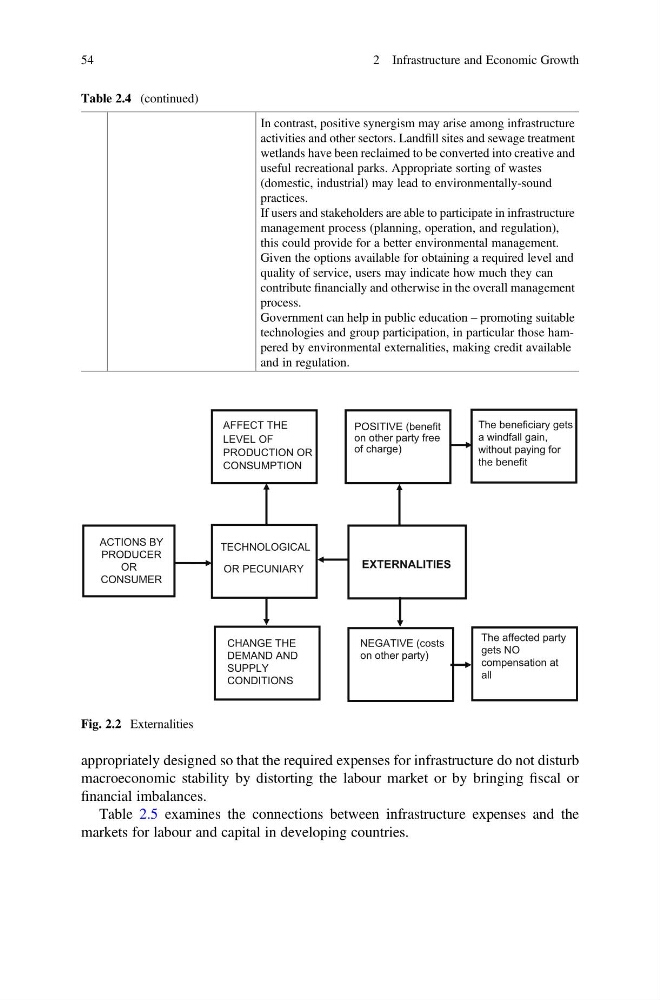
Fig. 2.2 Externalities
54
2 Infrastructure and Economic Growth
macroeconomic stability by distorting the labour market or by bringing fiscal or
financial imbalances.
Table 2.5 examines the connections between infrastructure expenses and the
markets for labour and capital in developing countries.
Table 2.4 (continued)
In contrast, positive synergism may arise among infrastructure
activities and other sectors. Landfill sites and sewage treatment
wetlands have been reclaimed to be converted into creative and
useful recreational parks. Appropriate sorting of wastes
(domestic, industrial) may lead to environmentally-sound
practices.
If users and stakeholders are able to participate in infrastructure
management process (planning, operation, and regulation),
this could provide for a better environmental management.
Given the options available for obtaining a required level and
quality of service, users may indicate how much they can
contribute financially and otherwise in the overall management
process.
Government can help in public education – promoting suitable
technologies and group participation, in particular those hampered by environmental externalities, making credit available
and in regulation.
AFFECT THE
LEVEL OF
PRODUCTION OR
CONSUMPTION
POSITIVE (benefit
on other party free
of charge)
The beneficiary gets
a windfall gain,
without paying for
the benefit
ACTIONS BY
PRODUCER
OR
CONSUMER
TECHNOLOGICAL
OR PECUNIARY
EXTERNALITIES
CHANGE THE
DEMAND AND
SUPPLY
CONDITIONS
NEGATIVE (costs
on other party)
The affected party
gets NO
compensation at
all
Fig. 2.2 Externalities
54
2 Infrastructure and Economic Growth