

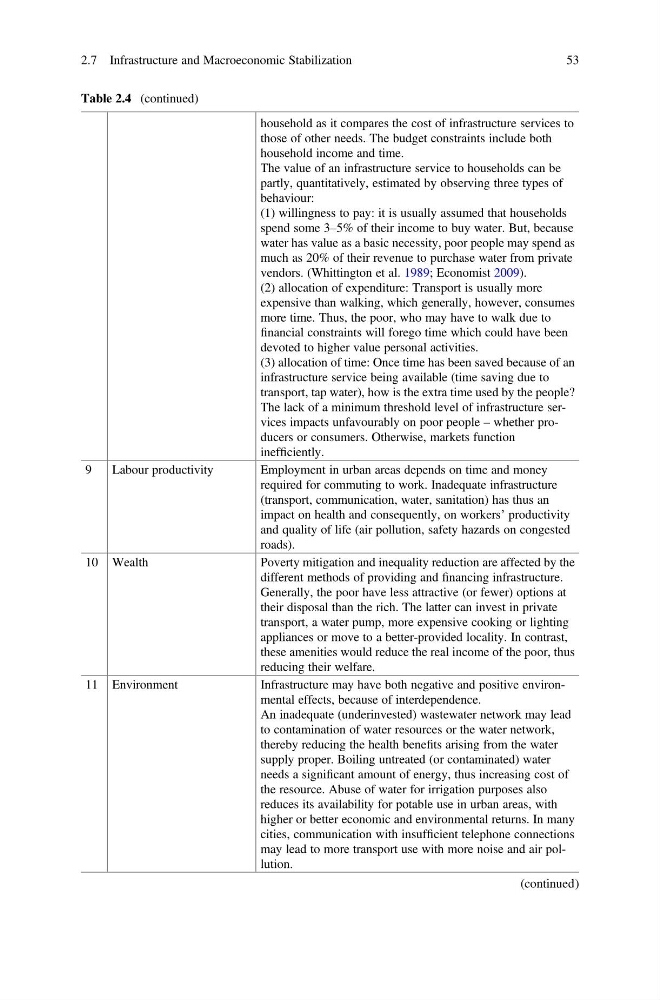
Table 2.4 (continued)
household as it compares the cost of infrastructure services to
those of other needs. The budget constraints include both
household income and time.
The value of an infrastructure service to households can be
partly, quantitatively, estimated by observing three types of
behaviour:
(1) willingness to pay: it is usually assumed that households
spend some 3–5% of their income to buy water. But, because
water has value as a basic necessity, poor people may spend as
much as 20% of their revenue to purchase water from private
vendors. (Whittington et al. 1989; Economist 2009).
(2) allocation of expenditure: Transport is usually more
expensive than walking, which generally, however, consumes
more time. Thus, the poor, who may have to walk due to
financial constraints will forego time which could have been
devoted to higher value personal activities.
(3) allocation of time: Once time has been saved because of an
infrastructure service being available (time saving due to
transport, tap water), how is the extra time used by the people?
The lack of a minimum threshold level of infrastructure services impacts unfavourably on poor people – whether producers or consumers. Otherwise, markets function
inefficiently.
9
Labour productivity
Employment in urban areas depends on time and money
required for commuting to work. Inadequate infrastructure
(transport, communication, water, sanitation) has thus an
impact on health and consequently, on workers’ productivity
and quality of life (air pollution, safety hazards on congested
roads).
10 Wealth
Poverty mitigation and inequality reduction are affected by the
different methods of providing and financing infrastructure.
Generally, the poor have less attractive (or fewer) options at
their disposal than the rich. The latter can invest in private
transport, a water pump, more expensive cooking or lighting
appliances or move to a better-provided locality. In contrast,
these amenities would reduce the real income of the poor, thus
reducing their welfare.
11 Environment
Infrastructure may have both negative and positive environmental effects, because of interdependence.
An inadequate (underinvested) wastewater network may lead
to contamination of water resources or the water network,
thereby reducing the health benefits arising from the water
supply proper. Boiling untreated (or contaminated) water
needs a significant amount of energy, thus increasing cost of
the resource. Abuse of water for irrigation purposes also
reduces its availability for potable use in urban areas, with
higher or better economic and environmental returns. In many
cities, communication with insufficient telephone connections
may lead to more transport use with more noise and air pollution.
(continued)
2.7 Infrastructure and Macroeconomic Stabilization
53
household as it compares the cost of infrastructure services to
those of other needs. The budget constraints include both
household income and time.
The value of an infrastructure service to households can be
partly, quantitatively, estimated by observing three types of
behaviour:
(1) willingness to pay: it is usually assumed that households
spend some 3–5% of their income to buy water. But, because
water has value as a basic necessity, poor people may spend as
much as 20% of their revenue to purchase water from private
vendors. (Whittington et al. 1989; Economist 2009).
(2) allocation of expenditure: Transport is usually more
expensive than walking, which generally, however, consumes
more time. Thus, the poor, who may have to walk due to
financial constraints will forego time which could have been
devoted to higher value personal activities.
(3) allocation of time: Once time has been saved because of an
infrastructure service being available (time saving due to
transport, tap water), how is the extra time used by the people?
The lack of a minimum threshold level of infrastructure services impacts unfavourably on poor people – whether producers or consumers. Otherwise, markets function
inefficiently.
9
Labour productivity
Employment in urban areas depends on time and money
required for commuting to work. Inadequate infrastructure
(transport, communication, water, sanitation) has thus an
impact on health and consequently, on workers’ productivity
and quality of life (air pollution, safety hazards on congested
roads).
10 Wealth
Poverty mitigation and inequality reduction are affected by the
different methods of providing and financing infrastructure.
Generally, the poor have less attractive (or fewer) options at
their disposal than the rich. The latter can invest in private
transport, a water pump, more expensive cooking or lighting
appliances or move to a better-provided locality. In contrast,
these amenities would reduce the real income of the poor, thus
reducing their welfare.
11 Environment
Infrastructure may have both negative and positive environmental effects, because of interdependence.
An inadequate (underinvested) wastewater network may lead
to contamination of water resources or the water network,
thereby reducing the health benefits arising from the water
supply proper. Boiling untreated (or contaminated) water
needs a significant amount of energy, thus increasing cost of
the resource. Abuse of water for irrigation purposes also
reduces its availability for potable use in urban areas, with
higher or better economic and environmental returns. In many
cities, communication with insufficient telephone connections
may lead to more transport use with more noise and air pollution.
(continued)
2.7 Infrastructure and Macroeconomic Stabilization
53