

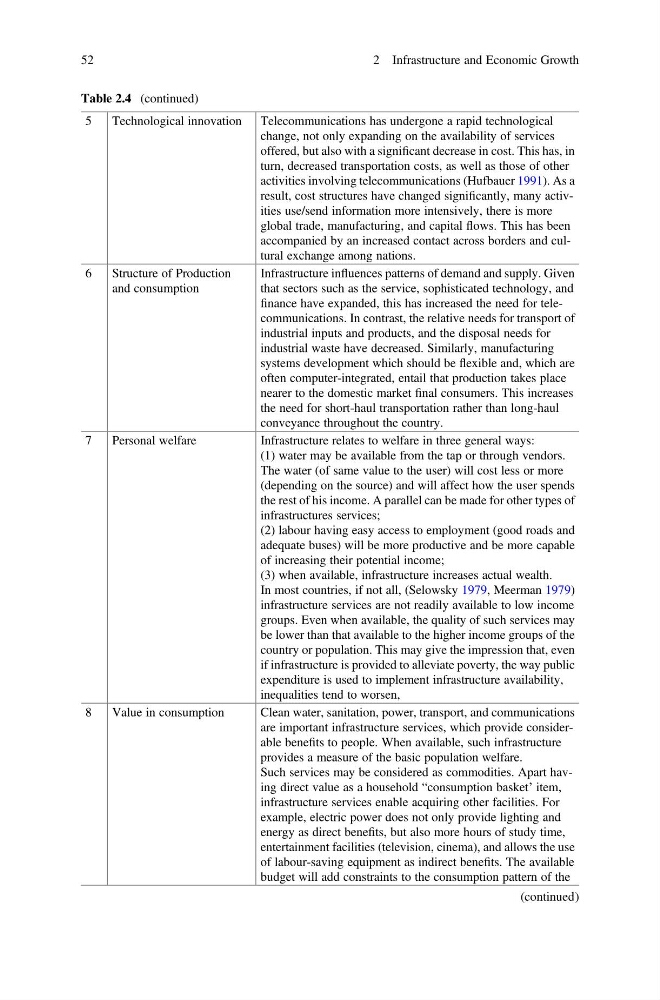
Table 2.4 (continued)
5
Technological innovation Telecommunications has undergone a rapid technological
change, not only expanding on the availability of services
offered, but also with a significant decrease in cost. This has, in
turn, decreased transportation costs, as well as those of other
activities involving telecommunications (Hufbauer 1991). As a
result, cost structures have changed significantly, many activities use/send information more intensively, there is more
global trade, manufacturing, and capital flows. This has been
accompanied by an increased contact across borders and cultural exchange among nations.
6
Structure of Production
and consumption
Infrastructure influences patterns of demand and supply. Given
that sectors such as the service, sophisticated technology, and
finance have expanded, this has increased the need for telecommunications. In contrast, the relative needs for transport of
industrial inputs and products, and the disposal needs for
industrial waste have decreased. Similarly, manufacturing
systems development which should be flexible and, which are
often computer-integrated, entail that production takes place
nearer to the domestic market final consumers. This increases
the need for short-haul transportation rather than long-haul
conveyance throughout the country.
7
Personal welfare
Infrastructure relates to welfare in three general ways:
(1) water may be available from the tap or through vendors.
The water (of same value to the user) will cost less or more
(depending on the source) and will affect how the user spends
the rest of his income. A parallel can be made for other types of
infrastructures services;
(2) labour having easy access to employment (good roads and
adequate buses) will be more productive and be more capable
of increasing their potential income;
(3) when available, infrastructure increases actual wealth.
In most countries, if not all, (Selowsky 1979, Meerman 1979)
infrastructure services are not readily available to low income
groups. Even when available, the quality of such services may
be lower than that available to the higher income groups of the
country or population. This may give the impression that, even
if infrastructure is provided to alleviate poverty, the way public
expenditure is used to implement infrastructure availability,
inequalities tend to worsen,
8
Value in consumption
Clean water, sanitation, power, transport, and communications
are important infrastructure services, which provide considerable benefits to people. When available, such infrastructure
provides a measure of the basic population welfare.
Such services may be considered as commodities. Apart having direct value as a household “consumption basket’ item,
infrastructure services enable acquiring other facilities. For
example, electric power does not only provide lighting and
energy as direct benefits, but also more hours of study time,
entertainment facilities (television, cinema), and allows the use
of labour-saving equipment as indirect benefits. The available
budget will add constraints to the consumption pattern of the
(continued)
52
2 Infrastructure and Economic Growth
5
Technological innovation Telecommunications has undergone a rapid technological
change, not only expanding on the availability of services
offered, but also with a significant decrease in cost. This has, in
turn, decreased transportation costs, as well as those of other
activities involving telecommunications (Hufbauer 1991). As a
result, cost structures have changed significantly, many activities use/send information more intensively, there is more
global trade, manufacturing, and capital flows. This has been
accompanied by an increased contact across borders and cultural exchange among nations.
6
Structure of Production
and consumption
Infrastructure influences patterns of demand and supply. Given
that sectors such as the service, sophisticated technology, and
finance have expanded, this has increased the need for telecommunications. In contrast, the relative needs for transport of
industrial inputs and products, and the disposal needs for
industrial waste have decreased. Similarly, manufacturing
systems development which should be flexible and, which are
often computer-integrated, entail that production takes place
nearer to the domestic market final consumers. This increases
the need for short-haul transportation rather than long-haul
conveyance throughout the country.
7
Personal welfare
Infrastructure relates to welfare in three general ways:
(1) water may be available from the tap or through vendors.
The water (of same value to the user) will cost less or more
(depending on the source) and will affect how the user spends
the rest of his income. A parallel can be made for other types of
infrastructures services;
(2) labour having easy access to employment (good roads and
adequate buses) will be more productive and be more capable
of increasing their potential income;
(3) when available, infrastructure increases actual wealth.
In most countries, if not all, (Selowsky 1979, Meerman 1979)
infrastructure services are not readily available to low income
groups. Even when available, the quality of such services may
be lower than that available to the higher income groups of the
country or population. This may give the impression that, even
if infrastructure is provided to alleviate poverty, the way public
expenditure is used to implement infrastructure availability,
inequalities tend to worsen,
8
Value in consumption
Clean water, sanitation, power, transport, and communications
are important infrastructure services, which provide considerable benefits to people. When available, such infrastructure
provides a measure of the basic population welfare.
Such services may be considered as commodities. Apart having direct value as a household “consumption basket’ item,
infrastructure services enable acquiring other facilities. For
example, electric power does not only provide lighting and
energy as direct benefits, but also more hours of study time,
entertainment facilities (television, cinema), and allows the use
of labour-saving equipment as indirect benefits. The available
budget will add constraints to the consumption pattern of the
(continued)
52
2 Infrastructure and Economic Growth