

20.4 Human Resources Availability
20.4.1 Four Kinds of People
Throughout History, it seems that people have been classified into four categories,
each with specific characteristics. Different civilisations gave different names to
these categories, but Erikson (2019) has found it convenient to give them names of
colours. These different categories have different types of behaviours, as shown in
Fig. 20.15. About 5% of people are dominated by only one colour (i.e. type of
behaviour), while about 80% of all people have behaviours governed by two colours,
and the remainder behave according to a combination of three colours. The most
common behaviour is governed by green characteristics (or with another colour in
combination), while the least common behaviour is dominated by red characteristics
(or with another colour in combination). Obviously, if everybody in an army had red
characteristics, all would be generals, and there would be no soldiers to do the
fighting.
The different types of behaviours exhibited by people stem from characteristics
and attitudes. Table 20.3 gives, for each colour, positive aspects and “negative”
aspects. The positive aspects relate to persons seeing themselves with these qualities.
Table 20.2 (continued)
Phase
The different steps
This task may be broken up into small manageable activities. After estimating the
selection and analysis workload progress milestones may be identified. Such an
analysis can help monitor the planning process.
All spare parts, tools, resources, or other requirements should be identified to avoid
delays, at execution time.
Identify a suitable (not too many!) number of performance parameters to monitor
the maintenance work.
Record changes made to the plan following the analysis.
Estimate the value added by these modifications.
Analysis must concentrate on improvements to all four maintenance process
phases.
PLANNING
Design and
construct
ANALYSIS
MAINTENANCE CONTINUOUS
IMPROVEMENT CYCLE
SCHEDULING
EXECUTION
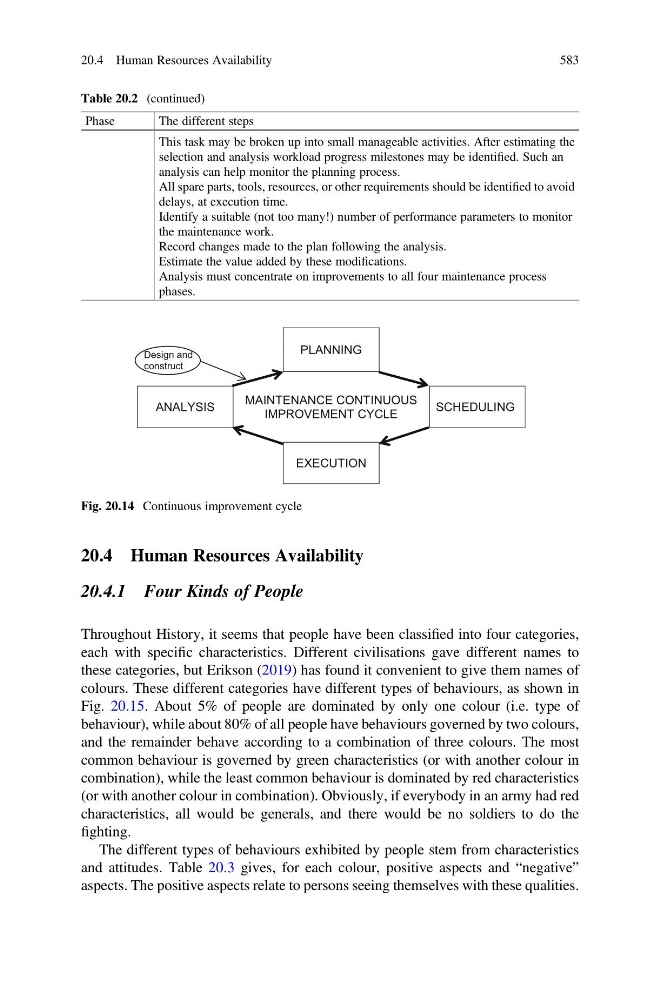
Fig. 20.14 Continuous improvement cycle
20.4 Human Resources Availability
583