

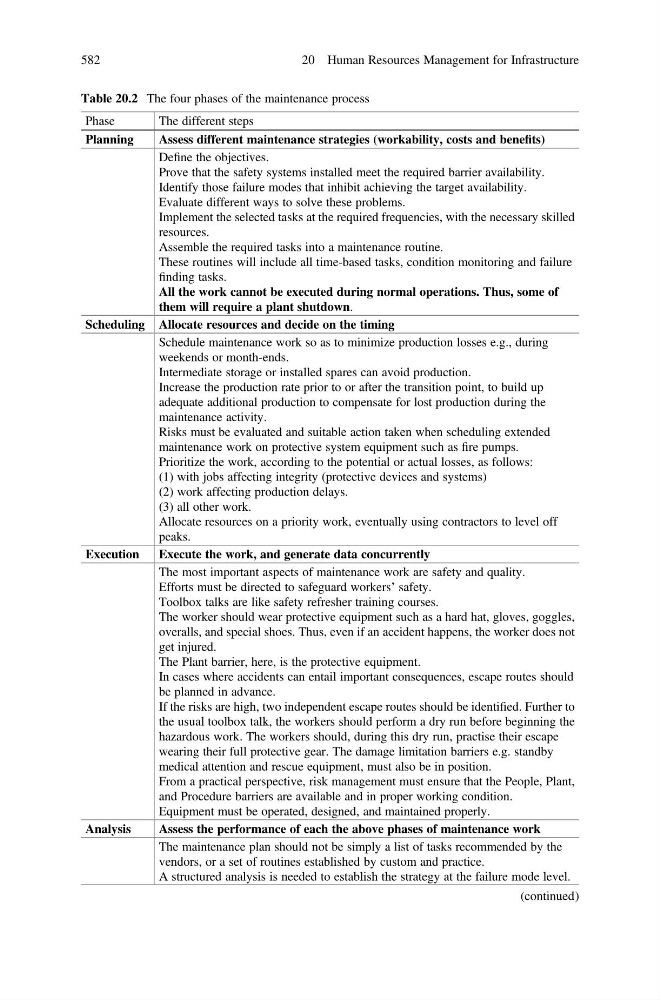
Table 20.2 The four phases of the maintenance process
Phase
The different steps
Planning
Assess different maintenance strategies (workability, costs and benefits)
Define the objectives.
Prove that the safety systems installed meet the required barrier availability.
Identify those failure modes that inhibit achieving the target availability.
Evaluate different ways to solve these problems.
Implement the selected tasks at the required frequencies, with the necessary skilled
resources.
Assemble the required tasks into a maintenance routine.
These routines will include all time-based tasks, condition monitoring and failure
finding tasks.
All the work cannot be executed during normal operations. Thus, some of
them will require a plant shutdown.
Scheduling Allocate resources and decide on the timing
Schedule maintenance work so as to minimize production losses e.g., during
weekends or month-ends.
Intermediate storage or installed spares can avoid production.
Increase the production rate prior to or after the transition point, to build up
adequate additional production to compensate for lost production during the
maintenance activity.
Risks must be evaluated and suitable action taken when scheduling extended
maintenance work on protective system equipment such as fire pumps.
Prioritize the work, according to the potential or actual losses, as follows:
(1) with jobs affecting integrity (protective devices and systems)
(2) work affecting production delays.
(3) all other work.
Allocate resources on a priority work, eventually using contractors to level off
peaks.
Execution
Execute the work, and generate data concurrently
The most important aspects of maintenance work are safety and quality.
Efforts must be directed to safeguard workers’ safety.
Toolbox talks are like safety refresher training courses.
The worker should wear protective equipment such as a hard hat, gloves, goggles,
overalls, and special shoes. Thus, even if an accident happens, the worker does not
get injured.
The Plant barrier, here, is the protective equipment.
In cases where accidents can entail important consequences, escape routes should
be planned in advance.
If the risks are high, two independent escape routes should be identified. Further to
the usual toolbox talk, the workers should perform a dry run before beginning the
hazardous work. The workers should, during this dry run, practise their escape
wearing their full protective gear. The damage limitation barriers e.g. standby
medical attention and rescue equipment, must also be in position.
From a practical perspective, risk management must ensure that the People, Plant,
and Procedure barriers are available and in proper working condition.
Equipment must be operated, designed, and maintained properly.
Analysis
Assess the performance of each the above phases of maintenance work
The maintenance plan should not be simply a list of tasks recommended by the
vendors, or a set of routines established by custom and practice.
A structured analysis is needed to establish the strategy at the failure mode level.
(continued)
582
20 Human Resources Management for Infrastructure