

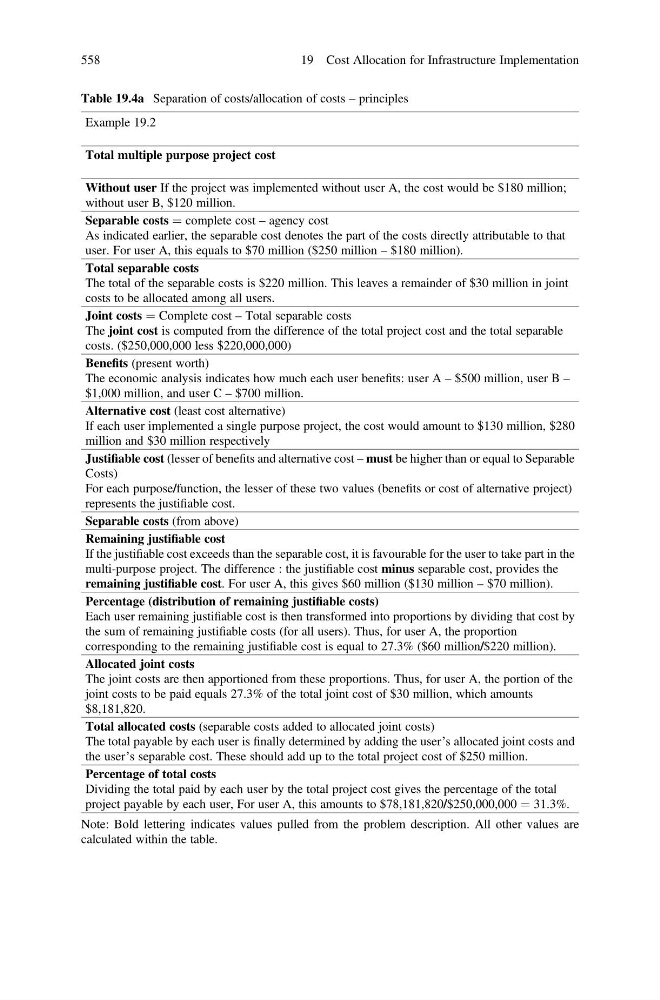
Table 19.4a Separation of costs/allocation of costs – principles
Example 19.2
Total multiple purpose project cost
Without user If the project was implemented without user A, the cost would be $180 million;
without user B, $120 million.
Separable costs ¼ complete cost – agency cost
As indicated earlier, the separable cost denotes the part of the costs directly attributable to that
user. For user A, this equals to $70 million ($250 million – $180 million).
Total separable costs
The total of the separable costs is $220 million. This leaves a remainder of $30 million in joint
costs to be allocated among all users.
Joint costs ¼ Complete cost – Total separable costs
The joint cost is computed from the difference of the total project cost and the total separable
costs. ($250,000,000 less $220,000,000)
Benefits (present worth)
The economic analysis indicates how much each user benefits: user A – $500 million, user B –
$1,000 million, and user C – $700 million.
Alternative cost (least cost alternative)
If each user implemented a single purpose project, the cost would amount to $130 million, $280
million and $30 million respectively
Justifiable cost (lesser of benefits and alternative cost – must be higher than or equal to Separable
Costs)
For each purpose/function, the lesser of these two values (benefits or cost of alternative project)
represents the justifiable cost.
Separable costs (from above)
Remaining justifiable cost
If the justifiable cost exceeds than the separable cost, it is favourable for the user to take part in the
multi-purpose project. The difference : the justifiable cost minus separable cost, provides the
remaining justifiable cost. For user A, this gives $60 million ($130 million – $70 million).
Percentage (distribution of remaining justifiable costs)
Each user remaining justifiable cost is then transformed into proportions by dividing that cost by
the sum of remaining justifiable costs (for all users). Thus, for user A, the proportion
corresponding to the remaining justifiable cost is equal to 27.3% ($60 million/$220 million).
Allocated joint costs
The joint costs are then apportioned from these proportions. Thus, for user A, the portion of the
joint costs to be paid equals 27.3% of the total joint cost of $30 million, which amounts
$8,181,820.
Total allocated costs (separable costs added to allocated joint costs)
The total payable by each user is finally determined by adding the user’s allocated joint costs and
the user’s separable cost. These should add up to the total project cost of $250 million.
Percentage of total costs
Dividing the total paid by each user by the total project cost gives the percentage of the total
project payable by each user, For user A, this amounts to $78,181,820/$250,000,000 ¼ 31.3%.
Note: Bold lettering indicates values pulled from the problem description. All other values are
calculated within the table.
558
19 Cost Allocation for Infrastructure Implementation