

As the National Research Council points out: “Infrastructure is a means to other
ends, and the effectiveness, efficiency, and reliability of its contribution to these
other ends must ultimately be the measure of infrastructure performance.” (Hall et al.
2016; Cornes and Sandler 1996). It follows that the assessment of infrastructure, its
management and the accompanying policies must examine the activities, systems,
and ends made possible by the infrastructure.
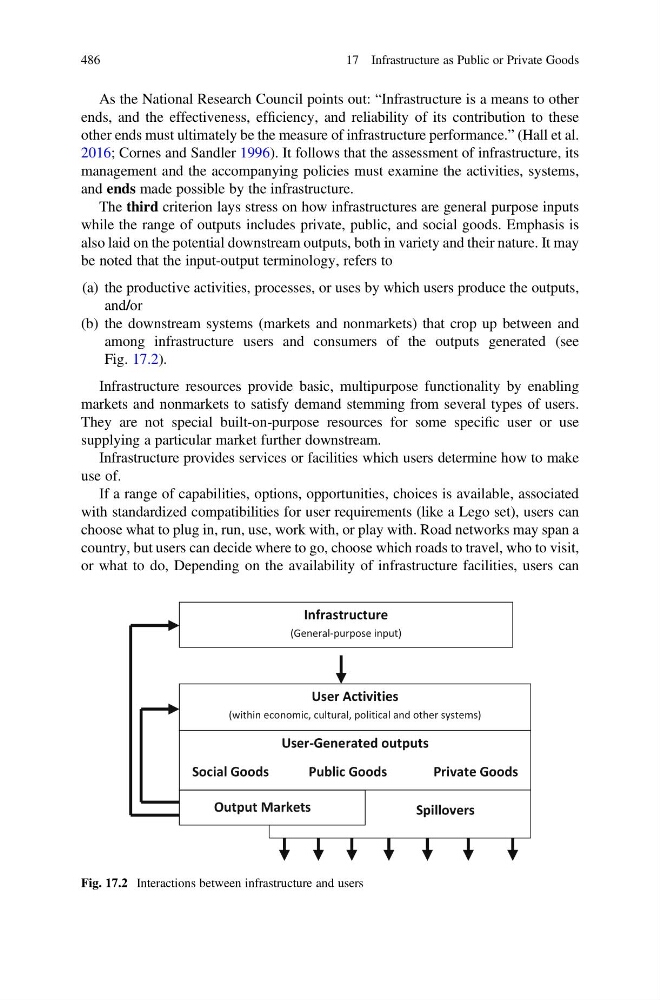
The third criterion lays stress on how infrastructures are general purpose inputs
while the range of outputs includes private, public, and social goods. Emphasis is
also laid on the potential downstream outputs, both in variety and their nature. It may
be noted that the input-output terminology, refers to
(a) the productive activities, processes, or uses by which users produce the outputs,
and/or
(b) the downstream systems (markets and nonmarkets) that crop up between and
among infrastructure users and consumers of the outputs generated (see
Fig. 17.2).
Infrastructure resources provide basic, multipurpose functionality by enabling
markets and nonmarkets to satisfy demand stemming from several types of users.
They are not special built-on-purpose resources for some specific user or use
supplying a particular market further downstream.
Infrastructure provides services or facilities which users determine how to make
use of.
If a range of capabilities, options, opportunities, choices is available, associated
with standardized compatibilities for user requirements (like a Lego set), users can
choose what to plug in, run, use, work with, or play with. Road networks may span a
country, but users can decide where to go, choose which roads to travel, who to visit,
or what to do, Depending on the availability of infrastructure facilities, users can
Infrastructure
(General-purpose input)
User Activities
(within economic, cultural, political and other systems)
User-Generated outputs
Social Goods
Public Goods
Private Goods
Spillovers
Output Markets
Fig. 17.2 Interactions between infrastructure and users
486
17 Infrastructure as Public or Private Goods
ends, and the effectiveness, efficiency, and reliability of its contribution to these
other ends must ultimately be the measure of infrastructure performance.” (Hall et al.
2016; Cornes and Sandler 1996). It follows that the assessment of infrastructure, its
management and the accompanying policies must examine the activities, systems,
and ends made possible by the infrastructure.
The third criterion lays stress on how infrastructures are general purpose inputs
while the range of outputs includes private, public, and social goods. Emphasis is
also laid on the potential downstream outputs, both in variety and their nature. It may
be noted that the input-output terminology, refers to
(a) the productive activities, processes, or uses by which users produce the outputs,
and/or
(b) the downstream systems (markets and nonmarkets) that crop up between and
among infrastructure users and consumers of the outputs generated (see
Fig. 17.2).
Infrastructure resources provide basic, multipurpose functionality by enabling
markets and nonmarkets to satisfy demand stemming from several types of users.
They are not special built-on-purpose resources for some specific user or use
supplying a particular market further downstream.
Infrastructure provides services or facilities which users determine how to make
use of.
If a range of capabilities, options, opportunities, choices is available, associated
with standardized compatibilities for user requirements (like a Lego set), users can
choose what to plug in, run, use, work with, or play with. Road networks may span a
country, but users can decide where to go, choose which roads to travel, who to visit,
or what to do, Depending on the availability of infrastructure facilities, users can
Infrastructure
(General-purpose input)
User Activities
(within economic, cultural, political and other systems)
User-Generated outputs
Social Goods
Public Goods
Private Goods
Spillovers
Output Markets
Fig. 17.2 Interactions between infrastructure and users
486
17 Infrastructure as Public or Private Goods