

(b) For partially nonrival resources having a finite capacity which can be renewed
and shared potentially, the marginal cost of access to the resource by an extra
person is zero over some range of demand, but not necessarily over all the range
of demand.
Although not always congested, the resource is congestible. Furthermore, as it
may depreciate physically, this implies that gradually the infrastructure may have a
reduced capacity, unless maintenance and renewal are carried out, at regular intervals (Poirier 2008). For lakes and roads infrastructure, sharing is possible, usually at
a cost, as this depends on how the resource is managed, the number of users and the
available capacity.
The first criterion explains the shareable nature of infrastructural resources,
which through technology, are accessible to be used concurrently by different
users for multiple uses. This presents a significant but often disregarded and not
fully exploited opportunity. Nonrivalry can be leveraged for a variety of purposes.
The second and third criteria focus on the creation of social value by infrastructure
resources – how can nonrivalry be leveraged? These criteria go outside the scope of
public goods characterization of infrastructure and give rise to additional demandside implications.
The second criterion lays stress on how infrastructure resources which are capital
goods enable social value creation when used productively. Unlike raw materials
(e.g., oil, coal) or intermediate goods (e.g., timber, screws), the capital goods are not
consumed, used up, or otherwise processed and incorporated into the final output
product for consumption.
Society needs infrastructure because infrastructure resources are inputs in a
system that produces outputs for which there is a demand. Users need electricity
to cook food or run a motor (lathe, fan, etc.). They do not need a power station for its
own sake, but only for the generation of the electricity they require. Essentially,
infrastructure resources are means rather than ends. For example, transport systems,
the electrical energy grid, ideas, environmental ecosystems, or the internet, generate
social benefits through their downstream uses. The infrastructure systems create
value for the downstream users who rely on accessing the services the infrastructure
provides. As a result, it is more sensible to talk about infrastructure use (users) rather
than infrastructure consumption (consumers), because, in fact, there is productive
use. A road system is socially beneficial when it allows various activities such as
when it facilitates communications, commerce, recreation, and of course, transport
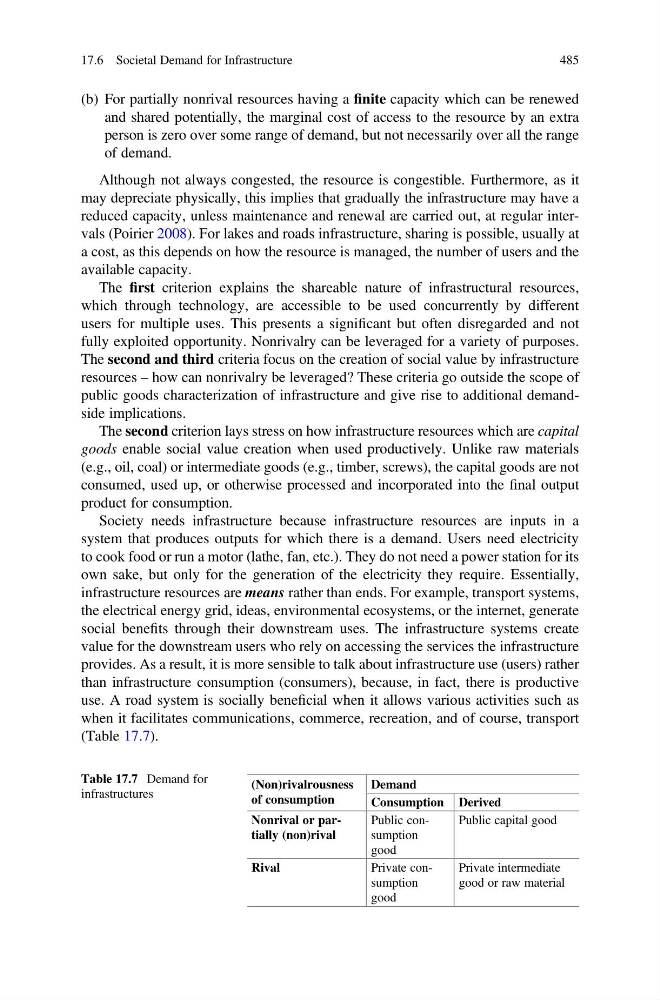
(Table 17.7).
Table 17.7 Demand for
infrastructures
(Non)rivalrousness
of consumption
Demand
Consumption Derived
Nonrival or partially (non)rival
Public consumption
good
Public capital good
Rival
Private consumption
good
Private intermediate
good or raw material
17.6 Societal Demand for Infrastructure
485
and shared potentially, the marginal cost of access to the resource by an extra
person is zero over some range of demand, but not necessarily over all the range
of demand.
Although not always congested, the resource is congestible. Furthermore, as it
may depreciate physically, this implies that gradually the infrastructure may have a
reduced capacity, unless maintenance and renewal are carried out, at regular intervals (Poirier 2008). For lakes and roads infrastructure, sharing is possible, usually at
a cost, as this depends on how the resource is managed, the number of users and the
available capacity.
The first criterion explains the shareable nature of infrastructural resources,
which through technology, are accessible to be used concurrently by different
users for multiple uses. This presents a significant but often disregarded and not
fully exploited opportunity. Nonrivalry can be leveraged for a variety of purposes.
The second and third criteria focus on the creation of social value by infrastructure
resources – how can nonrivalry be leveraged? These criteria go outside the scope of
public goods characterization of infrastructure and give rise to additional demandside implications.
The second criterion lays stress on how infrastructure resources which are capital
goods enable social value creation when used productively. Unlike raw materials
(e.g., oil, coal) or intermediate goods (e.g., timber, screws), the capital goods are not
consumed, used up, or otherwise processed and incorporated into the final output
product for consumption.
Society needs infrastructure because infrastructure resources are inputs in a
system that produces outputs for which there is a demand. Users need electricity
to cook food or run a motor (lathe, fan, etc.). They do not need a power station for its
own sake, but only for the generation of the electricity they require. Essentially,
infrastructure resources are means rather than ends. For example, transport systems,
the electrical energy grid, ideas, environmental ecosystems, or the internet, generate
social benefits through their downstream uses. The infrastructure systems create
value for the downstream users who rely on accessing the services the infrastructure
provides. As a result, it is more sensible to talk about infrastructure use (users) rather
than infrastructure consumption (consumers), because, in fact, there is productive
use. A road system is socially beneficial when it allows various activities such as
when it facilitates communications, commerce, recreation, and of course, transport
(Table 17.7).
Table 17.7 Demand for
infrastructures
(Non)rivalrousness
of consumption
Demand
Consumption Derived
Nonrival or partially (non)rival
Public consumption
good
Public capital good
Rival
Private consumption
good
Private intermediate
good or raw material
17.6 Societal Demand for Infrastructure
485