

plan their activities; they can decide to experiment, or to innovate, plan their use of
time and other complementary resources. Infrastructure (providers) facilitate, reinforce, contribute, and create such opportunities.
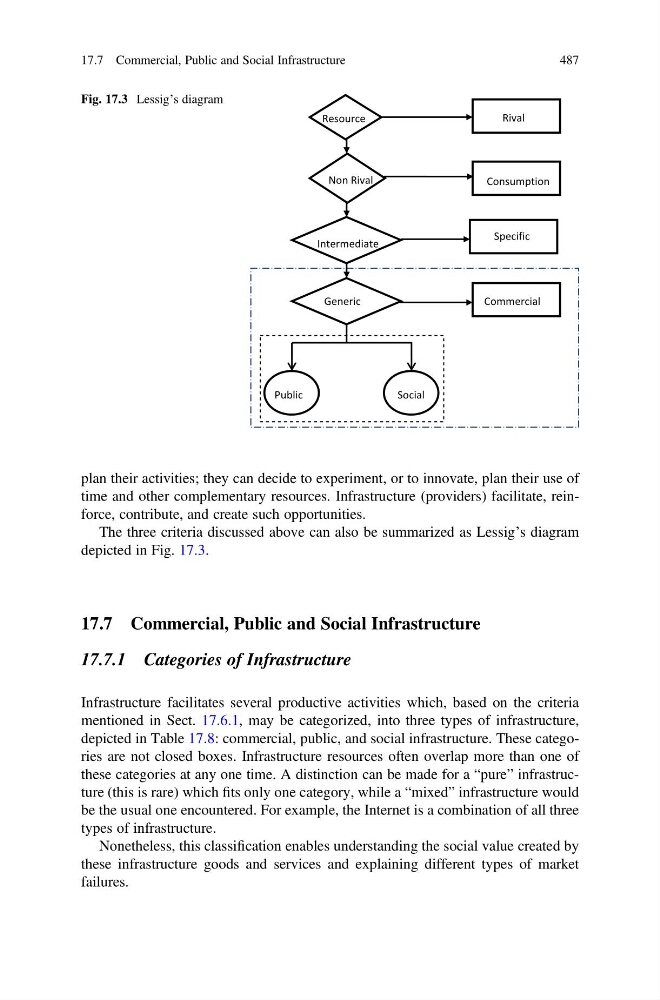
The three criteria discussed above can also be summarized as Lessig’s diagram
depicted in Fig. 17.3.
17.7 Commercial, Public and Social Infrastructure
17.7.1 Categories of Infrastructure
Infrastructure facilitates several productive activities which, based on the criteria
mentioned in Sect. 17.6.1, may be categorized, into three types of infrastructure,
depicted in Table 17.8: commercial, public, and social infrastructure. These categories are not closed boxes. Infrastructure resources often overlap more than one of
these categories at any one time. A distinction can be made for a “pure” infrastructure (this is rare) which fits only one category, while a “mixed” infrastructure would
be the usual one encountered. For example, the Internet is a combination of all three
types of infrastructure.
Nonetheless, this classification enables understanding the social value created by
these infrastructure goods and services and explaining different types of market
failures.
Rival
Consumption
Specific
Commercial
Resource
Non Rival
Intermediate
Generic
Public
Social
Fig. 17.3 Lessig’s diagram
17.7 Commercial, Public and Social Infrastructure
487
time and other complementary resources. Infrastructure (providers) facilitate, reinforce, contribute, and create such opportunities.
The three criteria discussed above can also be summarized as Lessig’s diagram
depicted in Fig. 17.3.
17.7 Commercial, Public and Social Infrastructure
17.7.1 Categories of Infrastructure
Infrastructure facilitates several productive activities which, based on the criteria
mentioned in Sect. 17.6.1, may be categorized, into three types of infrastructure,
depicted in Table 17.8: commercial, public, and social infrastructure. These categories are not closed boxes. Infrastructure resources often overlap more than one of
these categories at any one time. A distinction can be made for a “pure” infrastructure (this is rare) which fits only one category, while a “mixed” infrastructure would
be the usual one encountered. For example, the Internet is a combination of all three
types of infrastructure.
Nonetheless, this classification enables understanding the social value created by
these infrastructure goods and services and explaining different types of market
failures.
Rival
Consumption
Specific
Commercial
Resource
Non Rival
Intermediate
Generic
Public
Social
Fig. 17.3 Lessig’s diagram
17.7 Commercial, Public and Social Infrastructure
487