

p IP
ð Þ
¼ 1 À p
ð
Þ IL
ð Þ
or
p IP þ IL
ð
Þ ¼ IL
or p ¼
IL
IP þ IL
The letter p thus denotes the minimum required probability of selling at least an
additional unit. Otherwise, there is no justification for purchase and storage of that
additional unit. Additional units should only be purchased and stored when the
probability of selling at least an additional unit becomes greater than p (Tersine
1975).
Example 16.7
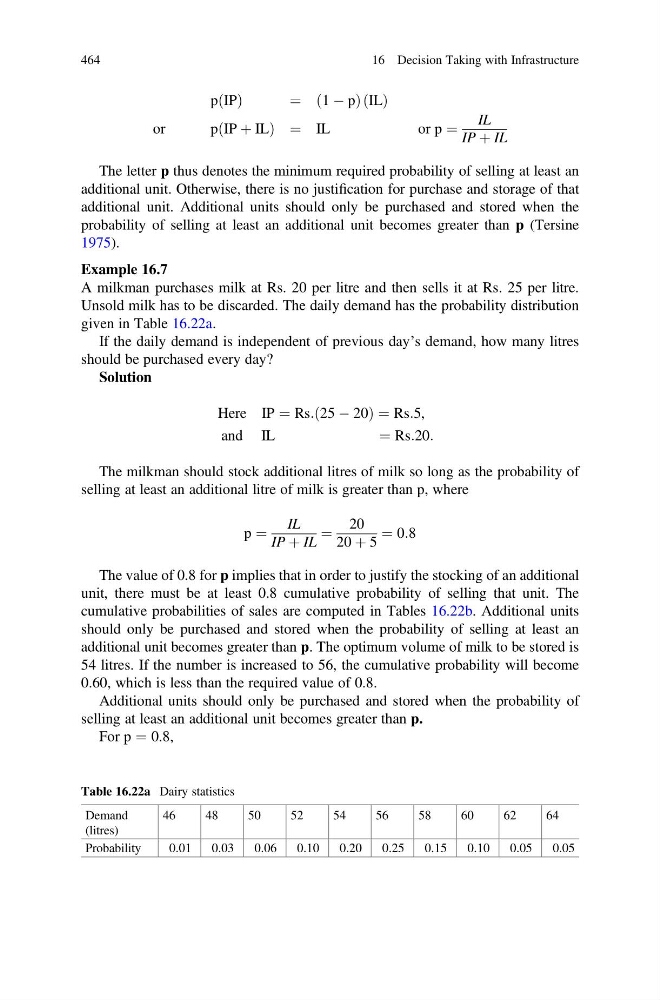
A milkman purchases milk at Rs. 20 per litre and then sells it at Rs. 25 per litre.
Unsold milk has to be discarded. The daily demand has the probability distribution
given in Table 16.22a.
If the daily demand is independent of previous day’s demand, how many litres
should be purchased every day?
Solution
Here IP ¼ Rs: 25 À 20
ð
Þ¼Rs:5,
and IL
¼ Rs:20:
The milkman should stock additional litres of milk so long as the probability of
selling at least an additional litre of milk is greater than p, where
p ¼
IL
IP þ IL
¼
20
20 þ 5
¼ 0:8
The value of 0.8 for p implies that in order to justify the stocking of an additional
unit, there must be at least 0.8 cumulative probability of selling that unit. The
cumulative probabilities of sales are computed in Tables 16.22b. Additional units
should only be purchased and stored when the probability of selling at least an
additional unit becomes greater than p. The optimum volume of milk to be stored is
54 litres. If the number is increased to 56, the cumulative probability will become
0.60, which is less than the required value of 0.8.
Additional units should only be purchased and stored when the probability of
selling at least an additional unit becomes greater than p.
For p ¼ 0.8,
Table 16.22a Dairy statistics
Demand
(litres)
46
48
50
52
54
56
58
60
62
64
Probability
0.01
0.03
0.06
0.10
0.20
0.25
0.15
0.10
0.05
0.05
464
16 Decision Taking with Infrastructure
ð Þ
¼ 1 À p
ð
Þ IL
ð Þ
or
p IP þ IL
ð
Þ ¼ IL
or p ¼
IL
IP þ IL
The letter p thus denotes the minimum required probability of selling at least an
additional unit. Otherwise, there is no justification for purchase and storage of that
additional unit. Additional units should only be purchased and stored when the
probability of selling at least an additional unit becomes greater than p (Tersine
1975).
Example 16.7
A milkman purchases milk at Rs. 20 per litre and then sells it at Rs. 25 per litre.
Unsold milk has to be discarded. The daily demand has the probability distribution
given in Table 16.22a.
If the daily demand is independent of previous day’s demand, how many litres
should be purchased every day?
Solution
Here IP ¼ Rs: 25 À 20
ð
Þ¼Rs:5,
and IL
¼ Rs:20:
The milkman should stock additional litres of milk so long as the probability of
selling at least an additional litre of milk is greater than p, where
p ¼
IL
IP þ IL
¼
20
20 þ 5
¼ 0:8
The value of 0.8 for p implies that in order to justify the stocking of an additional
unit, there must be at least 0.8 cumulative probability of selling that unit. The
cumulative probabilities of sales are computed in Tables 16.22b. Additional units
should only be purchased and stored when the probability of selling at least an
additional unit becomes greater than p. The optimum volume of milk to be stored is
54 litres. If the number is increased to 56, the cumulative probability will become
0.60, which is less than the required value of 0.8.
Additional units should only be purchased and stored when the probability of
selling at least an additional unit becomes greater than p.
For p ¼ 0.8,
Table 16.22a Dairy statistics
Demand
(litres)
46
48
50
52
54
56
58
60
62
64
Probability
0.01
0.03
0.06
0.10
0.20
0.25
0.15
0.10
0.05
0.05
464
16 Decision Taking with Infrastructure