

16.6.2 Expected Opportunity Loss (EOL) Criterion
The EMV approach is to maximise the expected monetary gains. Just as the minimax
criterion tries to minimise regrets, the expected opportunity loss (EOL) criterion
aims to minimise the expected opportunity loss (or expected value of regrets).
The expected opportunity loss (or expected value of regrets) denotes the amount
by which maximum expected profit will be decreased under various stock actions.
The optimal decision alternative corresponds to the one that produces a minimum
value of these losses.
The technique to determine the expected opportunity losses goes through the
following steps:
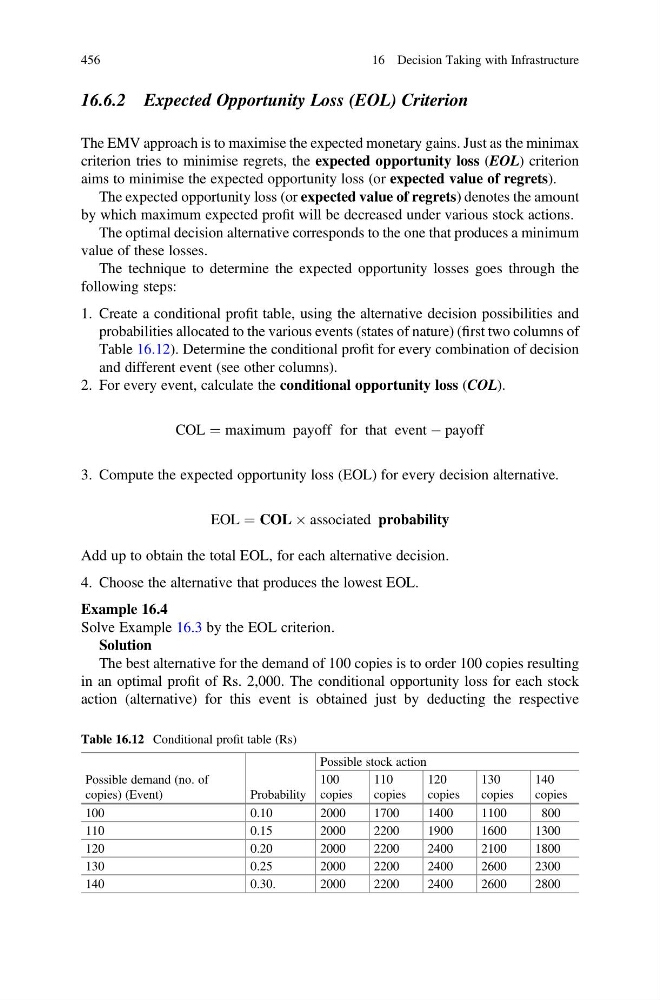
1. Create a conditional profit table, using the alternative decision possibilities and
probabilities allocated to the various events (states of nature) (first two columns of
Table 16.12). Determine the conditional profit for every combination of decision
and different event (see other columns).
2. For every event, calculate the conditional opportunity loss (COL).
COL ¼ maximum payoff for that event À payoff
3. Compute the expected opportunity loss (EOL) for every decision alternative.
EOL ¼ COL Â associated probability
Add up to obtain the total EOL, for each alternative decision.
4. Choose the alternative that produces the lowest EOL.
Example 16.4
Solve Example 16.3 by the EOL criterion.
Solution
The best alternative for the demand of 100 copies is to order 100 copies resulting
in an optimal profit of Rs. 2,000. The conditional opportunity loss for each stock
action (alternative) for this event is obtained just by deducting the respective
Table 16.12 Conditional profit table (Rs)
Possible demand (no. of
copies) (Event)
Probability
Possible stock action
100
copies
110
copies
120
copies
130
copies
140
copies
100
0.10
2000
1700
1400
1100
800
110
0.15
2000
2200
1900
1600
1300
120
0.20
2000
2200
2400
2100
1800
130
0.25
2000
2200
2400
2600
2300
140
0.30.
2000
2200
2400
2600
2800
456
16 Decision Taking with Infrastructure
The EMV approach is to maximise the expected monetary gains. Just as the minimax
criterion tries to minimise regrets, the expected opportunity loss (EOL) criterion
aims to minimise the expected opportunity loss (or expected value of regrets).
The expected opportunity loss (or expected value of regrets) denotes the amount
by which maximum expected profit will be decreased under various stock actions.
The optimal decision alternative corresponds to the one that produces a minimum
value of these losses.
The technique to determine the expected opportunity losses goes through the
following steps:
1. Create a conditional profit table, using the alternative decision possibilities and
probabilities allocated to the various events (states of nature) (first two columns of
Table 16.12). Determine the conditional profit for every combination of decision
and different event (see other columns).
2. For every event, calculate the conditional opportunity loss (COL).
COL ¼ maximum payoff for that event À payoff
3. Compute the expected opportunity loss (EOL) for every decision alternative.
EOL ¼ COL Â associated probability
Add up to obtain the total EOL, for each alternative decision.
4. Choose the alternative that produces the lowest EOL.
Example 16.4
Solve Example 16.3 by the EOL criterion.
Solution
The best alternative for the demand of 100 copies is to order 100 copies resulting
in an optimal profit of Rs. 2,000. The conditional opportunity loss for each stock
action (alternative) for this event is obtained just by deducting the respective
Table 16.12 Conditional profit table (Rs)
Possible demand (no. of
copies) (Event)
Probability
Possible stock action
100
copies
110
copies
120
copies
130
copies
140
copies
100
0.10
2000
1700
1400
1100
800
110
0.15
2000
2200
1900
1600
1300
120
0.20
2000
2200
2400
2100
1800
130
0.25
2000
2200
2400
2600
2300
140
0.30.
2000
2200
2400
2600
2800
456
16 Decision Taking with Infrastructure