

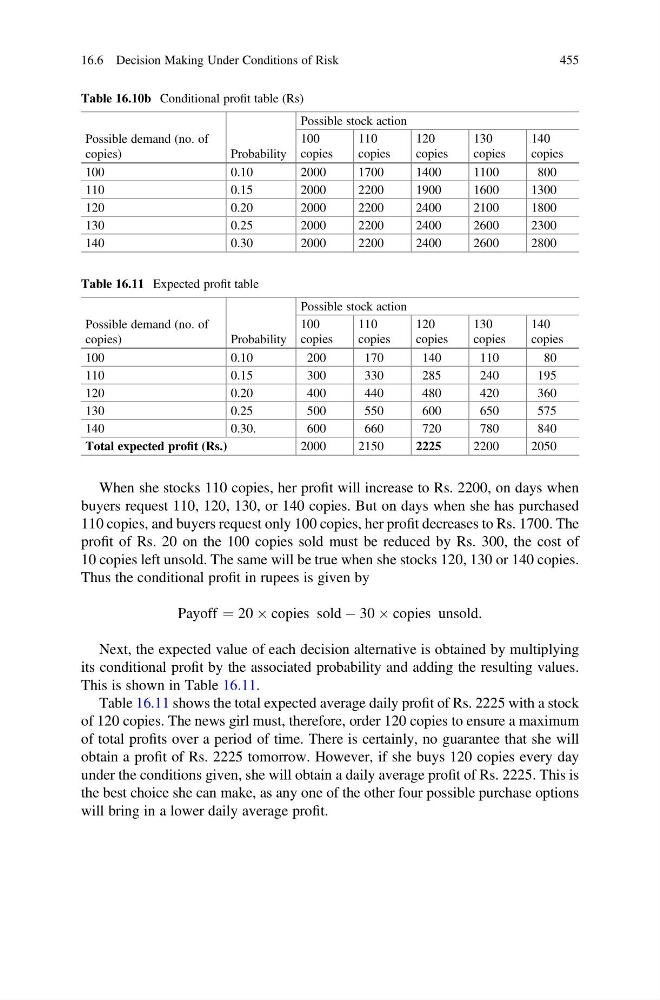
When she stocks 110 copies, her profit will increase to Rs. 2200, on days when
buyers request 110, 120, 130, or 140 copies. But on days when she has purchased
110 copies, and buyers request only 100 copies, her profit decreases to Rs. 1700. The
profit of Rs. 20 on the 100 copies sold must be reduced by Rs. 300, the cost of
10 copies left unsold. The same will be true when she stocks 120, 130 or 140 copies.
Thus the conditional profit in rupees is given by
Payoff ¼ 20 Â copies sold À 30 Â copies unsold:
Next, the expected value of each decision alternative is obtained by multiplying
its conditional profit by the associated probability and adding the resulting values.
This is shown in Table 16.11.
Table 16.11 shows the total expected average daily profit of Rs. 2225 with a stock
of 120 copies. The news girl must, therefore, order 120 copies to ensure a maximum
of total profits over a period of time. There is certainly, no guarantee that she will
obtain a profit of Rs. 2225 tomorrow. However, if she buys 120 copies every day
under the conditions given, she will obtain a daily average profit of Rs. 2225. This is
the best choice she can make, as any one of the other four possible purchase options
will bring in a lower daily average profit.
Table 16.10b Conditional profit table (Rs)
Possible demand (no. of
copies)
Probability
Possible stock action
100
copies
110
copies
120
copies
130
copies
140
copies
100
0.10
2000
1700
1400
1100
800
110
0.15
2000
2200
1900
1600
1300
120
0.20
2000
2200
2400
2100
1800
130
0.25
2000
2200
2400
2600
2300
140
0.30
2000
2200
2400
2600
2800
Table 16.11 Expected profit table
Possible demand (no. of
copies)
Probability
Possible stock action
100
copies
110
copies
120
copies
130
copies
140
copies
100
0.10
200
170
140
110
80
110
0.15
300
330
285
240
195
120
0.20
400
440
480
420
360
130
0.25
500
550
600
650
575
140
0.30.
600
660
720
780
840
Total expected profit (Rs.)
2000
2150
2225
2200
2050
16.6 Decision Making Under Conditions of Risk
455
buyers request 110, 120, 130, or 140 copies. But on days when she has purchased
110 copies, and buyers request only 100 copies, her profit decreases to Rs. 1700. The
profit of Rs. 20 on the 100 copies sold must be reduced by Rs. 300, the cost of
10 copies left unsold. The same will be true when she stocks 120, 130 or 140 copies.
Thus the conditional profit in rupees is given by
Payoff ¼ 20 Â copies sold À 30 Â copies unsold:
Next, the expected value of each decision alternative is obtained by multiplying
its conditional profit by the associated probability and adding the resulting values.
This is shown in Table 16.11.
Table 16.11 shows the total expected average daily profit of Rs. 2225 with a stock
of 120 copies. The news girl must, therefore, order 120 copies to ensure a maximum
of total profits over a period of time. There is certainly, no guarantee that she will
obtain a profit of Rs. 2225 tomorrow. However, if she buys 120 copies every day
under the conditions given, she will obtain a daily average profit of Rs. 2225. This is
the best choice she can make, as any one of the other four possible purchase options
will bring in a lower daily average profit.
Table 16.10b Conditional profit table (Rs)
Possible demand (no. of
copies)
Probability
Possible stock action
100
copies
110
copies
120
copies
130
copies
140
copies
100
0.10
2000
1700
1400
1100
800
110
0.15
2000
2200
1900
1600
1300
120
0.20
2000
2200
2400
2100
1800
130
0.25
2000
2200
2400
2600
2300
140
0.30
2000
2200
2400
2600
2800
Table 16.11 Expected profit table
Possible demand (no. of
copies)
Probability
Possible stock action
100
copies
110
copies
120
copies
130
copies
140
copies
100
0.10
200
170
140
110
80
110
0.15
300
330
285
240
195
120
0.20
400
440
480
420
360
130
0.25
500
550
600
650
575
140
0.30.
600
660
720
780
840
Total expected profit (Rs.)
2000
2150
2225
2200
2050
16.6 Decision Making Under Conditions of Risk
455