

that the most important criterion should be separated from the least important one by
a factor of 4. Thus, construction impact (C l ) is assigned the score ‘1’ and cost (C 2 ) is
assigned the score ‘4’. The water quality and visual impacts are both assigned a score
of ‘3.5’, with impact on birdlife (C 3 ) given the score ‘2’ and political acceptability
(C 6 ) assigned ‘1.5’.
Use the ratio weighting method to derive importance scores for these six criteria.
Solution 15.5
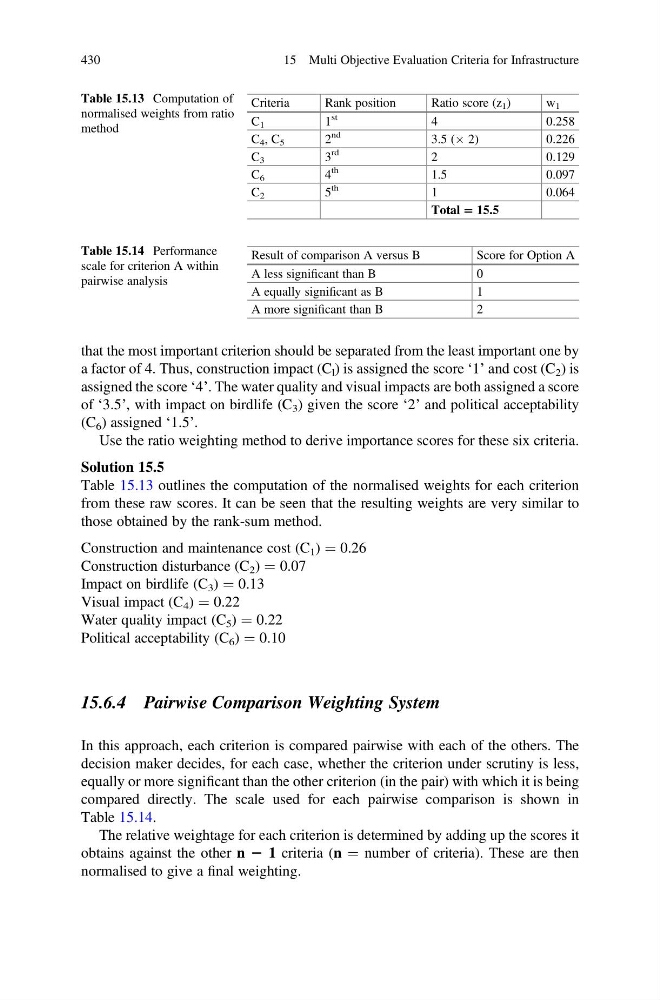
Table 15.13 outlines the computation of the normalised weights for each criterion
from these raw scores. It can be seen that the resulting weights are very similar to
those obtained by the rank-sum method.
Construction and maintenance cost (C 1 ) ¼ 0.26
Construction disturbance (C 2 ) ¼ 0.07
Impact on birdlife (C 3 ) ¼ 0.13
Visual impact (C 4 ) ¼ 0.22
Water quality impact (C 5 ) ¼ 0.22
Political acceptability (C 6 ) ¼ 0.10
15.6.4 Pairwise Comparison Weighting System
In this approach, each criterion is compared pairwise with each of the others. The
decision maker decides, for each case, whether the criterion under scrutiny is less,
equally or more significant than the other criterion (in the pair) with which it is being
compared directly. The scale used for each pairwise comparison is shown in
Table 15.14.
The relative weightage for each criterion is determined by adding up the scores it
obtains against the other n 2 1 criteria (n ¼ number of criteria). These are then
normalised to give a final weighting.
Table 15.13 Computation of
normalised weights from ratio
method
Criteria
Rank position
Ratio score (z 1 )
w 1
C 1
1
st
4
0.258
C 4 , C 5
2
nd
3.5 (Â 2)
0.226
C 3
3
rd
2
0.129
C 6
4
th
1.5
0.097
C 2
5
th
1
0.064
Total = 15.5
Table 15.14 Performance
scale for criterion A within
pairwise analysis
Result of comparison A versus B
Score for Option A
A less significant than B
0
A equally significant as B
1
A more significant than B
2
430
15 Multi Objective Evaluation Criteria for Infrastructure
a factor of 4. Thus, construction impact (C l ) is assigned the score ‘1’ and cost (C 2 ) is
assigned the score ‘4’. The water quality and visual impacts are both assigned a score
of ‘3.5’, with impact on birdlife (C 3 ) given the score ‘2’ and political acceptability
(C 6 ) assigned ‘1.5’.
Use the ratio weighting method to derive importance scores for these six criteria.
Solution 15.5
Table 15.13 outlines the computation of the normalised weights for each criterion
from these raw scores. It can be seen that the resulting weights are very similar to
those obtained by the rank-sum method.
Construction and maintenance cost (C 1 ) ¼ 0.26
Construction disturbance (C 2 ) ¼ 0.07
Impact on birdlife (C 3 ) ¼ 0.13
Visual impact (C 4 ) ¼ 0.22
Water quality impact (C 5 ) ¼ 0.22
Political acceptability (C 6 ) ¼ 0.10
15.6.4 Pairwise Comparison Weighting System
In this approach, each criterion is compared pairwise with each of the others. The
decision maker decides, for each case, whether the criterion under scrutiny is less,
equally or more significant than the other criterion (in the pair) with which it is being
compared directly. The scale used for each pairwise comparison is shown in
Table 15.14.
The relative weightage for each criterion is determined by adding up the scores it
obtains against the other n 2 1 criteria (n ¼ number of criteria). These are then
normalised to give a final weighting.
Table 15.13 Computation of
normalised weights from ratio
method
Criteria
Rank position
Ratio score (z 1 )
w 1
C 1
1
st
4
0.258
C 4 , C 5
2
nd
3.5 (Â 2)
0.226
C 3
3
rd
2
0.129
C 6
4
th
1.5
0.097
C 2
5
th
1
0.064
Total = 15.5
Table 15.14 Performance
scale for criterion A within
pairwise analysis
Result of comparison A versus B
Score for Option A
A less significant than B
0
A equally significant as B
1
A more significant than B
2
430
15 Multi Objective Evaluation Criteria for Infrastructure