

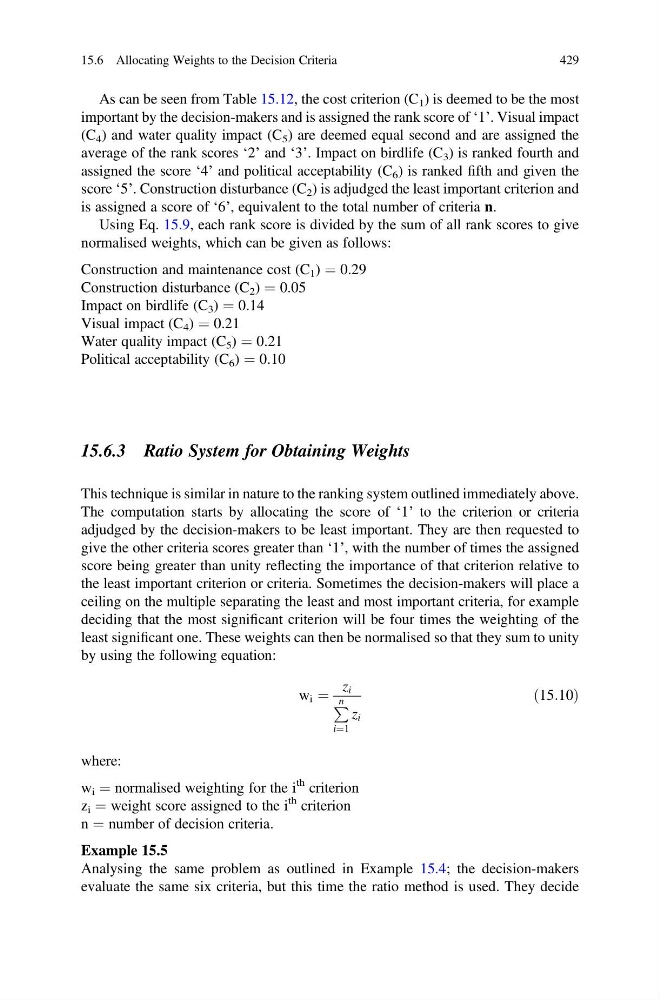
As can be seen from Table 15.12, the cost criterion (C 1 ) is deemed to be the most
important by the decision-makers and is assigned the rank score of ‘1’. Visual impact
(C 4 ) and water quality impact (C 5 ) are deemed equal second and are assigned the
average of the rank scores ‘2’ and ‘3’. Impact on birdlife (C 3 ) is ranked fourth and
assigned the score ‘4’ and political acceptability (C 6 ) is ranked fifth and given the
score ‘5’. Construction disturbance (C 2 ) is adjudged the least important criterion and
is assigned a score of ‘6’, equivalent to the total number of criteria n.
Using Eq. 15.9, each rank score is divided by the sum of all rank scores to give
normalised weights, which can be given as follows:
Construction and maintenance cost (C 1 ) ¼ 0.29
Construction disturbance (C 2 ) ¼ 0.05
Impact on birdlife (C 3 ) ¼ 0.14
Visual impact (C 4 ) ¼ 0.21
Water quality impact (C 5 ) ¼ 0.21
Political acceptability (C 6 ) ¼ 0.10
15.6.3 Ratio System for Obtaining Weights
This technique is similar in nature to the ranking system outlined immediately above.
The computation starts by allocating the score of ‘1’ to the criterion or criteria
adjudged by the decision-makers to be least important. They are then requested to
give the other criteria scores greater than ‘1’, with the number of times the assigned
score being greater than unity reflecting the importance of that criterion relative to
the least important criterion or criteria. Sometimes the decision-makers will place a
ceiling on the multiple separating the least and most important criteria, for example
deciding that the most significant criterion will be four times the weighting of the
least significant one. These weights can then be normalised so that they sum to unity
by using the following equation:
w i ¼
z i
P n
i¼1
z i
ð15:10Þ
where:
w i ¼ normalised weighting for the i
th criterion
z i ¼ weight score assigned to the i
th criterion
n ¼ number of decision criteria.
Example 15.5
Analysing the same problem as outlined in Example 15.4; the decision-makers
evaluate the same six criteria, but this time the ratio method is used. They decide
15.6 Allocating Weights to the Decision Criteria
429
important by the decision-makers and is assigned the rank score of ‘1’. Visual impact
(C 4 ) and water quality impact (C 5 ) are deemed equal second and are assigned the
average of the rank scores ‘2’ and ‘3’. Impact on birdlife (C 3 ) is ranked fourth and
assigned the score ‘4’ and political acceptability (C 6 ) is ranked fifth and given the
score ‘5’. Construction disturbance (C 2 ) is adjudged the least important criterion and
is assigned a score of ‘6’, equivalent to the total number of criteria n.
Using Eq. 15.9, each rank score is divided by the sum of all rank scores to give
normalised weights, which can be given as follows:
Construction and maintenance cost (C 1 ) ¼ 0.29
Construction disturbance (C 2 ) ¼ 0.05
Impact on birdlife (C 3 ) ¼ 0.14
Visual impact (C 4 ) ¼ 0.21
Water quality impact (C 5 ) ¼ 0.21
Political acceptability (C 6 ) ¼ 0.10
15.6.3 Ratio System for Obtaining Weights
This technique is similar in nature to the ranking system outlined immediately above.
The computation starts by allocating the score of ‘1’ to the criterion or criteria
adjudged by the decision-makers to be least important. They are then requested to
give the other criteria scores greater than ‘1’, with the number of times the assigned
score being greater than unity reflecting the importance of that criterion relative to
the least important criterion or criteria. Sometimes the decision-makers will place a
ceiling on the multiple separating the least and most important criteria, for example
deciding that the most significant criterion will be four times the weighting of the
least significant one. These weights can then be normalised so that they sum to unity
by using the following equation:
w i ¼
z i
P n
i¼1
z i
ð15:10Þ
where:
w i ¼ normalised weighting for the i
th criterion
z i ¼ weight score assigned to the i
th criterion
n ¼ number of decision criteria.
Example 15.5
Analysing the same problem as outlined in Example 15.4; the decision-makers
evaluate the same six criteria, but this time the ratio method is used. They decide
15.6 Allocating Weights to the Decision Criteria
429