

be assigned the next highest score of ‘5’. The least important criterion will thus end
up with the score n, where n is the number of chosen criteria.
The normalised importance weightage for each criterion can be determined using
the following formula:
w i ¼
n À r i þ 1
P n
i¼1
n À r i þ 1
ð
Þ
ð15:9Þ
where:
w i ¼ normalised weighting for the i
th criterion
r i ¼ ranking score for the i
th criterion
n ¼ number of decision criteria.
Example 15.4
Five options for the siting of a wastewater treatment plant are considered on the basis
of the following six criteria:
1. Construction and maintenance cost (C 1 )
2. Construction disturbance (C 2 )
3. Impact on birdlife (C 3 )
4. Visual impact (C 4 )
5. Water quality impact (C 5 )
6. Political acceptability (C 6 )
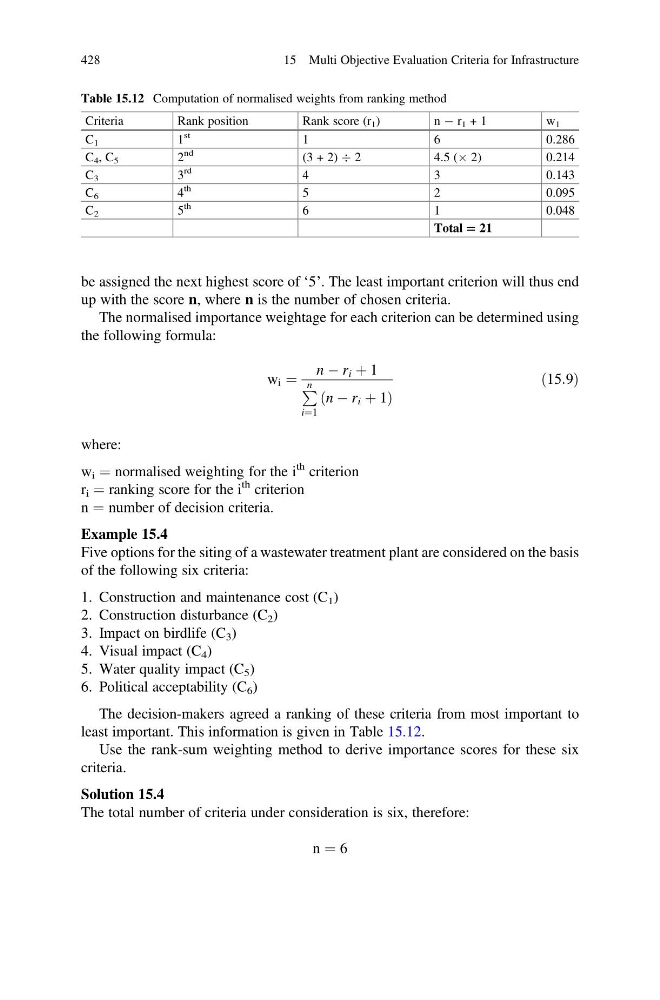
The decision-makers agreed a ranking of these criteria from most important to
least important. This information is given in Table 15.12.
Use the rank-sum weighting method to derive importance scores for these six
criteria.
Solution 15.4
The total number of criteria under consideration is six, therefore:
n ¼ 6
Table 15.12 Computation of normalised weights from ranking method
Criteria
Rank position
Rank score (r 1 )
nÀ r 1 + 1
w 1
C 1
1
st
1
6
0.286
C 4 , C 5
2
nd
(3 + 2) Ä 2
4.5 (Â 2)
0.214
C 3
3
rd
4
3
0.143
C 6
4
th
5
2
0.095
C 2
5
th
6
1
0.048
Total = 21
428
15 Multi Objective Evaluation Criteria for Infrastructure
up with the score n, where n is the number of chosen criteria.
The normalised importance weightage for each criterion can be determined using
the following formula:
w i ¼
n À r i þ 1
P n
i¼1
n À r i þ 1
ð
Þ
ð15:9Þ
where:
w i ¼ normalised weighting for the i
th criterion
r i ¼ ranking score for the i
th criterion
n ¼ number of decision criteria.
Example 15.4
Five options for the siting of a wastewater treatment plant are considered on the basis
of the following six criteria:
1. Construction and maintenance cost (C 1 )
2. Construction disturbance (C 2 )
3. Impact on birdlife (C 3 )
4. Visual impact (C 4 )
5. Water quality impact (C 5 )
6. Political acceptability (C 6 )
The decision-makers agreed a ranking of these criteria from most important to
least important. This information is given in Table 15.12.
Use the rank-sum weighting method to derive importance scores for these six
criteria.
Solution 15.4
The total number of criteria under consideration is six, therefore:
n ¼ 6
Table 15.12 Computation of normalised weights from ranking method
Criteria
Rank position
Rank score (r 1 )
nÀ r 1 + 1
w 1
C 1
1
st
1
6
0.286
C 4 , C 5
2
nd
(3 + 2) Ä 2
4.5 (Â 2)
0.214
C 3
3
rd
4
3
0.143
C 6
4
th
5
2
0.095
C 2
5
th
6
1
0.048
Total = 21
428
15 Multi Objective Evaluation Criteria for Infrastructure