

The additive weighting approach thus transforms the multi-criterion problem into
a single-dimension calculation. Again, in the vast majority of complex engineering
project appraisals, the different criterion types being assessed within the process,
because of their diverse origins (economic, environmental, technical), are expressed
in various units of measurement. These must then be converted to a common scale
before the additive model can be utilised. A common procedure employed is to
transform all criteria scores to a normalised linear scale going from 0 (worst) to
1 (best). However, this is often expanded to a 10-point or even a 100-point scale.
It is essential to highlight the fundamental difference between the economic
analysis of a proposal and a multi-criteria evaluation. Within an economic study,
all attributes are economics-based and are measured in their original monetary units.
Within the multi-criteria analysis for an engineering proposal, while cost may well
be included as a criterion because of the overall importance of its economic
consequences, it is treated the same as any of the other criteria, whatever their origin
or scale of measurement. Therefore, the original monetary value of the cost cannot
be used. A feasible range of possible costs must be assigned to this criterion,
denoting the minimum (0) and maximum (1, 10 or 100) ratings for it on the linear
scale. Each option examined can then be given a score on the standard scale based on
its raw monetary score. A weighting for the cost criterion is then derived which
reflects its importance relative to the others deemed relevant to the study. It is then in
a form that can be included within the additive weighting model, with a single
overall score being obtainable for each option examined.
Example 15.1 The Basic Simple Additive Weighting Model
Consider a comparative evaluation of three proposed designs for a new car. The
comparison will be carried out using the following five decision criteria:
(1) Purchase cost (Rs.)
(2) Level of safety (10-point scale)
(3) Aesthetic appearance (10-point scale)
(4) Mass (kg)
(5) Reliability (%)
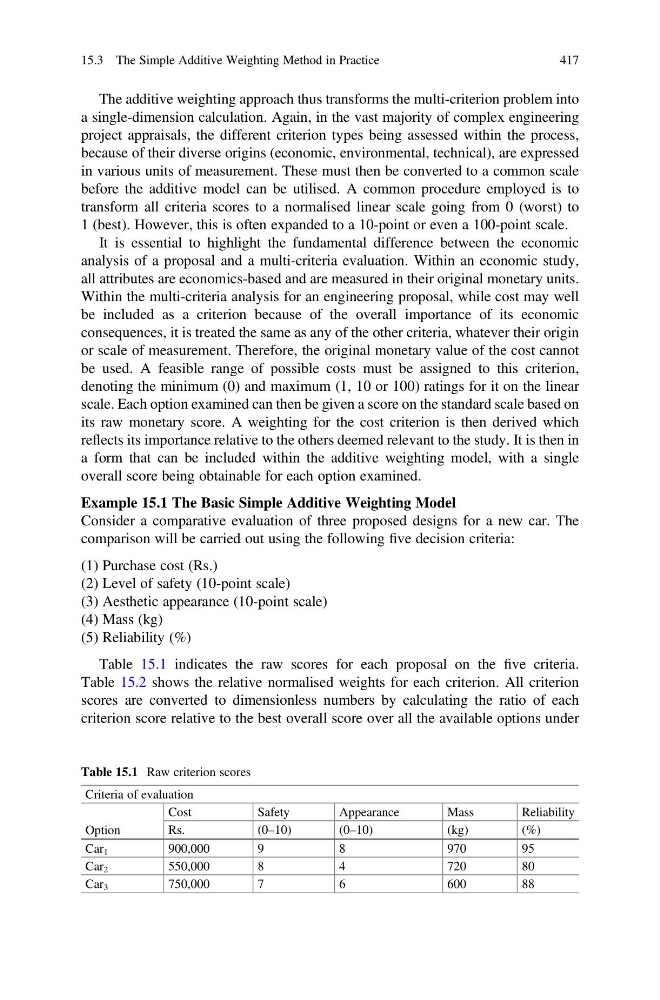
Table 15.1 indicates the raw scores for each proposal on the five criteria.
Table 15.2 shows the relative normalised weights for each criterion. All criterion
scores are converted to dimensionless numbers by calculating the ratio of each
criterion score relative to the best overall score over all the available options under
Table 15.1 Raw criterion scores
Criteria of evaluation
Option
Cost
Safety
Appearance
Mass
Reliability
Rs.
(0–10)
(0–10)
(kg)
(%)
Car 1
900,000
9
8
970
95
Car 2
550,000
8
4
720
80
Car 3
750,000
7
6
600
88
15.3 The Simple Additive Weighting Method in Practice
417
a single-dimension calculation. Again, in the vast majority of complex engineering
project appraisals, the different criterion types being assessed within the process,
because of their diverse origins (economic, environmental, technical), are expressed
in various units of measurement. These must then be converted to a common scale
before the additive model can be utilised. A common procedure employed is to
transform all criteria scores to a normalised linear scale going from 0 (worst) to
1 (best). However, this is often expanded to a 10-point or even a 100-point scale.
It is essential to highlight the fundamental difference between the economic
analysis of a proposal and a multi-criteria evaluation. Within an economic study,
all attributes are economics-based and are measured in their original monetary units.
Within the multi-criteria analysis for an engineering proposal, while cost may well
be included as a criterion because of the overall importance of its economic
consequences, it is treated the same as any of the other criteria, whatever their origin
or scale of measurement. Therefore, the original monetary value of the cost cannot
be used. A feasible range of possible costs must be assigned to this criterion,
denoting the minimum (0) and maximum (1, 10 or 100) ratings for it on the linear
scale. Each option examined can then be given a score on the standard scale based on
its raw monetary score. A weighting for the cost criterion is then derived which
reflects its importance relative to the others deemed relevant to the study. It is then in
a form that can be included within the additive weighting model, with a single
overall score being obtainable for each option examined.
Example 15.1 The Basic Simple Additive Weighting Model
Consider a comparative evaluation of three proposed designs for a new car. The
comparison will be carried out using the following five decision criteria:
(1) Purchase cost (Rs.)
(2) Level of safety (10-point scale)
(3) Aesthetic appearance (10-point scale)
(4) Mass (kg)
(5) Reliability (%)
Table 15.1 indicates the raw scores for each proposal on the five criteria.
Table 15.2 shows the relative normalised weights for each criterion. All criterion
scores are converted to dimensionless numbers by calculating the ratio of each
criterion score relative to the best overall score over all the available options under
Table 15.1 Raw criterion scores
Criteria of evaluation
Option
Cost
Safety
Appearance
Mass
Reliability
Rs.
(0–10)
(0–10)
(kg)
(%)
Car 1
900,000
9
8
970
95
Car 2
550,000
8
4
720
80
Car 3
750,000
7
6
600
88
15.3 The Simple Additive Weighting Method in Practice
417