

proposals are being compared on a pair of criteria, namely visual effects and political
acceptability. If a change in the relative performance of the two options in terms of
visual effects has an effect on the relative political acceptability of the two, utility
independence is absent, and a more complex multi-attribute model must be used.
One such form is the multiplicative model which allows a cross-influence between
criteria.
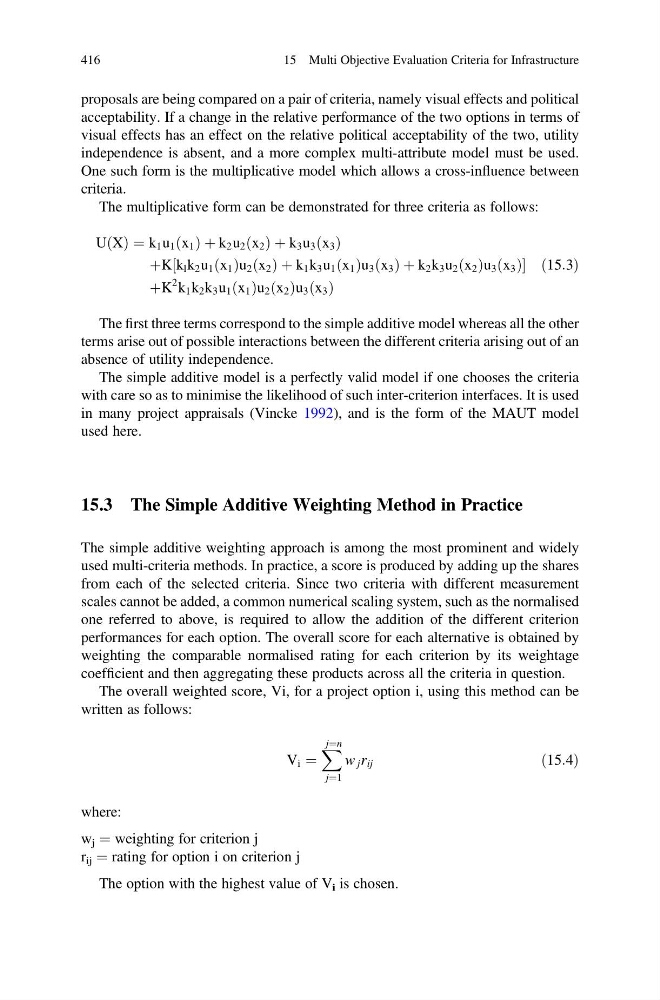
The multiplicative form can be demonstrated for three criteria as follows:
U X
ð Þ ¼ k 1 u 1 x 1
ð Þ þ k 2 u 2 x 2
ð Þ þ k 3 u 3 x 3
ð Þ
þK k l k 2 u 1 x 1
ð Þu 2 x 2
ð Þ þ k 1 k 3 u 1 x 1
ð Þu 3 x 3
ð Þ þ k 2 k 3 u 2 x 2
ð Þu 3 x 3
ð Þ
½
þK
2 k 1 k 2 k 3 u 1 x 1
ð Þu 2 x 2
ð Þu 3 x 3
ð Þ
ð15:3Þ
The first three terms correspond to the simple additive model whereas all the other
terms arise out of possible interactions between the different criteria arising out of an
absence of utility independence.
The simple additive model is a perfectly valid model if one chooses the criteria
with care so as to minimise the likelihood of such inter-criterion interfaces. It is used
in many project appraisals (Vincke 1992), and is the form of the MAUT model
used here.
15.3 The Simple Additive Weighting Method in Practice
The simple additive weighting approach is among the most prominent and widely
used multi-criteria methods. In practice, a score is produced by adding up the shares
from each of the selected criteria. Since two criteria with different measurement
scales cannot be added, a common numerical scaling system, such as the normalised
one referred to above, is required to allow the addition of the different criterion
performances for each option. The overall score for each alternative is obtained by
weighting the comparable normalised rating for each criterion by its weightage
coefficient and then aggregating these products across all the criteria in question.
The overall weighted score, Vi, for a project option i, using this method can be
written as follows:
V i ¼
X j¼n
j¼1
w j r ij
ð15:4Þ
where:
w j ¼ weighting for criterion j
r ij ¼ rating for option i on criterion j
The option with the highest value of V i is chosen.
416
15 Multi Objective Evaluation Criteria for Infrastructure
acceptability. If a change in the relative performance of the two options in terms of
visual effects has an effect on the relative political acceptability of the two, utility
independence is absent, and a more complex multi-attribute model must be used.
One such form is the multiplicative model which allows a cross-influence between
criteria.
The multiplicative form can be demonstrated for three criteria as follows:
U X
ð Þ ¼ k 1 u 1 x 1
ð Þ þ k 2 u 2 x 2
ð Þ þ k 3 u 3 x 3
ð Þ
þK k l k 2 u 1 x 1
ð Þu 2 x 2
ð Þ þ k 1 k 3 u 1 x 1
ð Þu 3 x 3
ð Þ þ k 2 k 3 u 2 x 2
ð Þu 3 x 3
ð Þ
½
þK
2 k 1 k 2 k 3 u 1 x 1
ð Þu 2 x 2
ð Þu 3 x 3
ð Þ
ð15:3Þ
The first three terms correspond to the simple additive model whereas all the other
terms arise out of possible interactions between the different criteria arising out of an
absence of utility independence.
The simple additive model is a perfectly valid model if one chooses the criteria
with care so as to minimise the likelihood of such inter-criterion interfaces. It is used
in many project appraisals (Vincke 1992), and is the form of the MAUT model
used here.
15.3 The Simple Additive Weighting Method in Practice
The simple additive weighting approach is among the most prominent and widely
used multi-criteria methods. In practice, a score is produced by adding up the shares
from each of the selected criteria. Since two criteria with different measurement
scales cannot be added, a common numerical scaling system, such as the normalised
one referred to above, is required to allow the addition of the different criterion
performances for each option. The overall score for each alternative is obtained by
weighting the comparable normalised rating for each criterion by its weightage
coefficient and then aggregating these products across all the criteria in question.
The overall weighted score, Vi, for a project option i, using this method can be
written as follows:
V i ¼
X j¼n
j¼1
w j r ij
ð15:4Þ
where:
w j ¼ weighting for criterion j
r ij ¼ rating for option i on criterion j
The option with the highest value of V i is chosen.
416
15 Multi Objective Evaluation Criteria for Infrastructure