

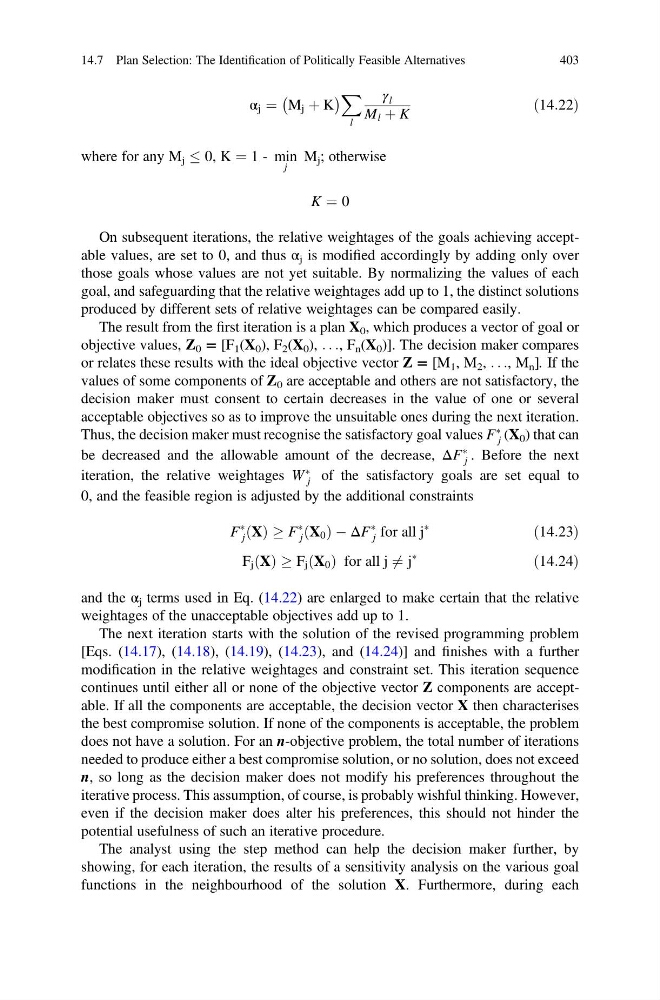
α j ¼ M j þ K
À
Á X
l
γ l
M l þ K
ð14:22Þ
where for any M j 0, K ¼ 1 - min
j
M j ; otherwise
K ¼ 0
On subsequent iterations, the relative weightages of the goals achieving acceptable values, are set to 0, and thus α j is modified accordingly by adding only over
those goals whose values are not yet suitable. By normalizing the values of each
goal, and safeguarding that the relative weightages add up to 1, the distinct solutions
produced by different sets of relative weightages can be compared easily.
The result from the first iteration is a plan X 0 , which produces a vector of goal or
objective values, Z 0 = [F 1 (X 0 ), F 2 (X 0 ), . . ., F n (X 0 )]. The decision maker compares
or relates these results with the ideal objective vector Z = [M 1 , M 2 , . . ., M n ]. If the
values of some components of Z 0 are acceptable and others are not satisfactory, the
decision maker must consent to certain decreases in the value of one or several
acceptable objectives so as to improve the unsuitable ones during the next iteration.
Thus, the decision maker must recognise the satisfactory goal values F
Ã
j (X 0 ) that can
be decreased and the allowable amount of the decrease, ΔF
Ã
j . Before the next
iteration, the relative weightages W
Ã
j of the satisfactory goals are set equal to
0, and the feasible region is adjusted by the additional constraints
F
Ã
j X
ð Þ ! F
Ã
j X 0
ð Þ À ΔF
Ã
j for all j
Ã
ð14:23Þ
F j X
ð Þ ! F j X 0
ð Þ for all j 6 ¼ j
Ã
ð14:24Þ
and the α j terms used in Eq. (14.22) are enlarged to make certain that the relative
weightages of the unacceptable objectives add up to 1.
The next iteration starts with the solution of the revised programming problem
[Eqs. (14.17), (14.18), (14.19), (14.23), and (14.24)] and finishes with a further
modification in the relative weightages and constraint set. This iteration sequence
continues until either all or none of the objective vector Z components are acceptable. If all the components are acceptable, the decision vector X then characterises
the best compromise solution. If none of the components is acceptable, the problem
does not have a solution. For an n-objective problem, the total number of iterations
needed to produce either a best compromise solution, or no solution, does not exceed
n, so long as the decision maker does not modify his preferences throughout the
iterative process. This assumption, of course, is probably wishful thinking. However,
even if the decision maker does alter his preferences, this should not hinder the
potential usefulness of such an iterative procedure.
The analyst using the step method can help the decision maker further, by
showing, for each iteration, the results of a sensitivity analysis on the various goal
functions in the neighbourhood of the solution X. Furthermore, during each
14.7 Plan Selection: The Identification of Politically Feasible Alternatives
403
À
Á X
l
γ l
M l þ K
ð14:22Þ
where for any M j 0, K ¼ 1 - min
j
M j ; otherwise
K ¼ 0
On subsequent iterations, the relative weightages of the goals achieving acceptable values, are set to 0, and thus α j is modified accordingly by adding only over
those goals whose values are not yet suitable. By normalizing the values of each
goal, and safeguarding that the relative weightages add up to 1, the distinct solutions
produced by different sets of relative weightages can be compared easily.
The result from the first iteration is a plan X 0 , which produces a vector of goal or
objective values, Z 0 = [F 1 (X 0 ), F 2 (X 0 ), . . ., F n (X 0 )]. The decision maker compares
or relates these results with the ideal objective vector Z = [M 1 , M 2 , . . ., M n ]. If the
values of some components of Z 0 are acceptable and others are not satisfactory, the
decision maker must consent to certain decreases in the value of one or several
acceptable objectives so as to improve the unsuitable ones during the next iteration.
Thus, the decision maker must recognise the satisfactory goal values F
Ã
j (X 0 ) that can
be decreased and the allowable amount of the decrease, ΔF
Ã
j . Before the next
iteration, the relative weightages W
Ã
j of the satisfactory goals are set equal to
0, and the feasible region is adjusted by the additional constraints
F
Ã
j X
ð Þ ! F
Ã
j X 0
ð Þ À ΔF
Ã
j for all j
Ã
ð14:23Þ
F j X
ð Þ ! F j X 0
ð Þ for all j 6 ¼ j
Ã
ð14:24Þ
and the α j terms used in Eq. (14.22) are enlarged to make certain that the relative
weightages of the unacceptable objectives add up to 1.
The next iteration starts with the solution of the revised programming problem
[Eqs. (14.17), (14.18), (14.19), (14.23), and (14.24)] and finishes with a further
modification in the relative weightages and constraint set. This iteration sequence
continues until either all or none of the objective vector Z components are acceptable. If all the components are acceptable, the decision vector X then characterises
the best compromise solution. If none of the components is acceptable, the problem
does not have a solution. For an n-objective problem, the total number of iterations
needed to produce either a best compromise solution, or no solution, does not exceed
n, so long as the decision maker does not modify his preferences throughout the
iterative process. This assumption, of course, is probably wishful thinking. However,
even if the decision maker does alter his preferences, this should not hinder the
potential usefulness of such an iterative procedure.
The analyst using the step method can help the decision maker further, by
showing, for each iteration, the results of a sensitivity analysis on the various goal
functions in the neighbourhood of the solution X. Furthermore, during each
14.7 Plan Selection: The Identification of Politically Feasible Alternatives
403