

about his goals. This information is, now, in turn used in the iterative calculation
phase, thus, providing another guideline towards the best compromise.
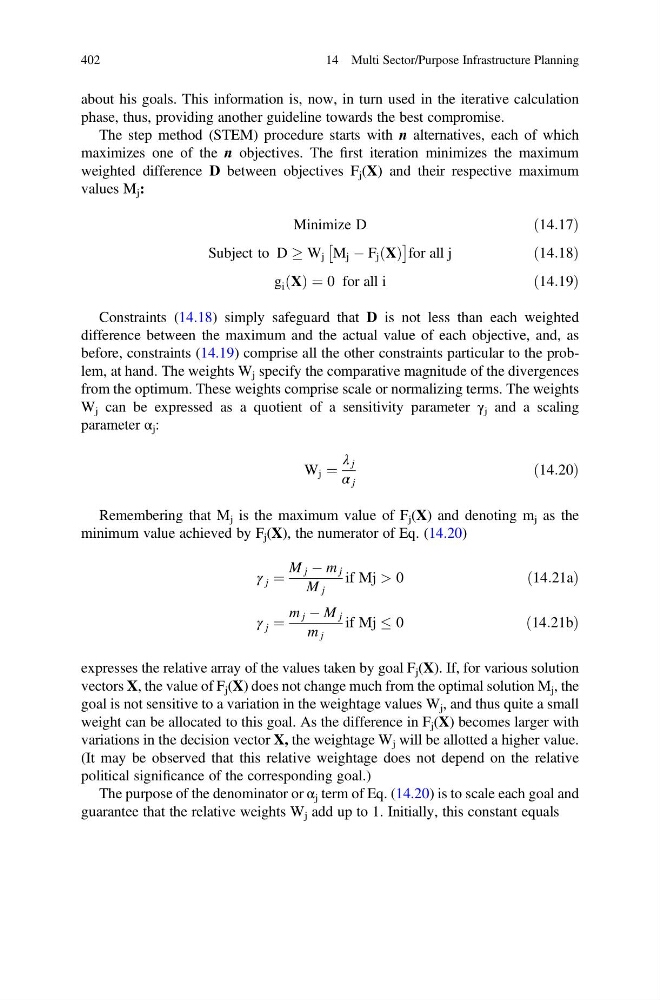
The step method (STEM) procedure starts with n alternatives, each of which
maximizes one of the n objectives. The first iteration minimizes the maximum
weighted difference D between objectives F j (X) and their respective maximum
values M j :
Minimize D
ð14:17Þ
Subject to D ! W j M j À F j X
ð Þ
Â
Ã
for all j
ð14:18Þ
g i X
ð Þ ¼ 0 for all i
ð14:19Þ
Constraints (14.18) simply safeguard that D is not less than each weighted
difference between the maximum and the actual value of each objective, and, as
before, constraints (14.19) comprise all the other constraints particular to the problem, at hand. The weights W j specify the comparative magnitude of the divergences
from the optimum. These weights comprise scale or normalizing terms. The weights
W j can be expressed as a quotient of a sensitivity parameter γ j and a scaling
parameter α j :
W j ¼
λ j
α j
ð14:20Þ
Remembering that M j is the maximum value of F j (X) and denoting m j as the
minimum value achieved by F j (X), the numerator of Eq. (14.20)
γ j ¼
M j À m j
M j
if Mj > 0
ð14:21aÞ
γ j ¼
m j À M j
m j
if Mj 0
ð14:21bÞ
expresses the relative array of the values taken by goal F j (X). If, for various solution
vectors X, the value of F j (X) does not change much from the optimal solution M j , the
goal is not sensitive to a variation in the weightage values W j , and thus quite a small
weight can be allocated to this goal. As the difference in F j (X) becomes larger with
variations in the decision vector X, the weightage W j will be allotted a higher value.
(It may be observed that this relative weightage does not depend on the relative
political significance of the corresponding goal.)
The purpose of the denominator or α j term of Eq. (14.20) is to scale each goal and
guarantee that the relative weights W j add up to 1. Initially, this constant equals
402
14 Multi Sector/Purpose Infrastructure Planning
phase, thus, providing another guideline towards the best compromise.
The step method (STEM) procedure starts with n alternatives, each of which
maximizes one of the n objectives. The first iteration minimizes the maximum
weighted difference D between objectives F j (X) and their respective maximum
values M j :
Minimize D
ð14:17Þ
Subject to D ! W j M j À F j X
ð Þ
Â
Ã
for all j
ð14:18Þ
g i X
ð Þ ¼ 0 for all i
ð14:19Þ
Constraints (14.18) simply safeguard that D is not less than each weighted
difference between the maximum and the actual value of each objective, and, as
before, constraints (14.19) comprise all the other constraints particular to the problem, at hand. The weights W j specify the comparative magnitude of the divergences
from the optimum. These weights comprise scale or normalizing terms. The weights
W j can be expressed as a quotient of a sensitivity parameter γ j and a scaling
parameter α j :
W j ¼
λ j
α j
ð14:20Þ
Remembering that M j is the maximum value of F j (X) and denoting m j as the
minimum value achieved by F j (X), the numerator of Eq. (14.20)
γ j ¼
M j À m j
M j
if Mj > 0
ð14:21aÞ
γ j ¼
m j À M j
m j
if Mj 0
ð14:21bÞ
expresses the relative array of the values taken by goal F j (X). If, for various solution
vectors X, the value of F j (X) does not change much from the optimal solution M j , the
goal is not sensitive to a variation in the weightage values W j , and thus quite a small
weight can be allocated to this goal. As the difference in F j (X) becomes larger with
variations in the decision vector X, the weightage W j will be allotted a higher value.
(It may be observed that this relative weightage does not depend on the relative
political significance of the corresponding goal.)
The purpose of the denominator or α j term of Eq. (14.20) is to scale each goal and
guarantee that the relative weights W j add up to 1. Initially, this constant equals
402
14 Multi Sector/Purpose Infrastructure Planning