

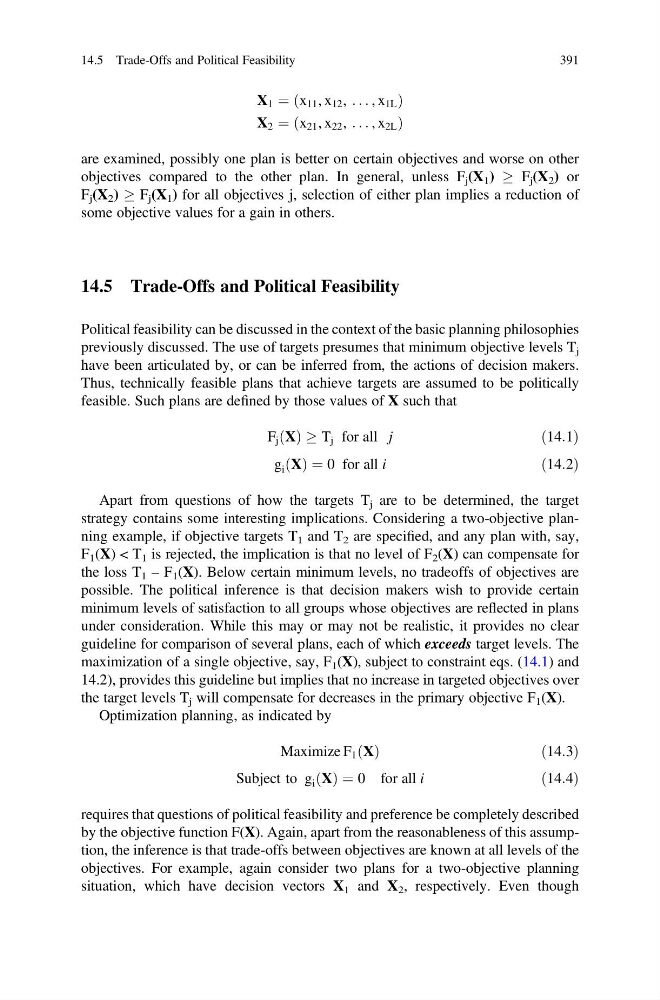
X 1 ¼ x 11 , x 12 , . . . , x 1L
ð
Þ
X 2 ¼ x 21 , x 22 , . . . , x 2L
ð
Þ
are examined, possibly one plan is better on certain objectives and worse on other
objectives compared to the other plan. In general, unless F j (X 1 ) ! F j (X 2 ) or
F j (X 2 ) ! F j (X 1 ) for all objectives j, selection of either plan implies a reduction of
some objective values for a gain in others.
14.5 Trade-Offs and Political Feasibility
Political feasibility can be discussed in the context of the basic planning philosophies
previously discussed. The use of targets presumes that minimum objective levels T j
have been articulated by, or can be inferred from, the actions of decision makers.
Thus, technically feasible plans that achieve targets are assumed to be politically
feasible. Such plans are defined by those values of X such that
F j X
ð Þ ! T j for all j
ð14:1Þ
g i X
ð Þ ¼ 0 for all i
ð14:2Þ
Apart from questions of how the targets T j are to be determined, the target
strategy contains some interesting implications. Considering a two-objective planning example, if objective targets T 1 and T 2 are specified, and any plan with, say,
F 1 (X) < T 1 is rejected, the implication is that no level of F 2 (X) can compensate for
the loss T 1 – F 1 (X). Below certain minimum levels, no tradeoffs of objectives are
possible. The political inference is that decision makers wish to provide certain
minimum levels of satisfaction to all groups whose objectives are reflected in plans
under consideration. While this may or may not be realistic, it provides no clear
guideline for comparison of several plans, each of which exceeds target levels. The
maximization of a single objective, say, F 1 (X), subject to constraint eqs. (14.1) and
14.2), provides this guideline but implies that no increase in targeted objectives over
the target levels T j will compensate for decreases in the primary objective F 1 (X).
Optimization planning, as indicated by
Maximize F 1 X
ð Þ
ð14:3Þ
Subject to g i X
ð Þ ¼ 0 for all i
ð14:4Þ
requires that questions of political feasibility and preference be completely described
by the objective function F(X). Again, apart from the reasonableness of this assumption, the inference is that trade-offs between objectives are known at all levels of the
objectives. For example, again consider two plans for a two-objective planning
situation, which have decision vectors X 1 and X 2 , respectively. Even though
14.5 Trade-Offs and Political Feasibility
391
ð
Þ
X 2 ¼ x 21 , x 22 , . . . , x 2L
ð
Þ
are examined, possibly one plan is better on certain objectives and worse on other
objectives compared to the other plan. In general, unless F j (X 1 ) ! F j (X 2 ) or
F j (X 2 ) ! F j (X 1 ) for all objectives j, selection of either plan implies a reduction of
some objective values for a gain in others.
14.5 Trade-Offs and Political Feasibility
Political feasibility can be discussed in the context of the basic planning philosophies
previously discussed. The use of targets presumes that minimum objective levels T j
have been articulated by, or can be inferred from, the actions of decision makers.
Thus, technically feasible plans that achieve targets are assumed to be politically
feasible. Such plans are defined by those values of X such that
F j X
ð Þ ! T j for all j
ð14:1Þ
g i X
ð Þ ¼ 0 for all i
ð14:2Þ
Apart from questions of how the targets T j are to be determined, the target
strategy contains some interesting implications. Considering a two-objective planning example, if objective targets T 1 and T 2 are specified, and any plan with, say,
F 1 (X) < T 1 is rejected, the implication is that no level of F 2 (X) can compensate for
the loss T 1 – F 1 (X). Below certain minimum levels, no tradeoffs of objectives are
possible. The political inference is that decision makers wish to provide certain
minimum levels of satisfaction to all groups whose objectives are reflected in plans
under consideration. While this may or may not be realistic, it provides no clear
guideline for comparison of several plans, each of which exceeds target levels. The
maximization of a single objective, say, F 1 (X), subject to constraint eqs. (14.1) and
14.2), provides this guideline but implies that no increase in targeted objectives over
the target levels T j will compensate for decreases in the primary objective F 1 (X).
Optimization planning, as indicated by
Maximize F 1 X
ð Þ
ð14:3Þ
Subject to g i X
ð Þ ¼ 0 for all i
ð14:4Þ
requires that questions of political feasibility and preference be completely described
by the objective function F(X). Again, apart from the reasonableness of this assumption, the inference is that trade-offs between objectives are known at all levels of the
objectives. For example, again consider two plans for a two-objective planning
situation, which have decision vectors X 1 and X 2 , respectively. Even though
14.5 Trade-Offs and Political Feasibility
391