

these situations it is simply a computational problem to find the solution vector X
*
which provides the optimal value of F(X), compatible with all constraints g i (X) = 0.
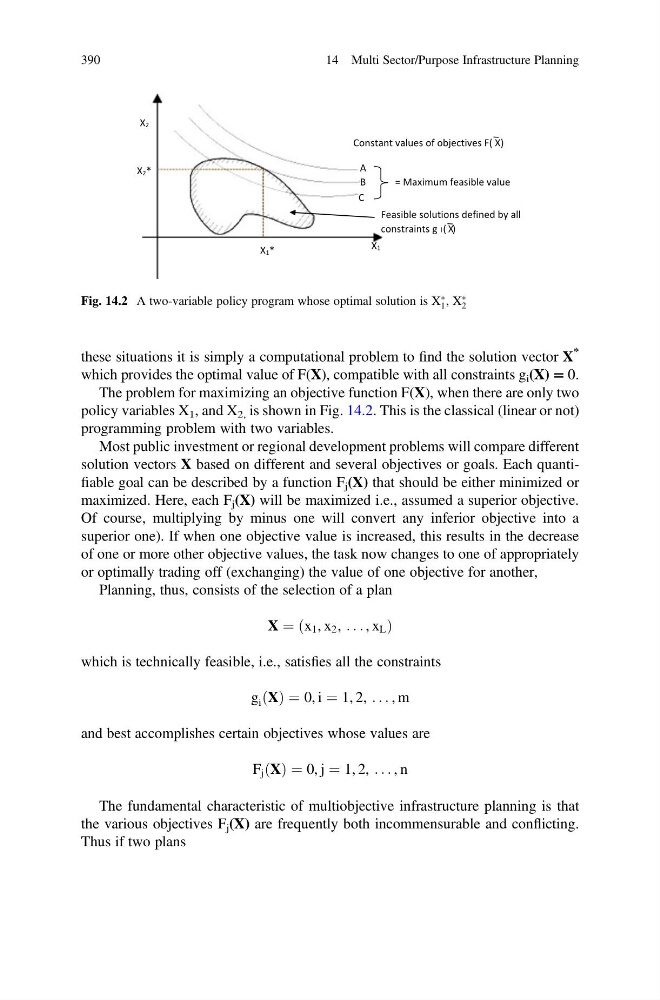
The problem for maximizing an objective function F(X), when there are only two
policy variables X 1 , and X 2, is shown in Fig. 14.2. This is the classical (linear or not)
programming problem with two variables.
Most public investment or regional development problems will compare different
solution vectors X based on different and several objectives or goals. Each quantifiable goal can be described by a function F j (X) that should be either minimized or
maximized. Here, each F j (X) will be maximized i.e., assumed a superior objective.
Of course, multiplying by minus one will convert any inferior objective into a
superior one). If when one objective value is increased, this results in the decrease
of one or more other objective values, the task now changes to one of appropriately
or optimally trading off (exchanging) the value of one objective for another,
Planning, thus, consists of the selection of a plan
X ¼ x 1 , x 2 , . . . , x L
ð
Þ
which is technically feasible, i.e., satisfies all the constraints
g i X
ð Þ ¼ 0, i ¼ 1, 2, . . . , m
and best accomplishes certain objectives whose values are
F j X
ð Þ ¼ 0, j ¼ 1, 2, . . . , n
The fundamental characteristic of multiobjective infrastructure planning is that
the various objectives F j (X) are frequently both incommensurable and conflicting.
Thus if two plans
Constant values of objectives F( X)
Feasible solutions defined by all
constraints g I ( X)
A
B
C
= Maximum feasible value
X2*
X2
X1*
X1
Fig. 14.2 A two-variable policy program whose optimal solution is X
Ã
1 , X
Ã
2
390
14 Multi Sector/Purpose Infrastructure Planning
*
which provides the optimal value of F(X), compatible with all constraints g i (X) = 0.
The problem for maximizing an objective function F(X), when there are only two
policy variables X 1 , and X 2, is shown in Fig. 14.2. This is the classical (linear or not)
programming problem with two variables.
Most public investment or regional development problems will compare different
solution vectors X based on different and several objectives or goals. Each quantifiable goal can be described by a function F j (X) that should be either minimized or
maximized. Here, each F j (X) will be maximized i.e., assumed a superior objective.
Of course, multiplying by minus one will convert any inferior objective into a
superior one). If when one objective value is increased, this results in the decrease
of one or more other objective values, the task now changes to one of appropriately
or optimally trading off (exchanging) the value of one objective for another,
Planning, thus, consists of the selection of a plan
X ¼ x 1 , x 2 , . . . , x L
ð
Þ
which is technically feasible, i.e., satisfies all the constraints
g i X
ð Þ ¼ 0, i ¼ 1, 2, . . . , m
and best accomplishes certain objectives whose values are
F j X
ð Þ ¼ 0, j ¼ 1, 2, . . . , n
The fundamental characteristic of multiobjective infrastructure planning is that
the various objectives F j (X) are frequently both incommensurable and conflicting.
Thus if two plans
Constant values of objectives F( X)
Feasible solutions defined by all
constraints g I ( X)
A
B
C
= Maximum feasible value
X2*
X2
X1*
X1
Fig. 14.2 A two-variable policy program whose optimal solution is X
Ã
1 , X
Ã
2
390
14 Multi Sector/Purpose Infrastructure Planning