

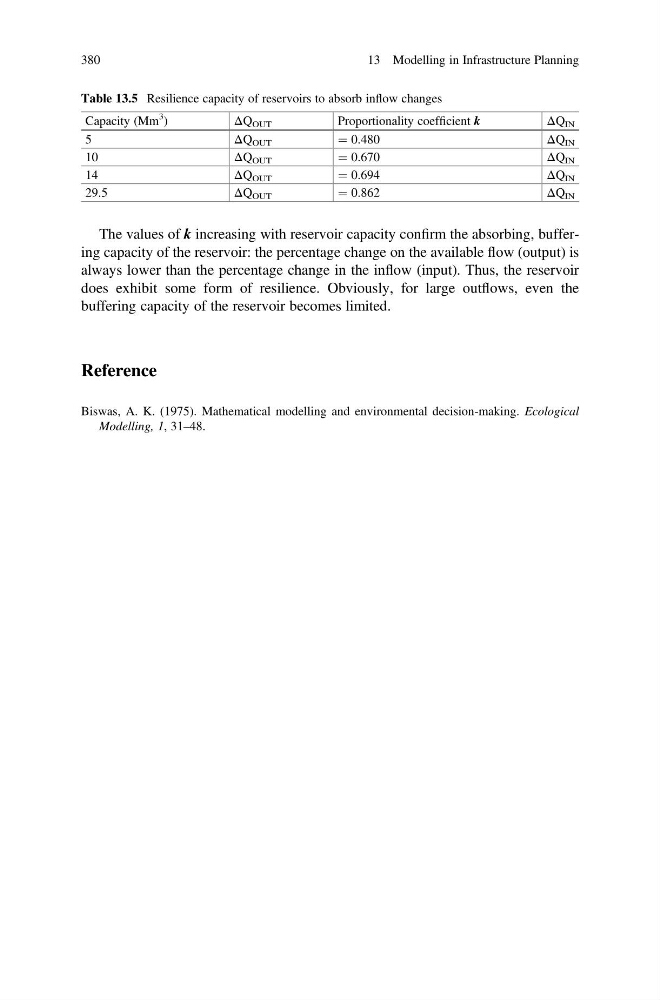
The values of k increasing with reservoir capacity confirm the absorbing, buffering capacity of the reservoir: the percentage change on the available flow (output) is
always lower than the percentage change in the inflow (input). Thus, the reservoir
does exhibit some form of resilience. Obviously, for large outflows, even the
buffering capacity of the reservoir becomes limited.
Reference
Biswas, A. K. (1975). Mathematical modelling and environmental decision-making. Ecological
Modelling, 1, 31–48.
Table 13.5 Resilience capacity of reservoirs to absorb inflow changes
Capacity (Mm
3 )
ΔQ OUT
Proportionality coefficient k
ΔQ IN
5
ΔQ OUT
¼ 0.480
ΔQ IN
10
ΔQ OUT
¼ 0.670
ΔQ IN
14
ΔQ OUT
¼ 0.694
ΔQ IN
29.5
ΔQ OUT
¼ 0.862
ΔQ IN
380
13 Modelling in Infrastructure Planning
always lower than the percentage change in the inflow (input). Thus, the reservoir
does exhibit some form of resilience. Obviously, for large outflows, even the
buffering capacity of the reservoir becomes limited.
Reference
Biswas, A. K. (1975). Mathematical modelling and environmental decision-making. Ecological
Modelling, 1, 31–48.
Table 13.5 Resilience capacity of reservoirs to absorb inflow changes
Capacity (Mm
3 )
ΔQ OUT
Proportionality coefficient k
ΔQ IN
5
ΔQ OUT
¼ 0.480
ΔQ IN
10
ΔQ OUT
¼ 0.670
ΔQ IN
14
ΔQ OUT
¼ 0.694
ΔQ IN
29.5
ΔQ OUT
¼ 0.862
ΔQ IN
380
13 Modelling in Infrastructure Planning