

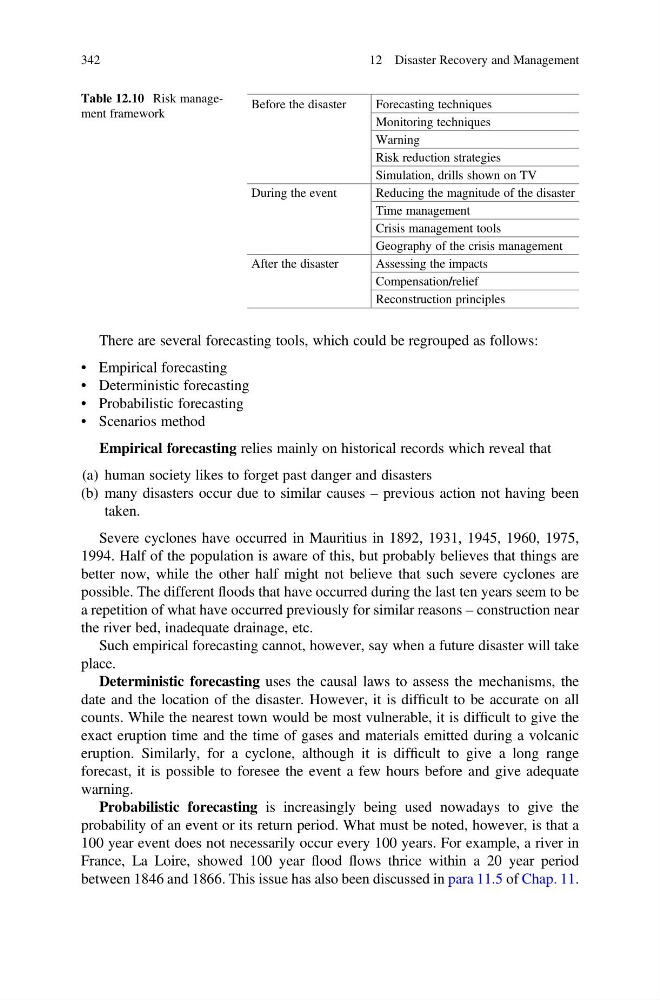
There are several forecasting tools, which could be regrouped as follows:
• Empirical forecasting
• Deterministic forecasting
• Probabilistic forecasting
• Scenarios method
Empirical forecasting relies mainly on historical records which reveal that
(a) human society likes to forget past danger and disasters
(b) many disasters occur due to similar causes – previous action not having been
taken.
Severe cyclones have occurred in Mauritius in 1892, 1931, 1945, 1960, 1975,
1994. Half of the population is aware of this, but probably believes that things are
better now, while the other half might not believe that such severe cyclones are
possible. The different floods that have occurred during the last ten years seem to be
a repetition of what have occurred previously for similar reasons – construction near
the river bed, inadequate drainage, etc.
Such empirical forecasting cannot, however, say when a future disaster will take
place.
Deterministic forecasting uses the causal laws to assess the mechanisms, the
date and the location of the disaster. However, it is difficult to be accurate on all
counts. While the nearest town would be most vulnerable, it is difficult to give the
exact eruption time and the time of gases and materials emitted during a volcanic
eruption. Similarly, for a cyclone, although it is difficult to give a long range
forecast, it is possible to foresee the event a few hours before and give adequate
warning.
Probabilistic forecasting is increasingly being used nowadays to give the
probability of an event or its return period. What must be noted, however, is that a
100 year event does not necessarily occur every 100 years. For example, a river in
France, La Loire, showed 100 year flood flows thrice within a 20 year period
between 1846 and 1866. This issue has also been discussed in para 11.5 of Chap. 11.
Table 12.10 Risk management framework
Before the disaster
Forecasting techniques
Monitoring techniques
Warning
Risk reduction strategies
Simulation, drills shown on TV
During the event
Reducing the magnitude of the disaster
Time management
Crisis management tools
Geography of the crisis management
After the disaster
Assessing the impacts
Compensation/relief
Reconstruction principles
342
12 Disaster Recovery and Management
• Empirical forecasting
• Deterministic forecasting
• Probabilistic forecasting
• Scenarios method
Empirical forecasting relies mainly on historical records which reveal that
(a) human society likes to forget past danger and disasters
(b) many disasters occur due to similar causes – previous action not having been
taken.
Severe cyclones have occurred in Mauritius in 1892, 1931, 1945, 1960, 1975,
1994. Half of the population is aware of this, but probably believes that things are
better now, while the other half might not believe that such severe cyclones are
possible. The different floods that have occurred during the last ten years seem to be
a repetition of what have occurred previously for similar reasons – construction near
the river bed, inadequate drainage, etc.
Such empirical forecasting cannot, however, say when a future disaster will take
place.
Deterministic forecasting uses the causal laws to assess the mechanisms, the
date and the location of the disaster. However, it is difficult to be accurate on all
counts. While the nearest town would be most vulnerable, it is difficult to give the
exact eruption time and the time of gases and materials emitted during a volcanic
eruption. Similarly, for a cyclone, although it is difficult to give a long range
forecast, it is possible to foresee the event a few hours before and give adequate
warning.
Probabilistic forecasting is increasingly being used nowadays to give the
probability of an event or its return period. What must be noted, however, is that a
100 year event does not necessarily occur every 100 years. For example, a river in
France, La Loire, showed 100 year flood flows thrice within a 20 year period
between 1846 and 1866. This issue has also been discussed in para 11.5 of Chap. 11.
Table 12.10 Risk management framework
Before the disaster
Forecasting techniques
Monitoring techniques
Warning
Risk reduction strategies
Simulation, drills shown on TV
During the event
Reducing the magnitude of the disaster
Time management
Crisis management tools
Geography of the crisis management
After the disaster
Assessing the impacts
Compensation/relief
Reconstruction principles
342
12 Disaster Recovery and Management