

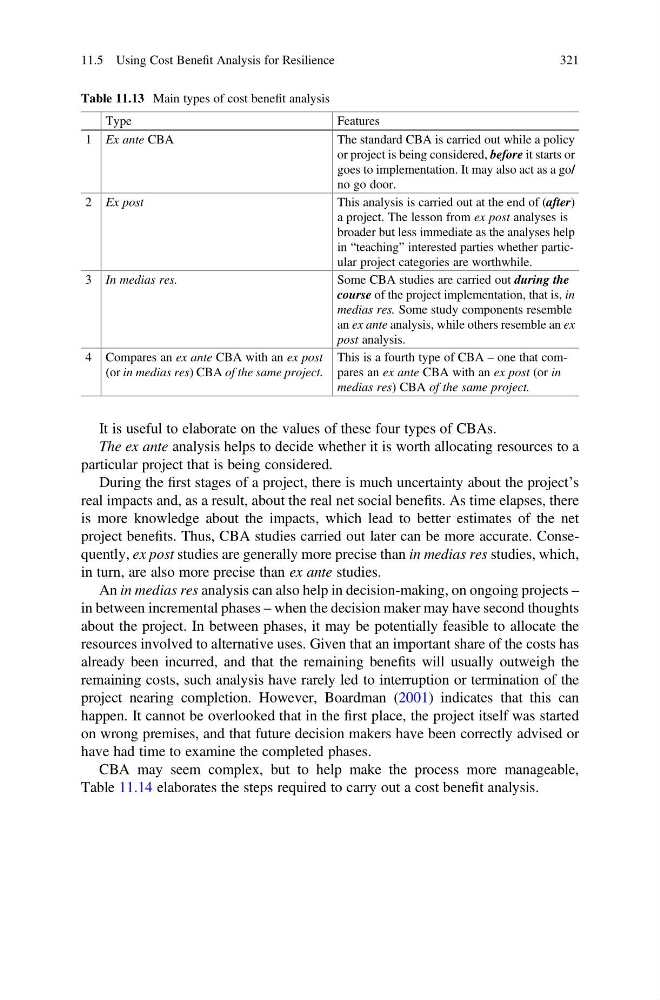
It is useful to elaborate on the values of these four types of CBAs.
The ex ante analysis helps to decide whether it is worth allocating resources to a
particular project that is being considered.
During the first stages of a project, there is much uncertainty about the project’s
real impacts and, as a result, about the real net social benefits. As time elapses, there
is more knowledge about the impacts, which lead to better estimates of the net
project benefits. Thus, CBA studies carried out later can be more accurate. Consequently, ex post studies are generally more precise than in medias res studies, which,
in turn, are also more precise than ex ante studies.
An in medias res analysis can also help in decision-making, on ongoing projects –
in between incremental phases – when the decision maker may have second thoughts
about the project. In between phases, it may be potentially feasible to allocate the
resources involved to alternative uses. Given that an important share of the costs has
already been incurred, and that the remaining benefits will usually outweigh the
remaining costs, such analysis have rarely led to interruption or termination of the
project nearing completion. However, Boardman (2001) indicates that this can
happen. It cannot be overlooked that in the first place, the project itself was started
on wrong premises, and that future decision makers have been correctly advised or
have had time to examine the completed phases.
CBA may seem complex, but to help make the process more manageable,
Table 11.14 elaborates the steps required to carry out a cost benefit analysis.
Table 11.13 Main types of cost benefit analysis
Type
Features
1 Ex ante CBA
The standard CBA is carried out while a policy
or project is being considered, before it starts or
goes to implementation. It may also act as a go/
no go door.
2 Ex post
This analysis is carried out at the end of (after)
a project. The lesson from ex post analyses is
broader but less immediate as the analyses help
in “teaching” interested parties whether particular project categories are worthwhile.
3 In medias res.
Some CBA studies are carried out during the
course of the project implementation, that is, in
medias res. Some study components resemble
an ex ante analysis, while others resemble an ex
post analysis.
4 Compares an ex ante CBA with an ex post
(or in medias res) CBA of the same project.
This is a fourth type of CBA – one that compares an ex ante CBA with an ex post (or in
medias res) CBA of the same project.
11.5 Using Cost Benefit Analysis for Resilience
321
The ex ante analysis helps to decide whether it is worth allocating resources to a
particular project that is being considered.
During the first stages of a project, there is much uncertainty about the project’s
real impacts and, as a result, about the real net social benefits. As time elapses, there
is more knowledge about the impacts, which lead to better estimates of the net
project benefits. Thus, CBA studies carried out later can be more accurate. Consequently, ex post studies are generally more precise than in medias res studies, which,
in turn, are also more precise than ex ante studies.
An in medias res analysis can also help in decision-making, on ongoing projects –
in between incremental phases – when the decision maker may have second thoughts
about the project. In between phases, it may be potentially feasible to allocate the
resources involved to alternative uses. Given that an important share of the costs has
already been incurred, and that the remaining benefits will usually outweigh the
remaining costs, such analysis have rarely led to interruption or termination of the
project nearing completion. However, Boardman (2001) indicates that this can
happen. It cannot be overlooked that in the first place, the project itself was started
on wrong premises, and that future decision makers have been correctly advised or
have had time to examine the completed phases.
CBA may seem complex, but to help make the process more manageable,
Table 11.14 elaborates the steps required to carry out a cost benefit analysis.
Table 11.13 Main types of cost benefit analysis
Type
Features
1 Ex ante CBA
The standard CBA is carried out while a policy
or project is being considered, before it starts or
goes to implementation. It may also act as a go/
no go door.
2 Ex post
This analysis is carried out at the end of (after)
a project. The lesson from ex post analyses is
broader but less immediate as the analyses help
in “teaching” interested parties whether particular project categories are worthwhile.
3 In medias res.
Some CBA studies are carried out during the
course of the project implementation, that is, in
medias res. Some study components resemble
an ex ante analysis, while others resemble an ex
post analysis.
4 Compares an ex ante CBA with an ex post
(or in medias res) CBA of the same project.
This is a fourth type of CBA – one that compares an ex ante CBA with an ex post (or in
medias res) CBA of the same project.
11.5 Using Cost Benefit Analysis for Resilience
321