

11.4.4 Comparison
It may be observed that this last resilience metric would still give 100%, even if the
system – though requiring no effort (cost) – takes a considerable time to recover to
normal performance. It is therefore judicious to associate several resilience metrics
to assess or compare different systems.
11.5 Using Cost Benefit Analysis for Resilience
11.5.1 General Principles
Governments and public authorities (local, regional, and central governments, and
international donor institutions often use the cost-benefit analysis (CBA) approach
for assessing the benefits accruing to society from public investment projects and
policies. The CBA technique has been generally used to systematically determine
the costs and benefits, and inherent possible trade-offs, and to finally evaluate the
economic efficiency of projects. (Dasgupta and Pearce 1986). Although there are
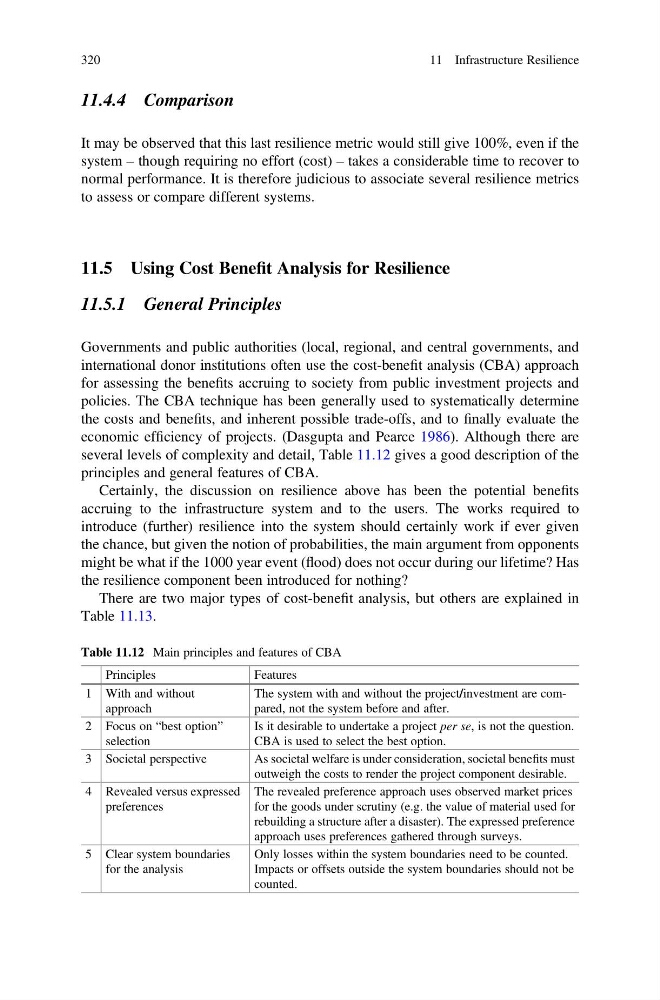
several levels of complexity and detail, Table 11.12 gives a good description of the
principles and general features of CBA.
Certainly, the discussion on resilience above has been the potential benefits
accruing to the infrastructure system and to the users. The works required to
introduce (further) resilience into the system should certainly work if ever given
the chance, but given the notion of probabilities, the main argument from opponents
might be what if the 1000 year event (flood) does not occur during our lifetime? Has
the resilience component been introduced for nothing?
There are two major types of cost-benefit analysis, but others are explained in
Table 11.13.
Table 11.12 Main principles and features of CBA
Principles
Features
1 With and without
approach
The system with and without the project/investment are compared, not the system before and after.
2 Focus on “best option”
selection
Is it desirable to undertake a project per se, is not the question.
CBA is used to select the best option.
3 Societal perspective
As societal welfare is under consideration, societal benefits must
outweigh the costs to render the project component desirable.
4 Revealed versus expressed
preferences
The revealed preference approach uses observed market prices
for the goods under scrutiny (e.g. the value of material used for
rebuilding a structure after a disaster). The expressed preference
approach uses preferences gathered through surveys.
5 Clear system boundaries
for the analysis
Only losses within the system boundaries need to be counted.
Impacts or offsets outside the system boundaries should not be
counted.
320
11 Infrastructure Resilience
It may be observed that this last resilience metric would still give 100%, even if the
system – though requiring no effort (cost) – takes a considerable time to recover to
normal performance. It is therefore judicious to associate several resilience metrics
to assess or compare different systems.
11.5 Using Cost Benefit Analysis for Resilience
11.5.1 General Principles
Governments and public authorities (local, regional, and central governments, and
international donor institutions often use the cost-benefit analysis (CBA) approach
for assessing the benefits accruing to society from public investment projects and
policies. The CBA technique has been generally used to systematically determine
the costs and benefits, and inherent possible trade-offs, and to finally evaluate the
economic efficiency of projects. (Dasgupta and Pearce 1986). Although there are
several levels of complexity and detail, Table 11.12 gives a good description of the
principles and general features of CBA.
Certainly, the discussion on resilience above has been the potential benefits
accruing to the infrastructure system and to the users. The works required to
introduce (further) resilience into the system should certainly work if ever given
the chance, but given the notion of probabilities, the main argument from opponents
might be what if the 1000 year event (flood) does not occur during our lifetime? Has
the resilience component been introduced for nothing?
There are two major types of cost-benefit analysis, but others are explained in
Table 11.13.
Table 11.12 Main principles and features of CBA
Principles
Features
1 With and without
approach
The system with and without the project/investment are compared, not the system before and after.
2 Focus on “best option”
selection
Is it desirable to undertake a project per se, is not the question.
CBA is used to select the best option.
3 Societal perspective
As societal welfare is under consideration, societal benefits must
outweigh the costs to render the project component desirable.
4 Revealed versus expressed
preferences
The revealed preference approach uses observed market prices
for the goods under scrutiny (e.g. the value of material used for
rebuilding a structure after a disaster). The expressed preference
approach uses preferences gathered through surveys.
5 Clear system boundaries
for the analysis
Only losses within the system boundaries need to be counted.
Impacts or offsets outside the system boundaries should not be
counted.
320
11 Infrastructure Resilience