

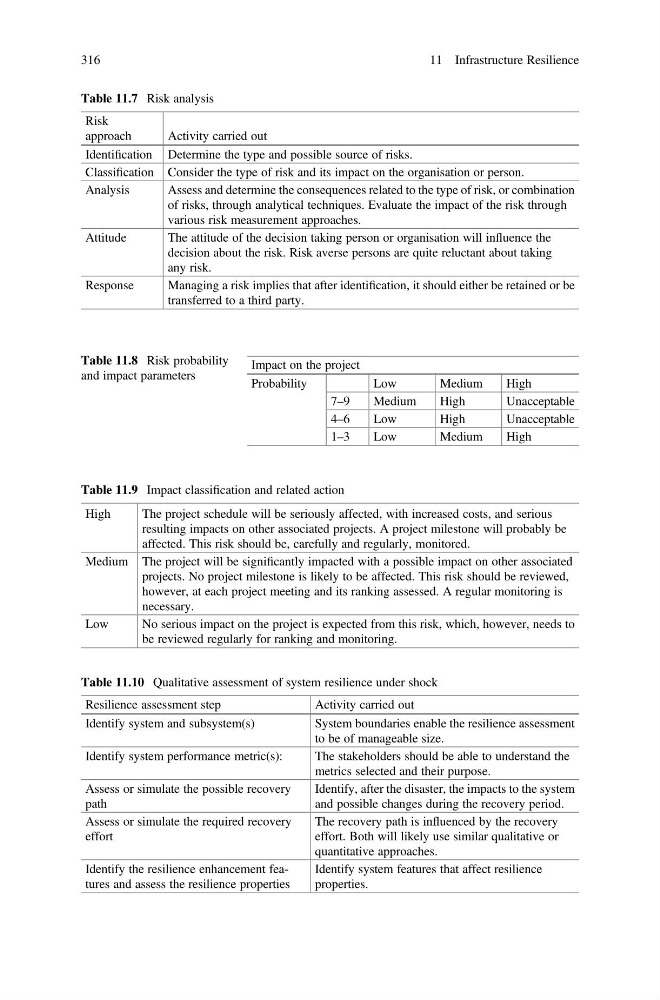
Table 11.8 Risk probability
and impact parameters
Impact on the project
Probability
Low
Medium
High
7–9
Medium
High
Unacceptable
4–6
Low
High
Unacceptable
1–3
Low
Medium
High
Table 11.9 Impact classification and related action
High
The project schedule will be seriously affected, with increased costs, and serious
resulting impacts on other associated projects. A project milestone will probably be
affected. This risk should be, carefully and regularly, monitored.
Medium The project will be significantly impacted with a possible impact on other associated
projects. No project milestone is likely to be affected. This risk should be reviewed,
however, at each project meeting and its ranking assessed. A regular monitoring is
necessary.
Low
No serious impact on the project is expected from this risk, which, however, needs to
be reviewed regularly for ranking and monitoring.
Table 11.10 Qualitative assessment of system resilience under shock
Resilience assessment step
Activity carried out
Identify system and subsystem(s)
System boundaries enable the resilience assessment
to be of manageable size.
Identify system performance metric(s):
The stakeholders should be able to understand the
metrics selected and their purpose.
Assess or simulate the possible recovery
path
Identify, after the disaster, the impacts to the system
and possible changes during the recovery period.
Assess or simulate the required recovery
effort
The recovery path is influenced by the recovery
effort. Both will likely use similar qualitative or
quantitative approaches.
Identify the resilience enhancement features and assess the resilience properties
Identify system features that affect resilience
properties.
Table 11.7 Risk analysis
Risk
approach
Activity carried out
Identification Determine the type and possible source of risks.
Classification Consider the type of risk and its impact on the organisation or person.
Analysis
Assess and determine the consequences related to the type of risk, or combination
of risks, through analytical techniques. Evaluate the impact of the risk through
various risk measurement approaches.
Attitude
The attitude of the decision taking person or organisation will influence the
decision about the risk. Risk averse persons are quite reluctant about taking
any risk.
Response
Managing a risk implies that after identification, it should either be retained or be
transferred to a third party.
316
11 Infrastructure Resilience
and impact parameters
Impact on the project
Probability
Low
Medium
High
7–9
Medium
High
Unacceptable
4–6
Low
High
Unacceptable
1–3
Low
Medium
High
Table 11.9 Impact classification and related action
High
The project schedule will be seriously affected, with increased costs, and serious
resulting impacts on other associated projects. A project milestone will probably be
affected. This risk should be, carefully and regularly, monitored.
Medium The project will be significantly impacted with a possible impact on other associated
projects. No project milestone is likely to be affected. This risk should be reviewed,
however, at each project meeting and its ranking assessed. A regular monitoring is
necessary.
Low
No serious impact on the project is expected from this risk, which, however, needs to
be reviewed regularly for ranking and monitoring.
Table 11.10 Qualitative assessment of system resilience under shock
Resilience assessment step
Activity carried out
Identify system and subsystem(s)
System boundaries enable the resilience assessment
to be of manageable size.
Identify system performance metric(s):
The stakeholders should be able to understand the
metrics selected and their purpose.
Assess or simulate the possible recovery
path
Identify, after the disaster, the impacts to the system
and possible changes during the recovery period.
Assess or simulate the required recovery
effort
The recovery path is influenced by the recovery
effort. Both will likely use similar qualitative or
quantitative approaches.
Identify the resilience enhancement features and assess the resilience properties
Identify system features that affect resilience
properties.
Table 11.7 Risk analysis
Risk
approach
Activity carried out
Identification Determine the type and possible source of risks.
Classification Consider the type of risk and its impact on the organisation or person.
Analysis
Assess and determine the consequences related to the type of risk, or combination
of risks, through analytical techniques. Evaluate the impact of the risk through
various risk measurement approaches.
Attitude
The attitude of the decision taking person or organisation will influence the
decision about the risk. Risk averse persons are quite reluctant about taking
any risk.
Response
Managing a risk implies that after identification, it should either be retained or be
transferred to a third party.
316
11 Infrastructure Resilience