

11.2 Assessing Infrastructure Resilience
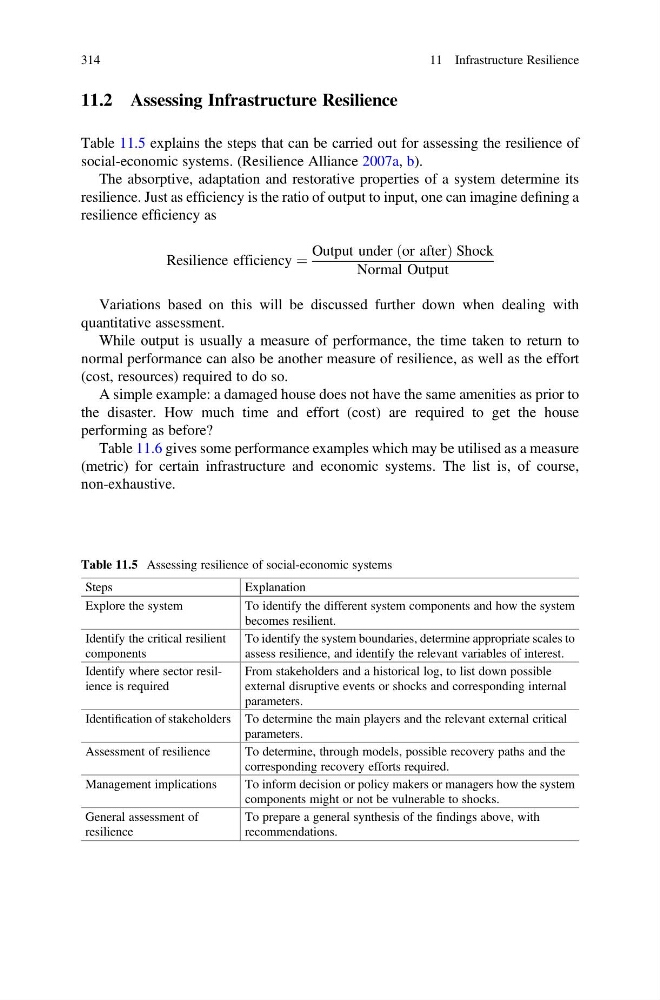
Table 11.5 explains the steps that can be carried out for assessing the resilience of
social-economic systems. (Resilience Alliance 2007a, b).
The absorptive, adaptation and restorative properties of a system determine its
resilience. Just as efficiency is the ratio of output to input, one can imagine defining a
resilience efficiency as
Resilience efficiency ¼
Output under or after
ð
ÞShock
Normal Output
Variations based on this will be discussed further down when dealing with
quantitative assessment.
While output is usually a measure of performance, the time taken to return to
normal performance can also be another measure of resilience, as well as the effort
(cost, resources) required to do so.
A simple example: a damaged house does not have the same amenities as prior to
the disaster. How much time and effort (cost) are required to get the house
performing as before?
Table 11.6 gives some performance examples which may be utilised as a measure
(metric) for certain infrastructure and economic systems. The list is, of course,
non-exhaustive.
Table 11.5 Assessing resilience of social-economic systems
Steps
Explanation
Explore the system
To identify the different system components and how the system
becomes resilient.
Identify the critical resilient
components
To identify the system boundaries, determine appropriate scales to
assess resilience, and identify the relevant variables of interest.
Identify where sector resilience is required
From stakeholders and a historical log, to list down possible
external disruptive events or shocks and corresponding internal
parameters.
Identification of stakeholders To determine the main players and the relevant external critical
parameters.
Assessment of resilience
To determine, through models, possible recovery paths and the
corresponding recovery efforts required.
Management implications
To inform decision or policy makers or managers how the system
components might or not be vulnerable to shocks.
General assessment of
resilience
To prepare a general synthesis of the findings above, with
recommendations.
314
11 Infrastructure Resilience
Table 11.5 explains the steps that can be carried out for assessing the resilience of
social-economic systems. (Resilience Alliance 2007a, b).
The absorptive, adaptation and restorative properties of a system determine its
resilience. Just as efficiency is the ratio of output to input, one can imagine defining a
resilience efficiency as
Resilience efficiency ¼
Output under or after
ð
ÞShock
Normal Output
Variations based on this will be discussed further down when dealing with
quantitative assessment.
While output is usually a measure of performance, the time taken to return to
normal performance can also be another measure of resilience, as well as the effort
(cost, resources) required to do so.
A simple example: a damaged house does not have the same amenities as prior to
the disaster. How much time and effort (cost) are required to get the house
performing as before?
Table 11.6 gives some performance examples which may be utilised as a measure
(metric) for certain infrastructure and economic systems. The list is, of course,
non-exhaustive.
Table 11.5 Assessing resilience of social-economic systems
Steps
Explanation
Explore the system
To identify the different system components and how the system
becomes resilient.
Identify the critical resilient
components
To identify the system boundaries, determine appropriate scales to
assess resilience, and identify the relevant variables of interest.
Identify where sector resilience is required
From stakeholders and a historical log, to list down possible
external disruptive events or shocks and corresponding internal
parameters.
Identification of stakeholders To determine the main players and the relevant external critical
parameters.
Assessment of resilience
To determine, through models, possible recovery paths and the
corresponding recovery efforts required.
Management implications
To inform decision or policy makers or managers how the system
components might or not be vulnerable to shocks.
General assessment of
resilience
To prepare a general synthesis of the findings above, with
recommendations.
314
11 Infrastructure Resilience