

11.1.6 Resilience Enhancement Features and Resilience
Sectors
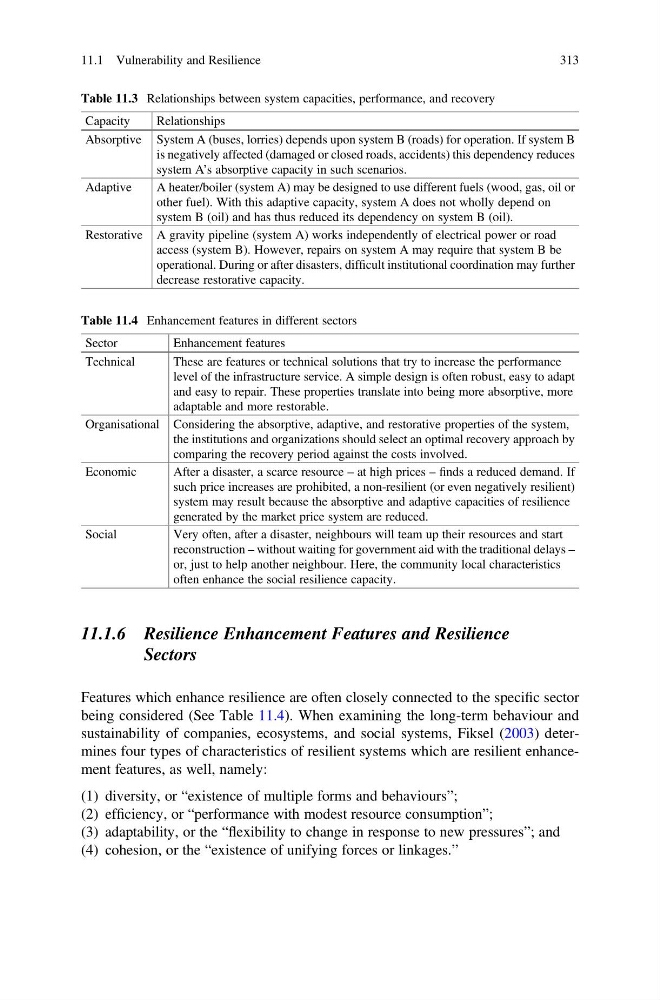
Features which enhance resilience are often closely connected to the specific sector
being considered (See Table 11.4). When examining the long-term behaviour and
sustainability of companies, ecosystems, and social systems, Fiksel (2003) determines four types of characteristics of resilient systems which are resilient enhancement features, as well, namely:
(1) diversity, or “existence of multiple forms and behaviours”;
(2) efficiency, or “performance with modest resource consumption”;
(3) adaptability, or the “flexibility to change in response to new pressures”; and
(4) cohesion, or the “existence of unifying forces or linkages.”
Table 11.3 Relationships between system capacities, performance, and recovery
Capacity
Relationships
Absorptive System A (buses, lorries) depends upon system B (roads) for operation. If system B
is negatively affected (damaged or closed roads, accidents) this dependency reduces
system A’s absorptive capacity in such scenarios.
Adaptive
A heater/boiler (system A) may be designed to use different fuels (wood, gas, oil or
other fuel). With this adaptive capacity, system A does not wholly depend on
system B (oil) and has thus reduced its dependency on system B (oil).
Restorative A gravity pipeline (system A) works independently of electrical power or road
access (system B). However, repairs on system A may require that system B be
operational. During or after disasters, difficult institutional coordination may further
decrease restorative capacity.
Table 11.4 Enhancement features in different sectors
Sector
Enhancement features
Technical
These are features or technical solutions that try to increase the performance
level of the infrastructure service. A simple design is often robust, easy to adapt
and easy to repair. These properties translate into being more absorptive, more
adaptable and more restorable.
Organisational Considering the absorptive, adaptive, and restorative properties of the system,
the institutions and organizations should select an optimal recovery approach by
comparing the recovery period against the costs involved.
Economic
After a disaster, a scarce resource – at high prices – finds a reduced demand. If
such price increases are prohibited, a non-resilient (or even negatively resilient)
system may result because the absorptive and adaptive capacities of resilience
generated by the market price system are reduced.
Social
Very often, after a disaster, neighbours will team up their resources and start
reconstruction – without waiting for government aid with the traditional delays –
or, just to help another neighbour. Here, the community local characteristics
often enhance the social resilience capacity.
11.1 Vulnerability and Resilience
313
Sectors
Features which enhance resilience are often closely connected to the specific sector
being considered (See Table 11.4). When examining the long-term behaviour and
sustainability of companies, ecosystems, and social systems, Fiksel (2003) determines four types of characteristics of resilient systems which are resilient enhancement features, as well, namely:
(1) diversity, or “existence of multiple forms and behaviours”;
(2) efficiency, or “performance with modest resource consumption”;
(3) adaptability, or the “flexibility to change in response to new pressures”; and
(4) cohesion, or the “existence of unifying forces or linkages.”
Table 11.3 Relationships between system capacities, performance, and recovery
Capacity
Relationships
Absorptive System A (buses, lorries) depends upon system B (roads) for operation. If system B
is negatively affected (damaged or closed roads, accidents) this dependency reduces
system A’s absorptive capacity in such scenarios.
Adaptive
A heater/boiler (system A) may be designed to use different fuels (wood, gas, oil or
other fuel). With this adaptive capacity, system A does not wholly depend on
system B (oil) and has thus reduced its dependency on system B (oil).
Restorative A gravity pipeline (system A) works independently of electrical power or road
access (system B). However, repairs on system A may require that system B be
operational. During or after disasters, difficult institutional coordination may further
decrease restorative capacity.
Table 11.4 Enhancement features in different sectors
Sector
Enhancement features
Technical
These are features or technical solutions that try to increase the performance
level of the infrastructure service. A simple design is often robust, easy to adapt
and easy to repair. These properties translate into being more absorptive, more
adaptable and more restorable.
Organisational Considering the absorptive, adaptive, and restorative properties of the system,
the institutions and organizations should select an optimal recovery approach by
comparing the recovery period against the costs involved.
Economic
After a disaster, a scarce resource – at high prices – finds a reduced demand. If
such price increases are prohibited, a non-resilient (or even negatively resilient)
system may result because the absorptive and adaptive capacities of resilience
generated by the market price system are reduced.
Social
Very often, after a disaster, neighbours will team up their resources and start
reconstruction – without waiting for government aid with the traditional delays –
or, just to help another neighbour. Here, the community local characteristics
often enhance the social resilience capacity.
11.1 Vulnerability and Resilience
313