

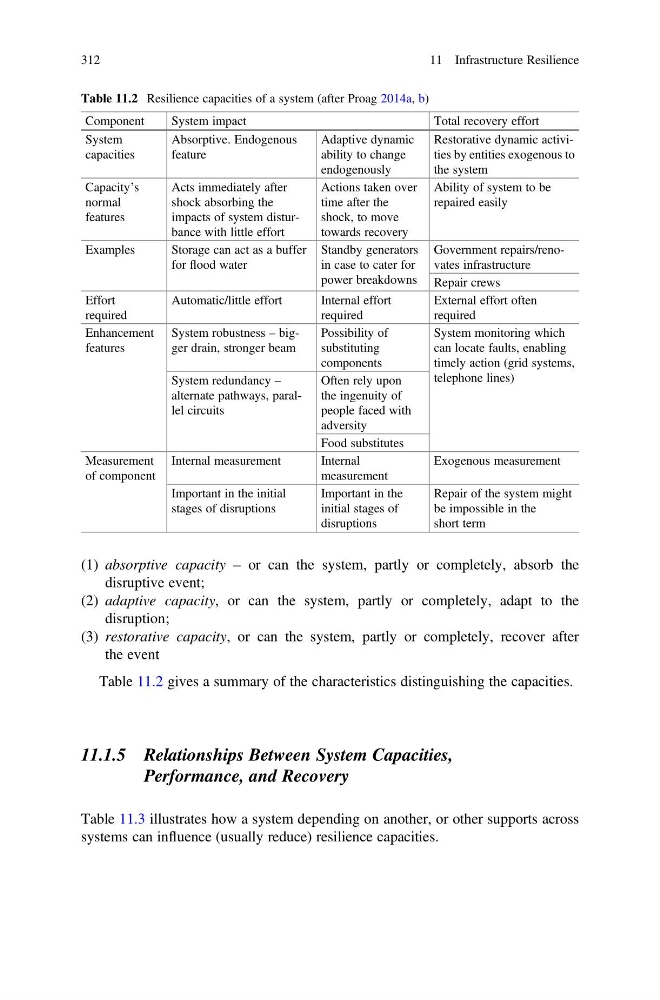
(1) absorptive capacity – or can the system, partly or completely, absorb the
disruptive event;
(2) adaptive capacity, or can the system, partly or completely, adapt to the
disruption;
(3) restorative capacity, or can the system, partly or completely, recover after
the event
Table 11.2 gives a summary of the characteristics distinguishing the capacities.
11.1.5 Relationships Between System Capacities,
Performance, and Recovery
Table 11.3 illustrates how a system depending on another, or other supports across
systems can influence (usually reduce) resilience capacities.
Table 11.2 Resilience capacities of a system (after Proag 2014a, b)
Component
System impact
Total recovery effort
System
capacities
Absorptive. Endogenous
feature
Adaptive dynamic
ability to change
endogenously
Restorative dynamic activities by entities exogenous to
the system
Capacity’s
normal
features
Acts immediately after
shock absorbing the
impacts of system disturbance with little effort
Actions taken over
time after the
shock, to move
towards recovery
Ability of system to be
repaired easily
Examples
Storage can act as a buffer
for flood water
Standby generators
in case to cater for
power breakdowns
Government repairs/renovates infrastructure
Repair crews
Effort
required
Automatic/little effort
Internal effort
required
External effort often
required
Enhancement
features
System robustness – bigger drain, stronger beam
Possibility of
substituting
components
System monitoring which
can locate faults, enabling
timely action (grid systems,
telephone lines)
System redundancy –
alternate pathways, parallel circuits
Often rely upon
the ingenuity of
people faced with
adversity
Food substitutes
Measurement
of component
Internal measurement
Internal
measurement
Exogenous measurement
Important in the initial
stages of disruptions
Important in the
initial stages of
disruptions
Repair of the system might
be impossible in the
short term
312
11 Infrastructure Resilience
disruptive event;
(2) adaptive capacity, or can the system, partly or completely, adapt to the
disruption;
(3) restorative capacity, or can the system, partly or completely, recover after
the event
Table 11.2 gives a summary of the characteristics distinguishing the capacities.
11.1.5 Relationships Between System Capacities,
Performance, and Recovery
Table 11.3 illustrates how a system depending on another, or other supports across
systems can influence (usually reduce) resilience capacities.
Table 11.2 Resilience capacities of a system (after Proag 2014a, b)
Component
System impact
Total recovery effort
System
capacities
Absorptive. Endogenous
feature
Adaptive dynamic
ability to change
endogenously
Restorative dynamic activities by entities exogenous to
the system
Capacity’s
normal
features
Acts immediately after
shock absorbing the
impacts of system disturbance with little effort
Actions taken over
time after the
shock, to move
towards recovery
Ability of system to be
repaired easily
Examples
Storage can act as a buffer
for flood water
Standby generators
in case to cater for
power breakdowns
Government repairs/renovates infrastructure
Repair crews
Effort
required
Automatic/little effort
Internal effort
required
External effort often
required
Enhancement
features
System robustness – bigger drain, stronger beam
Possibility of
substituting
components
System monitoring which
can locate faults, enabling
timely action (grid systems,
telephone lines)
System redundancy –
alternate pathways, parallel circuits
Often rely upon
the ingenuity of
people faced with
adversity
Food substitutes
Measurement
of component
Internal measurement
Internal
measurement
Exogenous measurement
Important in the initial
stages of disruptions
Important in the
initial stages of
disruptions
Repair of the system might
be impossible in the
short term
312
11 Infrastructure Resilience