

In many procurement decisions, when project alternatives need to be compared,
quality will be ranked equally with reliability. How the organization tries to maintain
quality and reliability of its equipment and services are important policy issues.
Consider a new product being tested, either by the manufacturer, buyer or both. If
its performance characteristics {x} meet the specifications {x T }, {Δ}, the buyer
proceeds with using the product. If, as a user, he finds the product never fails to
satisfy the specifications, then the product or service is considered reliable in the
environmental conditions of use.
For normal users, the reliability means that a service has a high probability, R,
of being available in the quantity, quality, and at the time required.
Using this concept of reliability influences the users’ choice of infrastructure use
and indirectly production. A seaside resort which cannot rely on the water network
will certainly give a high preference to water desalination methods, particularly if the
costs are comparable.
In contrast, if during the course of time, the product does fail to satisfy the
specifications, then it is considered to be unreliable in the environmental conditions
of use. The unreliability F of an infrastructure is thus the probability that the
product fails to satisfy the specification, over a given time period. Failure can be
due to several factors, such as wear and tear, mechanical failure or fracture,
corrosion.
Of course, any infrastructure, product or service should eventually fail to satisfy
the specification. If the possibility is infinitely small, then the product will be
considered a good one, although, this is not commercially interesting. However,
with increasing technology and complexity, the product is likely to fail within a
given lifetime, particularly when lower selling prices (and production costs) are
given priority. As competition creeps in, it is important to provide reliability into the
infrastructure products and services at the design stage, itself. This is, unfortunately,
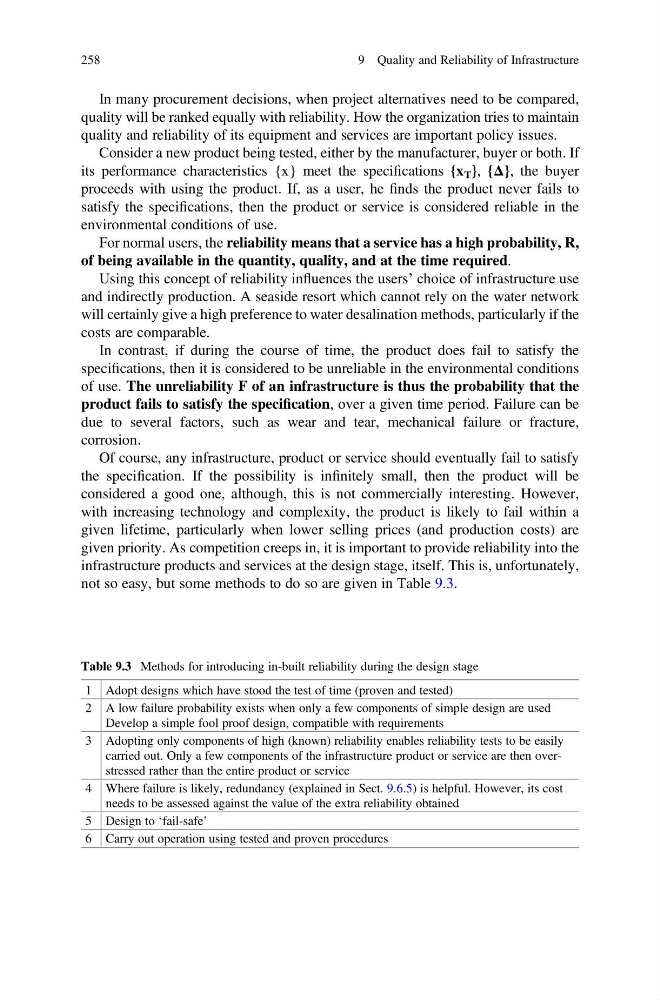
not so easy, but some methods to do so are given in Table 9.3.
Table 9.3 Methods for introducing in-built reliability during the design stage
1 Adopt designs which have stood the test of time (proven and tested)
2 A low failure probability exists when only a few components of simple design are used
Develop a simple fool proof design, compatible with requirements
3 Adopting only components of high (known) reliability enables reliability tests to be easily
carried out. Only a few components of the infrastructure product or service are then overstressed rather than the entire product or service
4 Where failure is likely, redundancy (explained in Sect. 9.6.5) is helpful. However, its cost
needs to be assessed against the value of the extra reliability obtained
5 Design to ‘fail-safe’
6 Carry out operation using tested and proven procedures
258
9 Quality and Reliability of Infrastructure
quality will be ranked equally with reliability. How the organization tries to maintain
quality and reliability of its equipment and services are important policy issues.
Consider a new product being tested, either by the manufacturer, buyer or both. If
its performance characteristics {x} meet the specifications {x T }, {Δ}, the buyer
proceeds with using the product. If, as a user, he finds the product never fails to
satisfy the specifications, then the product or service is considered reliable in the
environmental conditions of use.
For normal users, the reliability means that a service has a high probability, R,
of being available in the quantity, quality, and at the time required.
Using this concept of reliability influences the users’ choice of infrastructure use
and indirectly production. A seaside resort which cannot rely on the water network
will certainly give a high preference to water desalination methods, particularly if the
costs are comparable.
In contrast, if during the course of time, the product does fail to satisfy the
specifications, then it is considered to be unreliable in the environmental conditions
of use. The unreliability F of an infrastructure is thus the probability that the
product fails to satisfy the specification, over a given time period. Failure can be
due to several factors, such as wear and tear, mechanical failure or fracture,
corrosion.
Of course, any infrastructure, product or service should eventually fail to satisfy
the specification. If the possibility is infinitely small, then the product will be
considered a good one, although, this is not commercially interesting. However,
with increasing technology and complexity, the product is likely to fail within a
given lifetime, particularly when lower selling prices (and production costs) are
given priority. As competition creeps in, it is important to provide reliability into the
infrastructure products and services at the design stage, itself. This is, unfortunately,
not so easy, but some methods to do so are given in Table 9.3.
Table 9.3 Methods for introducing in-built reliability during the design stage
1 Adopt designs which have stood the test of time (proven and tested)
2 A low failure probability exists when only a few components of simple design are used
Develop a simple fool proof design, compatible with requirements
3 Adopting only components of high (known) reliability enables reliability tests to be easily
carried out. Only a few components of the infrastructure product or service are then overstressed rather than the entire product or service
4 Where failure is likely, redundancy (explained in Sect. 9.6.5) is helpful. However, its cost
needs to be assessed against the value of the extra reliability obtained
5 Design to ‘fail-safe’
6 Carry out operation using tested and proven procedures
258
9 Quality and Reliability of Infrastructure