

9.2.3 The Meaning of Failure
Failure implies that the infrastructure service, product system or component no
longer performs its required function. But this required function may not exactly
be defined. For example, while a bus is working perfectly, it is considered reliable,
and if it stopped working, it is no longer so, or has failed. But, what if the bus engine
is consuming more fuel (or producing more fumes) than when new? Thus, what is
termed failure relies completely on the initial definition of the required function –
which, in turn, is influenced by the type of the infrastructure service or product
(electricity, water, train or plane service).
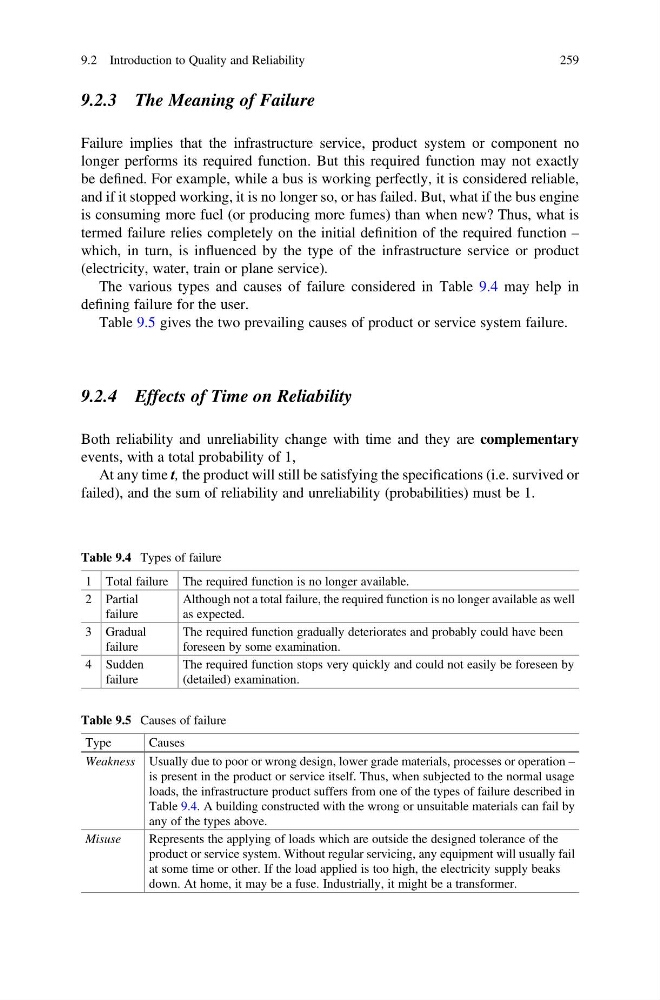
The various types and causes of failure considered in Table 9.4 may help in
defining failure for the user.
Table 9.5 gives the two prevailing causes of product or service system failure.
9.2.4 Effects of Time on Reliability
Both reliability and unreliability change with time and they are complementary
events, with a total probability of 1,
At any time t, the product will still be satisfying the specifications (i.e. survived or
failed), and the sum of reliability and unreliability (probabilities) must be 1.
Table 9.4 Types of failure
1 Total failure The required function is no longer available.
2 Partial
failure
Although not a total failure, the required function is no longer available as well
as expected.
3 Gradual
failure
The required function gradually deteriorates and probably could have been
foreseen by some examination.
4 Sudden
failure
The required function stops very quickly and could not easily be foreseen by
(detailed) examination.
Table 9.5 Causes of failure
Type
Causes
Weakness Usually due to poor or wrong design, lower grade materials, processes or operation –
is present in the product or service itself. Thus, when subjected to the normal usage
loads, the infrastructure product suffers from one of the types of failure described in
Table 9.4. A building constructed with the wrong or unsuitable materials can fail by
any of the types above.
Misuse
Represents the applying of loads which are outside the designed tolerance of the
product or service system. Without regular servicing, any equipment will usually fail
at some time or other. If the load applied is too high, the electricity supply beaks
down. At home, it may be a fuse. Industrially, it might be a transformer.
9.2 Introduction to Quality and Reliability
259
Failure implies that the infrastructure service, product system or component no
longer performs its required function. But this required function may not exactly
be defined. For example, while a bus is working perfectly, it is considered reliable,
and if it stopped working, it is no longer so, or has failed. But, what if the bus engine
is consuming more fuel (or producing more fumes) than when new? Thus, what is
termed failure relies completely on the initial definition of the required function –
which, in turn, is influenced by the type of the infrastructure service or product
(electricity, water, train or plane service).
The various types and causes of failure considered in Table 9.4 may help in
defining failure for the user.
Table 9.5 gives the two prevailing causes of product or service system failure.
9.2.4 Effects of Time on Reliability
Both reliability and unreliability change with time and they are complementary
events, with a total probability of 1,
At any time t, the product will still be satisfying the specifications (i.e. survived or
failed), and the sum of reliability and unreliability (probabilities) must be 1.
Table 9.4 Types of failure
1 Total failure The required function is no longer available.
2 Partial
failure
Although not a total failure, the required function is no longer available as well
as expected.
3 Gradual
failure
The required function gradually deteriorates and probably could have been
foreseen by some examination.
4 Sudden
failure
The required function stops very quickly and could not easily be foreseen by
(detailed) examination.
Table 9.5 Causes of failure
Type
Causes
Weakness Usually due to poor or wrong design, lower grade materials, processes or operation –
is present in the product or service itself. Thus, when subjected to the normal usage
loads, the infrastructure product suffers from one of the types of failure described in
Table 9.4. A building constructed with the wrong or unsuitable materials can fail by
any of the types above.
Misuse
Represents the applying of loads which are outside the designed tolerance of the
product or service system. Without regular servicing, any equipment will usually fail
at some time or other. If the load applied is too high, the electricity supply beaks
down. At home, it may be a fuse. Industrially, it might be a transformer.
9.2 Introduction to Quality and Reliability
259