

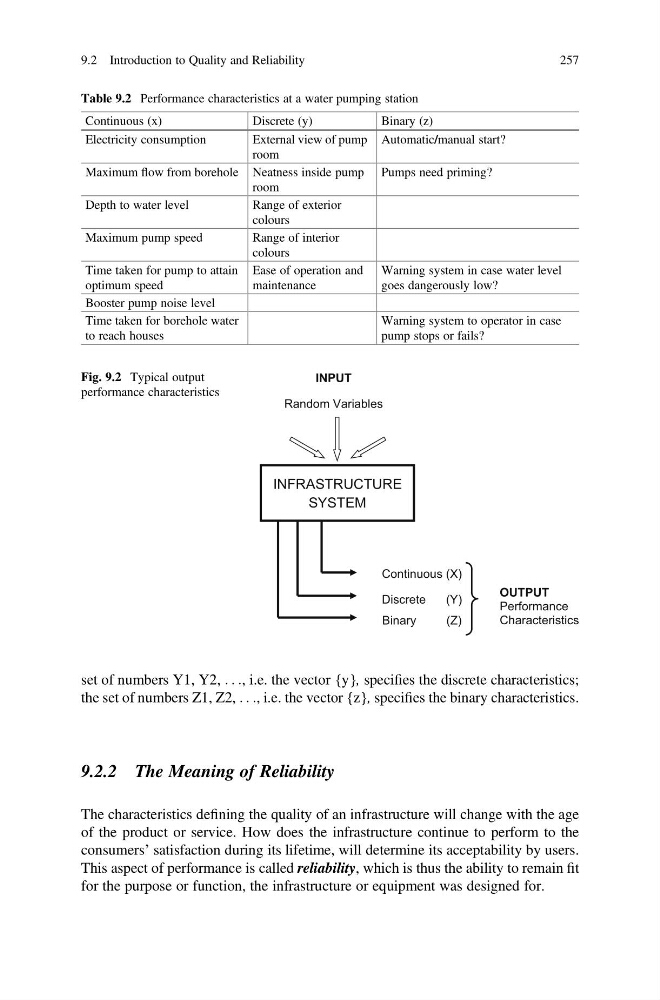
set of numbers Y1, Y2, . . ., i.e. the vector {y}, specifies the discrete characteristics;
the set of numbers Z1, Z2, . . ., i.e. the vector {z}, specifies the binary characteristics.
9.2.2 The Meaning of Reliability
The characteristics defining the quality of an infrastructure will change with the age
of the product or service. How does the infrastructure continue to perform to the
consumers’ satisfaction during its lifetime, will determine its acceptability by users.
This aspect of performance is called reliability, which is thus the ability to remain fit
for the purpose or function, the infrastructure or equipment was designed for.
Table 9.2 Performance characteristics at a water pumping station
Continuous (x)
Discrete (y)
Binary (z)
Electricity consumption
External view of pump
room
Automatic/manual start?
Maximum flow from borehole Neatness inside pump
room
Pumps need priming?
Depth to water level
Range of exterior
colours
Maximum pump speed
Range of interior
colours
Time taken for pump to attain
optimum speed
Ease of operation and
maintenance
Warning system in case water level
goes dangerously low?
Booster pump noise level
Time taken for borehole water
to reach houses
Warning system to operator in case
pump stops or fails?
INFRASTRUCTURE
SYSTEM
INPUT
Random Variables
Continuous (X)
Discrete
(Y)
Binary
(Z)
OUTPUT
Performance
Characteristics
Fig. 9.2 Typical output
performance characteristics
9.2 Introduction to Quality and Reliability
257
the set of numbers Z1, Z2, . . ., i.e. the vector {z}, specifies the binary characteristics.
9.2.2 The Meaning of Reliability
The characteristics defining the quality of an infrastructure will change with the age
of the product or service. How does the infrastructure continue to perform to the
consumers’ satisfaction during its lifetime, will determine its acceptability by users.
This aspect of performance is called reliability, which is thus the ability to remain fit
for the purpose or function, the infrastructure or equipment was designed for.
Table 9.2 Performance characteristics at a water pumping station
Continuous (x)
Discrete (y)
Binary (z)
Electricity consumption
External view of pump
room
Automatic/manual start?
Maximum flow from borehole Neatness inside pump
room
Pumps need priming?
Depth to water level
Range of exterior
colours
Maximum pump speed
Range of interior
colours
Time taken for pump to attain
optimum speed
Ease of operation and
maintenance
Warning system in case water level
goes dangerously low?
Booster pump noise level
Time taken for borehole water
to reach houses
Warning system to operator in case
pump stops or fails?
INFRASTRUCTURE
SYSTEM
INPUT
Random Variables
Continuous (X)
Discrete
(Y)
Binary
(Z)
OUTPUT
Performance
Characteristics
Fig. 9.2 Typical output
performance characteristics
9.2 Introduction to Quality and Reliability
257