

5.7 Use of the Backcasting Method
5.7.1 The Possible Demographic Changes
The population projection as worked out by the Central Statistical Office, (CSO)
Mauritius does not include the migration of foreign workers into Mauritius. Such a
population trend represents a negative impact on the “working age population” as
well as the national economy in the long term. Given that the development of water
schemes take a long time, it is dangerous to rely on the CSO population projections
for the planning of water resources of the country. A massive increase in immigration (if the government decides to attract foreign workers to sustain the national
economic growth) is likely to occur more quickly that the development in water
supply – the country may then be faced with an acute water shortage in the long term.
Therefore, the water demand arising from both the population trend and migration of
foreign workers in the long term should be considered in water demand management
and planning in the future. As such, the population projection worked out by Proag
(2016) is probably more appropriate if an infrastructure component like water is
being considered. In this case, the extrapolation extends until 2067 so as to cover the
50 years planning horizon considered above.
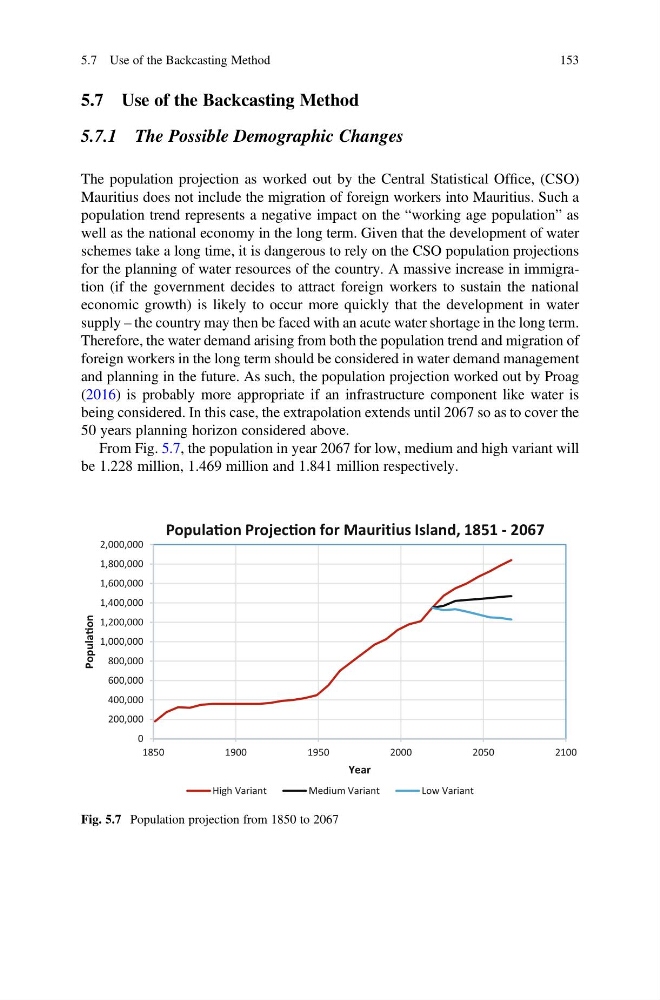
From Fig. 5.7, the population in year 2067 for low, medium and high variant will
be 1.228 million, 1.469 million and 1.841 million respectively.
0
200,000
400,000
600,000
800,000
1,000,000
1,200,000
1,400,000
1,600,000
1,800,000
2,000,000
1850
1900
1950
2000
2050
2100
PopulaƟon
Year
PopulaƟon ProjecƟon for Maurit¶us Island, 1851 - 2067
High Variant
Medium Variant
Low Variant
Fig. 5.7 Population projection from 1850 to 2067
5.7 Use of the Backcasting Method
153
5.7.1 The Possible Demographic Changes
The population projection as worked out by the Central Statistical Office, (CSO)
Mauritius does not include the migration of foreign workers into Mauritius. Such a
population trend represents a negative impact on the “working age population” as
well as the national economy in the long term. Given that the development of water
schemes take a long time, it is dangerous to rely on the CSO population projections
for the planning of water resources of the country. A massive increase in immigration (if the government decides to attract foreign workers to sustain the national
economic growth) is likely to occur more quickly that the development in water
supply – the country may then be faced with an acute water shortage in the long term.
Therefore, the water demand arising from both the population trend and migration of
foreign workers in the long term should be considered in water demand management
and planning in the future. As such, the population projection worked out by Proag
(2016) is probably more appropriate if an infrastructure component like water is
being considered. In this case, the extrapolation extends until 2067 so as to cover the
50 years planning horizon considered above.
From Fig. 5.7, the population in year 2067 for low, medium and high variant will
be 1.228 million, 1.469 million and 1.841 million respectively.
0
200,000
400,000
600,000
800,000
1,000,000
1,200,000
1,400,000
1,600,000
1,800,000
2,000,000
1850
1900
1950
2000
2050
2100
PopulaƟon
Year
PopulaƟon ProjecƟon for Maurit¶us Island, 1851 - 2067
High Variant
Medium Variant
Low Variant
Fig. 5.7 Population projection from 1850 to 2067
5.7 Use of the Backcasting Method
153