

different from existing rail routes). However, on small islands, space is usually at
a premium.
(6) dismantling or demolishing costs are now so high that the owner will likely wait
for as long as the structure does not fail before he really pulls down the
infrastructure.
In effect, not only may the lifetime of an asset exceed 50 years, but the space
available might dictate that successive additions be made to existing infrastructure.
Thus, we see that the time after T o may well exceed 50 years. It is interesting to
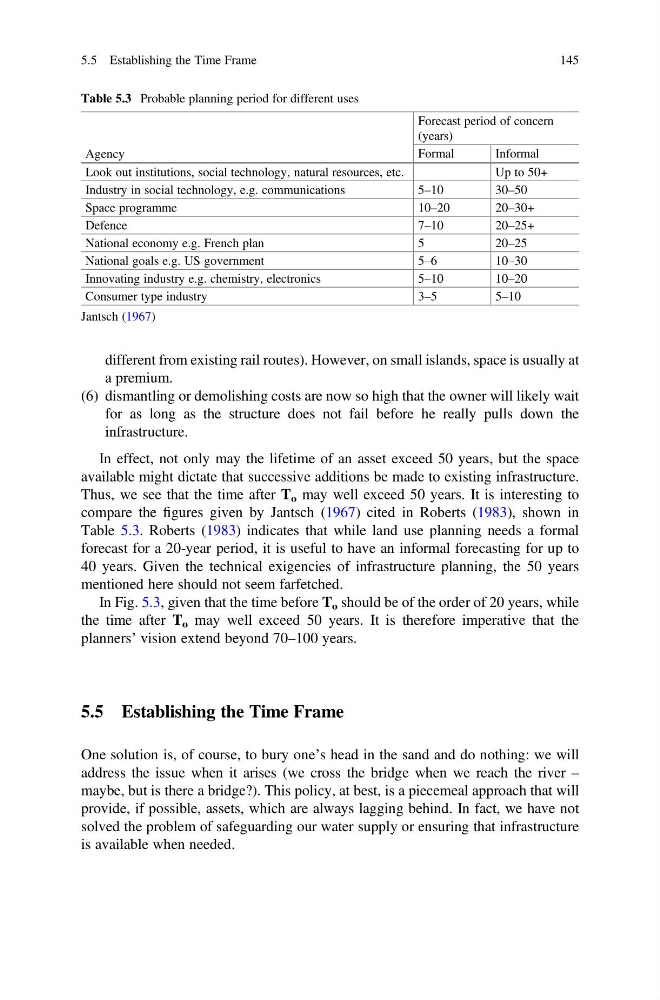
compare the figures given by Jantsch (1967) cited in Roberts (1983), shown in
Table 5.3. Roberts (1983) indicates that while land use planning needs a formal
forecast for a 20-year period, it is useful to have an informal forecasting for up to
40 years. Given the technical exigencies of infrastructure planning, the 50 years
mentioned here should not seem farfetched.
In Fig. 5.3, given that the time before T o should be of the order of 20 years, while
the time after T o may well exceed 50 years. It is therefore imperative that the
planners’ vision extend beyond 70–100 years.
5.5 Establishing the Time Frame
One solution is, of course, to bury one’s head in the sand and do nothing: we will
address the issue when it arises (we cross the bridge when we reach the river –
maybe, but is there a bridge?). This policy, at best, is a piecemeal approach that will
provide, if possible, assets, which are always lagging behind. In fact, we have not
solved the problem of safeguarding our water supply or ensuring that infrastructure
is available when needed.
Table 5.3 Probable planning period for different uses
Agency
Forecast period of concern
(years)
Formal
Informal
Look out institutions, social technology, natural resources, etc.
Up to 50+
Industry in social technology, e.g. communications
5–10
30–50
Space programme
10–20
20–30+
Defence
7–10
20–25+
National economy e.g. French plan
5
20–25
National goals e.g. US government
5–6
1 0 –30
Innovating industry e.g. chemistry, electronics
5–10
10–20
Consumer type industry
3–5
5 –10
Jantsch (1967)
5.5 Establishing the Time Frame
145
a premium.
(6) dismantling or demolishing costs are now so high that the owner will likely wait
for as long as the structure does not fail before he really pulls down the
infrastructure.
In effect, not only may the lifetime of an asset exceed 50 years, but the space
available might dictate that successive additions be made to existing infrastructure.
Thus, we see that the time after T o may well exceed 50 years. It is interesting to
compare the figures given by Jantsch (1967) cited in Roberts (1983), shown in
Table 5.3. Roberts (1983) indicates that while land use planning needs a formal
forecast for a 20-year period, it is useful to have an informal forecasting for up to
40 years. Given the technical exigencies of infrastructure planning, the 50 years
mentioned here should not seem farfetched.
In Fig. 5.3, given that the time before T o should be of the order of 20 years, while
the time after T o may well exceed 50 years. It is therefore imperative that the
planners’ vision extend beyond 70–100 years.
5.5 Establishing the Time Frame
One solution is, of course, to bury one’s head in the sand and do nothing: we will
address the issue when it arises (we cross the bridge when we reach the river –
maybe, but is there a bridge?). This policy, at best, is a piecemeal approach that will
provide, if possible, assets, which are always lagging behind. In fact, we have not
solved the problem of safeguarding our water supply or ensuring that infrastructure
is available when needed.
Table 5.3 Probable planning period for different uses
Agency
Forecast period of concern
(years)
Formal
Informal
Look out institutions, social technology, natural resources, etc.
Up to 50+
Industry in social technology, e.g. communications
5–10
30–50
Space programme
10–20
20–30+
Defence
7–10
20–25+
National economy e.g. French plan
5
20–25
National goals e.g. US government
5–6
1 0 –30
Innovating industry e.g. chemistry, electronics
5–10
10–20
Consumer type industry
3–5
5 –10
Jantsch (1967)
5.5 Establishing the Time Frame
145