

This is precisely one of the biggest challenges of planning which is, too often,
classified in the “too difficult” box. As a result, only short term solutions are
examined.
However, if one wants to handle sustainable development seriously, it is important to address the principle of intergenerational equity, namely to plan for the long
term, where future generations will inherit infrastructure that they use comfortably,
rather than be confronted with everyday inadequate provision of facilities. In short, a
sustainable nuisance!
As mentioned earlier, it is difficult to foresee future technology and, thus, future
requirements. However, the forecasting exercise raises useful questions if the future
of the country needs to be addressed. This approach would, as indicated earlier,
result in an assessment of the water resources potential and future water demand
culminating in a Master Plan for Water resources for the country, and identifying the
gaps, where a delay in project implementation would result in a poor distribution to
the population.
Having seen the example of water, it should be easy to switch to infrastructure,
generally. The time taken to assess requirements, conceive a project and actual
implementation will require a timeframe in the neighbourhood of 20 years.
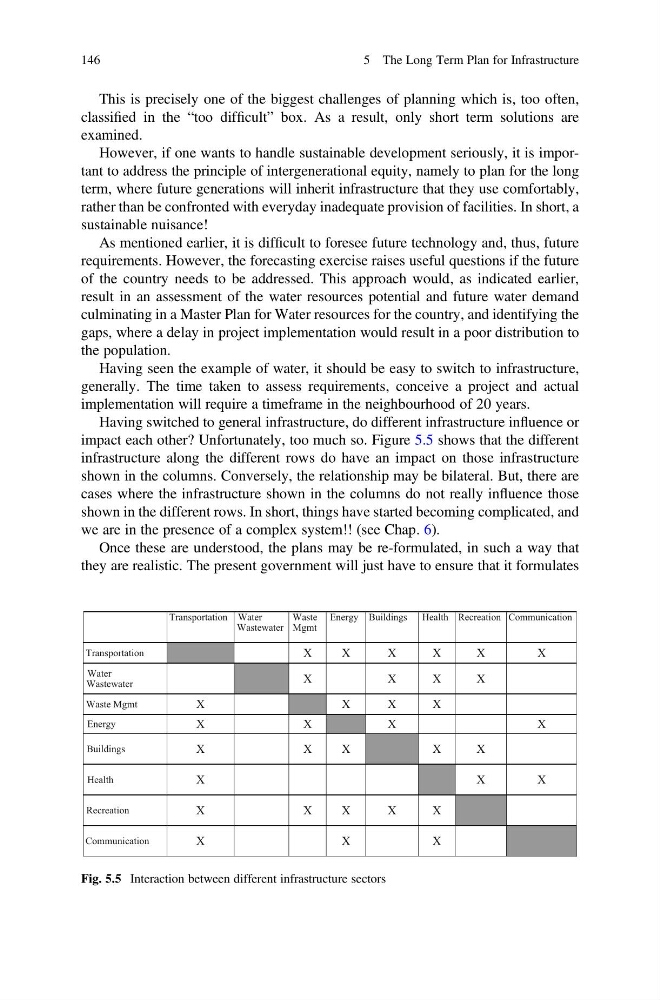
Having switched to general infrastructure, do different infrastructure influence or
impact each other? Unfortunately, too much so. Figure 5.5 shows that the different
infrastructure along the different rows do have an impact on those infrastructure
shown in the columns. Conversely, the relationship may be bilateral. But, there are
cases where the infrastructure shown in the columns do not really influence those
shown in the different rows. In short, things have started becoming complicated, and
we are in the presence of a complex system!! (see Chap. 6).
Once these are understood, the plans may be re-formulated, in such a way that
they are realistic. The present government will just have to ensure that it formulates
Transportation Water
Wastewater
Waste
Mgmt
Energy Buildings
Health Recreation Communication
Transportation
X
X
X
X
X
X
Water
Wastewater
X
X
X
X
Waste Mgmt
X
X
X
X
Energy
X
X
X
X
Buildings
X
X
X
X
X
Health
X
X
X
Recreation
X
X
X
X
X
Communication
X
X
X
Fig. 5.5 Interaction between different infrastructure sectors
146
5 The Long Term Plan for Infrastructure
classified in the “too difficult” box. As a result, only short term solutions are
examined.
However, if one wants to handle sustainable development seriously, it is important to address the principle of intergenerational equity, namely to plan for the long
term, where future generations will inherit infrastructure that they use comfortably,
rather than be confronted with everyday inadequate provision of facilities. In short, a
sustainable nuisance!
As mentioned earlier, it is difficult to foresee future technology and, thus, future
requirements. However, the forecasting exercise raises useful questions if the future
of the country needs to be addressed. This approach would, as indicated earlier,
result in an assessment of the water resources potential and future water demand
culminating in a Master Plan for Water resources for the country, and identifying the
gaps, where a delay in project implementation would result in a poor distribution to
the population.
Having seen the example of water, it should be easy to switch to infrastructure,
generally. The time taken to assess requirements, conceive a project and actual
implementation will require a timeframe in the neighbourhood of 20 years.
Having switched to general infrastructure, do different infrastructure influence or
impact each other? Unfortunately, too much so. Figure 5.5 shows that the different
infrastructure along the different rows do have an impact on those infrastructure
shown in the columns. Conversely, the relationship may be bilateral. But, there are
cases where the infrastructure shown in the columns do not really influence those
shown in the different rows. In short, things have started becoming complicated, and
we are in the presence of a complex system!! (see Chap. 6).
Once these are understood, the plans may be re-formulated, in such a way that
they are realistic. The present government will just have to ensure that it formulates
Transportation Water
Wastewater
Waste
Mgmt
Energy Buildings
Health Recreation Communication
Transportation
X
X
X
X
X
X
Water
Wastewater
X
X
X
X
Waste Mgmt
X
X
X
X
Energy
X
X
X
X
Buildings
X
X
X
X
X
Health
X
X
X
Recreation
X
X
X
X
X
Communication
X
X
X
Fig. 5.5 Interaction between different infrastructure sectors
146
5 The Long Term Plan for Infrastructure