

(6) Although embarrassing companies might be useful, praising those companies
or suppliers who are adopting the right policies will encourage the others to
follow suit.
(7) To be effective, customer actions must be directed to the important supply
chain intermediaries who can most influence the producer or supplier.
(8) Important people in companies are often influenced by their immediate contacts
or relatives, who may also be targeted towards action.
(9) There are sometimes strong religious reasons to support good environmental
practices.
(10) Investing time and effort to improve one’s own local environment.
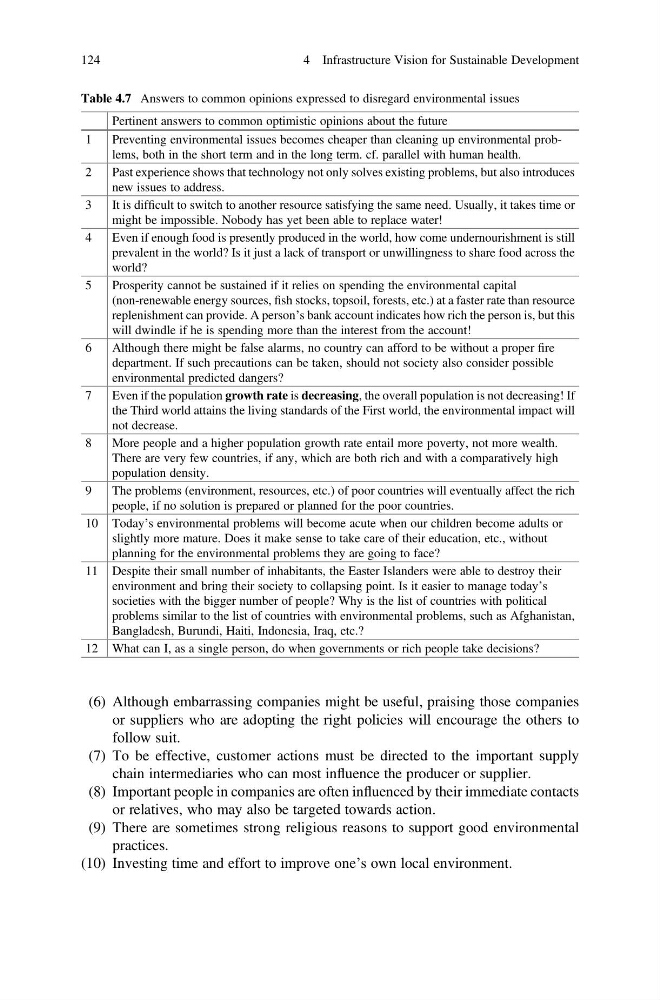
Table 4.7 Answers to common opinions expressed to disregard environmental issues
Pertinent answers to common optimistic opinions about the future
1
Preventing environmental issues becomes cheaper than cleaning up environmental problems, both in the short term and in the long term. cf. parallel with human health.
2
Past experience shows that technology not only solves existing problems, but also introduces
new issues to address.
3
It is difficult to switch to another resource satisfying the same need. Usually, it takes time or
might be impossible. Nobody has yet been able to replace water!
4
Even if enough food is presently produced in the world, how come undernourishment is still
prevalent in the world? Is it just a lack of transport or unwillingness to share food across the
world?
5
Prosperity cannot be sustained if it relies on spending the environmental capital
(non-renewable energy sources, fish stocks, topsoil, forests, etc.) at a faster rate than resource
replenishment can provide. A person’s bank account indicates how rich the person is, but this
will dwindle if he is spending more than the interest from the account!
6
Although there might be false alarms, no country can afford to be without a proper fire
department. If such precautions can be taken, should not society also consider possible
environmental predicted dangers?
7
Even if the population growth rate is decreasing, the overall population is not decreasing! If
the Third world attains the living standards of the First world, the environmental impact will
not decrease.
8
More people and a higher population growth rate entail more poverty, not more wealth.
There are very few countries, if any, which are both rich and with a comparatively high
population density.
9
The problems (environment, resources, etc.) of poor countries will eventually affect the rich
people, if no solution is prepared or planned for the poor countries.
10 Today’s environmental problems will become acute when our children become adults or
slightly more mature. Does it make sense to take care of their education, etc., without
planning for the environmental problems they are going to face?
11 Despite their small number of inhabitants, the Easter Islanders were able to destroy their
environment and bring their society to collapsing point. Is it easier to manage today’s
societies with the bigger number of people? Why is the list of countries with political
problems similar to the list of countries with environmental problems, such as Afghanistan,
Bangladesh, Burundi, Haiti, Indonesia, Iraq, etc.?
12 What can I, as a single person, do when governments or rich people take decisions?
124
4 Infrastructure Vision for Sustainable Development
or suppliers who are adopting the right policies will encourage the others to
follow suit.
(7) To be effective, customer actions must be directed to the important supply
chain intermediaries who can most influence the producer or supplier.
(8) Important people in companies are often influenced by their immediate contacts
or relatives, who may also be targeted towards action.
(9) There are sometimes strong religious reasons to support good environmental
practices.
(10) Investing time and effort to improve one’s own local environment.
Table 4.7 Answers to common opinions expressed to disregard environmental issues
Pertinent answers to common optimistic opinions about the future
1
Preventing environmental issues becomes cheaper than cleaning up environmental problems, both in the short term and in the long term. cf. parallel with human health.
2
Past experience shows that technology not only solves existing problems, but also introduces
new issues to address.
3
It is difficult to switch to another resource satisfying the same need. Usually, it takes time or
might be impossible. Nobody has yet been able to replace water!
4
Even if enough food is presently produced in the world, how come undernourishment is still
prevalent in the world? Is it just a lack of transport or unwillingness to share food across the
world?
5
Prosperity cannot be sustained if it relies on spending the environmental capital
(non-renewable energy sources, fish stocks, topsoil, forests, etc.) at a faster rate than resource
replenishment can provide. A person’s bank account indicates how rich the person is, but this
will dwindle if he is spending more than the interest from the account!
6
Although there might be false alarms, no country can afford to be without a proper fire
department. If such precautions can be taken, should not society also consider possible
environmental predicted dangers?
7
Even if the population growth rate is decreasing, the overall population is not decreasing! If
the Third world attains the living standards of the First world, the environmental impact will
not decrease.
8
More people and a higher population growth rate entail more poverty, not more wealth.
There are very few countries, if any, which are both rich and with a comparatively high
population density.
9
The problems (environment, resources, etc.) of poor countries will eventually affect the rich
people, if no solution is prepared or planned for the poor countries.
10 Today’s environmental problems will become acute when our children become adults or
slightly more mature. Does it make sense to take care of their education, etc., without
planning for the environmental problems they are going to face?
11 Despite their small number of inhabitants, the Easter Islanders were able to destroy their
environment and bring their society to collapsing point. Is it easier to manage today’s
societies with the bigger number of people? Why is the list of countries with political
problems similar to the list of countries with environmental problems, such as Afghanistan,
Bangladesh, Burundi, Haiti, Indonesia, Iraq, etc.?
12 What can I, as a single person, do when governments or rich people take decisions?
124
4 Infrastructure Vision for Sustainable Development