

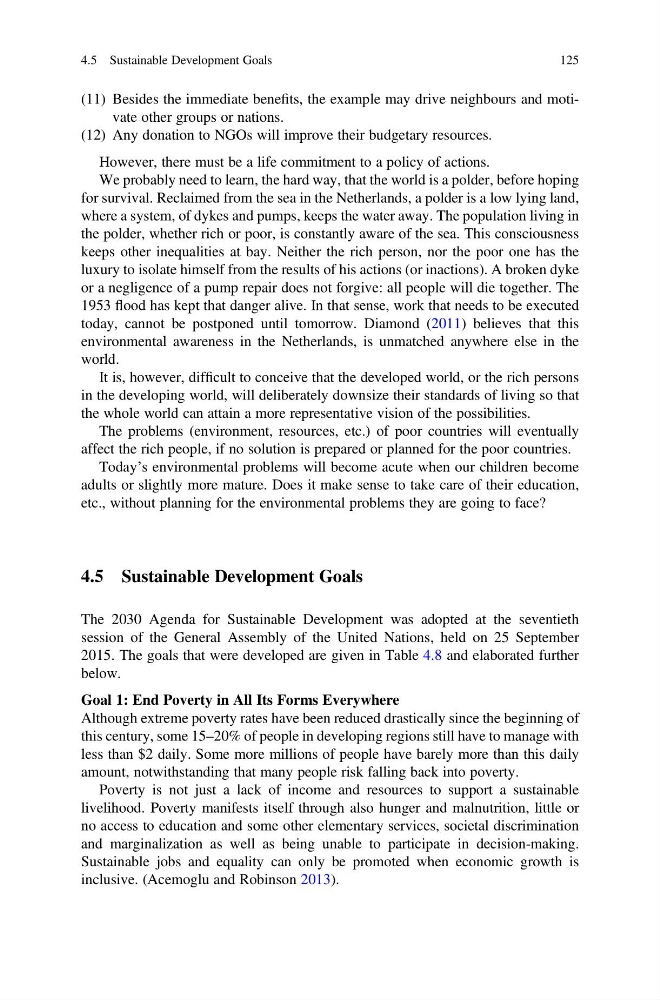
(11) Besides the immediate benefits, the example may drive neighbours and motivate other groups or nations.
(12) Any donation to NGOs will improve their budgetary resources.
However, there must be a life commitment to a policy of actions.
We probably need to learn, the hard way, that the world is a polder, before hoping
for survival. Reclaimed from the sea in the Netherlands, a polder is a low lying land,
where a system, of dykes and pumps, keeps the water away. The population living in
the polder, whether rich or poor, is constantly aware of the sea. This consciousness
keeps other inequalities at bay. Neither the rich person, nor the poor one has the
luxury to isolate himself from the results of his actions (or inactions). A broken dyke
or a negligence of a pump repair does not forgive: all people will die together. The
1953 flood has kept that danger alive. In that sense, work that needs to be executed
today, cannot be postponed until tomorrow. Diamond (2011) believes that this
environmental awareness in the Netherlands, is unmatched anywhere else in the
world.
It is, however, difficult to conceive that the developed world, or the rich persons
in the developing world, will deliberately downsize their standards of living so that
the whole world can attain a more representative vision of the possibilities.
The problems (environment, resources, etc.) of poor countries will eventually
affect the rich people, if no solution is prepared or planned for the poor countries.
Today’s environmental problems will become acute when our children become
adults or slightly more mature. Does it make sense to take care of their education,
etc., without planning for the environmental problems they are going to face?
4.5 Sustainable Development Goals
The 2030 Agenda for Sustainable Development was adopted at the seventieth
session of the General Assembly of the United Nations, held on 25 September
2015. The goals that were developed are given in Table 4.8 and elaborated further
below.
Goal 1: End Poverty in All Its Forms Everywhere
Although extreme poverty rates have been reduced drastically since the beginning of
this century, some 15–20% of people in developing regions still have to manage with
less than $2 daily. Some more millions of people have barely more than this daily
amount, notwithstanding that many people risk falling back into poverty.
Poverty is not just a lack of income and resources to support a sustainable
livelihood. Poverty manifests itself through also hunger and malnutrition, little or
no access to education and some other elementary services, societal discrimination
and marginalization as well as being unable to participate in decision-making.
Sustainable jobs and equality can only be promoted when economic growth is
inclusive. (Acemoglu and Robinson 2013).
4.5 Sustainable Development Goals
125
(12) Any donation to NGOs will improve their budgetary resources.
However, there must be a life commitment to a policy of actions.
We probably need to learn, the hard way, that the world is a polder, before hoping
for survival. Reclaimed from the sea in the Netherlands, a polder is a low lying land,
where a system, of dykes and pumps, keeps the water away. The population living in
the polder, whether rich or poor, is constantly aware of the sea. This consciousness
keeps other inequalities at bay. Neither the rich person, nor the poor one has the
luxury to isolate himself from the results of his actions (or inactions). A broken dyke
or a negligence of a pump repair does not forgive: all people will die together. The
1953 flood has kept that danger alive. In that sense, work that needs to be executed
today, cannot be postponed until tomorrow. Diamond (2011) believes that this
environmental awareness in the Netherlands, is unmatched anywhere else in the
world.
It is, however, difficult to conceive that the developed world, or the rich persons
in the developing world, will deliberately downsize their standards of living so that
the whole world can attain a more representative vision of the possibilities.
The problems (environment, resources, etc.) of poor countries will eventually
affect the rich people, if no solution is prepared or planned for the poor countries.
Today’s environmental problems will become acute when our children become
adults or slightly more mature. Does it make sense to take care of their education,
etc., without planning for the environmental problems they are going to face?
4.5 Sustainable Development Goals
The 2030 Agenda for Sustainable Development was adopted at the seventieth
session of the General Assembly of the United Nations, held on 25 September
2015. The goals that were developed are given in Table 4.8 and elaborated further
below.
Goal 1: End Poverty in All Its Forms Everywhere
Although extreme poverty rates have been reduced drastically since the beginning of
this century, some 15–20% of people in developing regions still have to manage with
less than $2 daily. Some more millions of people have barely more than this daily
amount, notwithstanding that many people risk falling back into poverty.
Poverty is not just a lack of income and resources to support a sustainable
livelihood. Poverty manifests itself through also hunger and malnutrition, little or
no access to education and some other elementary services, societal discrimination
and marginalization as well as being unable to participate in decision-making.
Sustainable jobs and equality can only be promoted when economic growth is
inclusive. (Acemoglu and Robinson 2013).
4.5 Sustainable Development Goals
125