

3 Solar Cells: Basics
55
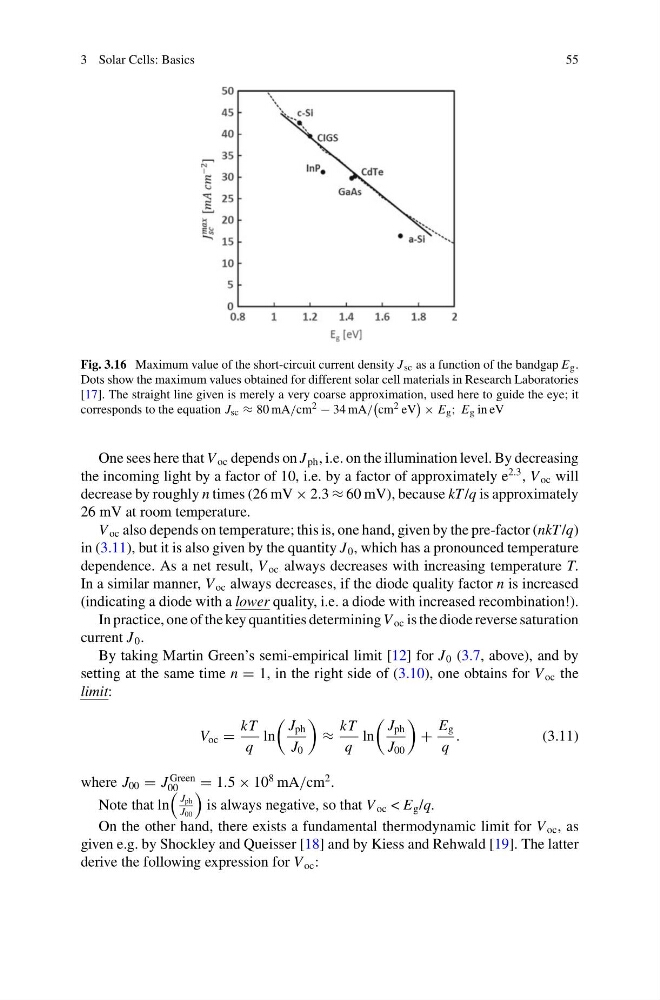
Fig. 3.16 Maximum value of the short-circuit current density J sc as a function of the bandgap E g .
Dots show the maximum values obtained for different solar cell materials in Research Laboratories
[17]. The straight line given is merely a very coarse approximation, used here to guide the eye; it
corresponds to the equation J sc ≈ 80 mA/cm 2 − 34 mA/
cm 2 eV
× E g ; E g in eV
One sees here that V oc depends on J ph , i.e. on the illumination level. By decreasing
the incoming light by a factor of 10, i.e. by a factor of approximately e
2.3 , V oc will
decrease by roughly n times (26 mV × 2.3 ≈ 60 mV), because kT /q is approximately
26 mV at room temperature.
V oc also depends on temperature; this is, one hand, given by the pre-factor (nkT /q)
in (3.11), but it is also given by the quantity J 0 , which has a pronounced temperature
dependence. As a net result, V oc always decreases with increasing temperature T.
In a similar manner, V oc always decreases, if the diode quality factor n is increased
(indicating a diode with a lower quality, i.e. a diode with increased recombination!).
In practice, one of the key quantities determining V oc is the diode reverse saturation
current J 0 .
By taking Martin Green’s semi-empirical limit [12] for J 0 (3.7, above), and by
setting at the same time n = 1, in the right side of (3.10), one obtains for V oc the
limit:
V oc =
kT
q
ln
J ph
J 0
≈
kT
q
ln
J ph
J 00
+
E g
q
.
(3.11)
where J 00 = J
Green
00
= 1.5 × 10
8 mA/cm
2 .
Note that ln
J ph
J 00
is always negative, so that V oc < E g /q.
On the other hand, there exists a fundamental thermodynamic limit for V oc , as
given e.g. by Shockley and Queisser [18] and by Kiess and Rehwald [19]. The latter
derive the following expression for V oc :
55
Fig. 3.16 Maximum value of the short-circuit current density J sc as a function of the bandgap E g .
Dots show the maximum values obtained for different solar cell materials in Research Laboratories
[17]. The straight line given is merely a very coarse approximation, used here to guide the eye; it
corresponds to the equation J sc ≈ 80 mA/cm 2 − 34 mA/
cm 2 eV
× E g ; E g in eV
One sees here that V oc depends on J ph , i.e. on the illumination level. By decreasing
the incoming light by a factor of 10, i.e. by a factor of approximately e
2.3 , V oc will
decrease by roughly n times (26 mV × 2.3 ≈ 60 mV), because kT /q is approximately
26 mV at room temperature.
V oc also depends on temperature; this is, one hand, given by the pre-factor (nkT /q)
in (3.11), but it is also given by the quantity J 0 , which has a pronounced temperature
dependence. As a net result, V oc always decreases with increasing temperature T.
In a similar manner, V oc always decreases, if the diode quality factor n is increased
(indicating a diode with a lower quality, i.e. a diode with increased recombination!).
In practice, one of the key quantities determining V oc is the diode reverse saturation
current J 0 .
By taking Martin Green’s semi-empirical limit [12] for J 0 (3.7, above), and by
setting at the same time n = 1, in the right side of (3.10), one obtains for V oc the
limit:
V oc =
kT
q
ln
J ph
J 0
≈
kT
q
ln
J ph
J 00
+
E g
q
.
(3.11)
where J 00 = J
Green
00
= 1.5 × 10
8 mA/cm
2 .
Note that ln
J ph
J 00
is always negative, so that V oc < E g /q.
On the other hand, there exists a fundamental thermodynamic limit for V oc , as
given e.g. by Shockley and Queisser [18] and by Kiess and Rehwald [19]. The latter
derive the following expression for V oc :