

56
A. Shah
V oc = E g /q + (kT /q) ln
h
3 c
2
/2π kT
N incident /E
2
g
,
(3.12)
where h is Planck’s constant, c the speed of light and N incident the number of photons
incident per unit area and second with energies hν > E g . N incident corresponds to our
quantity φ (see Sect. 3.2.4 and (3.1)). Note that Meillaud-Sculati has shown in her
Ph.D. thesis [20] that the Shockley-Queisser approach [18] and the Kiess-Rehwald
approach [19] are equivalent.
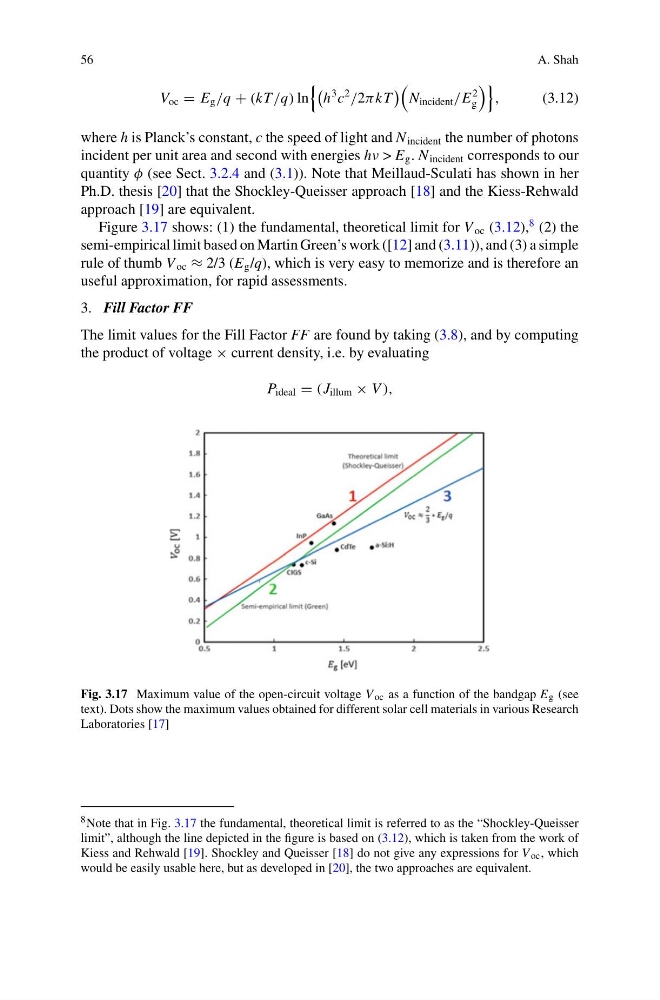
Figure 3.17 shows: (1) the fundamental, theoretical limit for V oc (3.12),
8 (2) the
semi-empirical limit based on Martin Green’s work ([12] and (3.11)), and (3) a simple
rule of thumb V oc ≈ 2/3 (E g /q), which is very easy to memorize and is therefore an
useful approximation, for rapid assessments.
3. Fill Factor FF
The limit values for the Fill Factor FF are found by taking (3.8), and by computing
the product of voltage × current density, i.e. by evaluating
P ideal = (J illum × V ),
Fig. 3.17 Maximum value of the open-circuit voltage V oc as a function of the bandgap E g (see
text). Dots show the maximum values obtained for different solar cell materials in various Research
Laboratories [17]
8 Note that in Fig. 3.17 the fundamental, theoretical limit is referred to as the “Shockley-Queisser
limit”, although the line depicted in the figure is based on (3.12), which is taken from the work of
Kiess and Rehwald [19]. Shockley and Queisser [18] do not give any expressions for V oc , which
would be easily usable here, but as developed in [20], the two approaches are equivalent.
A. Shah
V oc = E g /q + (kT /q) ln
h
3 c
2
/2π kT
N incident /E
2
g
,
(3.12)
where h is Planck’s constant, c the speed of light and N incident the number of photons
incident per unit area and second with energies hν > E g . N incident corresponds to our
quantity φ (see Sect. 3.2.4 and (3.1)). Note that Meillaud-Sculati has shown in her
Ph.D. thesis [20] that the Shockley-Queisser approach [18] and the Kiess-Rehwald
approach [19] are equivalent.
Figure 3.17 shows: (1) the fundamental, theoretical limit for V oc (3.12),
8 (2) the
semi-empirical limit based on Martin Green’s work ([12] and (3.11)), and (3) a simple
rule of thumb V oc ≈ 2/3 (E g /q), which is very easy to memorize and is therefore an
useful approximation, for rapid assessments.
3. Fill Factor FF
The limit values for the Fill Factor FF are found by taking (3.8), and by computing
the product of voltage × current density, i.e. by evaluating
P ideal = (J illum × V ),
Fig. 3.17 Maximum value of the open-circuit voltage V oc as a function of the bandgap E g (see
text). Dots show the maximum values obtained for different solar cell materials in various Research
Laboratories [17]
8 Note that in Fig. 3.17 the fundamental, theoretical limit is referred to as the “Shockley-Queisser
limit”, although the line depicted in the figure is based on (3.12), which is taken from the work of
Kiess and Rehwald [19]. Shockley and Queisser [18] do not give any expressions for V oc , which
would be easily usable here, but as developed in [20], the two approaches are equivalent.