

3 Solar Cells: Basics
49
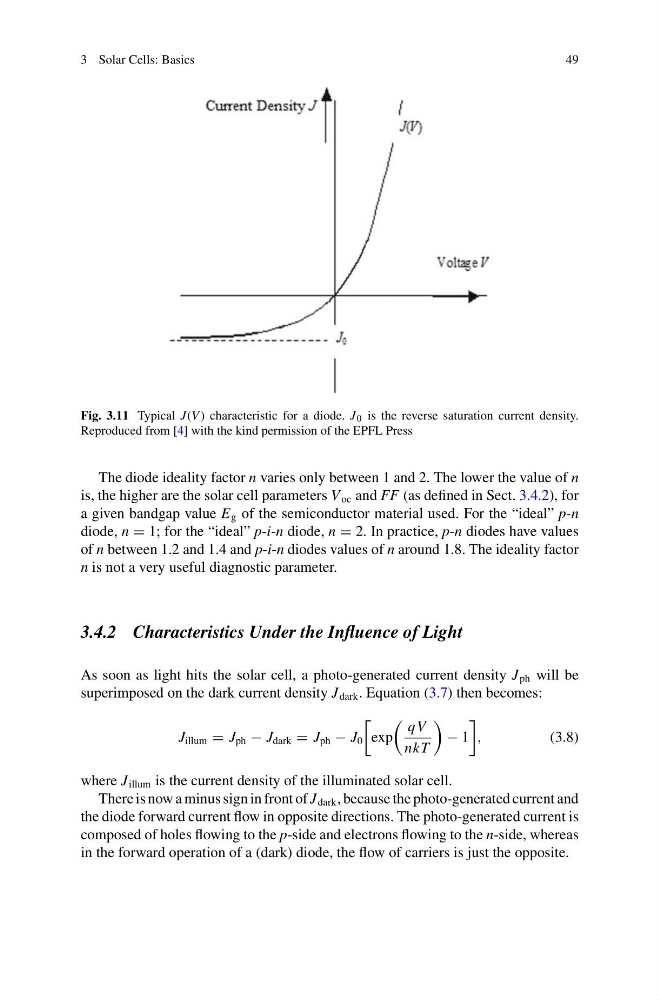
Fig. 3.11 Typical J(V ) characteristic for a diode. J 0 is the reverse saturation current density.
Reproduced from [4] with the kind permission of the EPFL Press
The diode ideality factor n varies only between 1 and 2. The lower the value of n
is, the higher are the solar cell parameters V oc and FF (as defined in Sect. 3.4.2), for
a given bandgap value E g of the semiconductor material used. For the “ideal” p-n
diode, n = 1; for the “ideal” p-i-n diode, n = 2. In practice, p-n diodes have values
of n between 1.2 and 1.4 and p-i-n diodes values of n around 1.8. The ideality factor
n is not a very useful diagnostic parameter.
3.4.2 Characteristics Under the Influence of Light
As soon as light hits the solar cell, a photo-generated current density J ph will be
superimposed on the dark current density J dark . Equation (3.7) then becomes:
J illum = J ph − J dark = J ph − J 0
exp
qV
nkT
− 1
,
(3.8)
where J illum is the current density of the illuminated solar cell.
There is now a minus sign in front of J dark , because the photo-generated current and
the diode forward current flow in opposite directions. The photo-generated current is
composed of holes flowing to the p-side and electrons flowing to the n-side, whereas
in the forward operation of a (dark) diode, the flow of carriers is just the opposite.
49
Fig. 3.11 Typical J(V ) characteristic for a diode. J 0 is the reverse saturation current density.
Reproduced from [4] with the kind permission of the EPFL Press
The diode ideality factor n varies only between 1 and 2. The lower the value of n
is, the higher are the solar cell parameters V oc and FF (as defined in Sect. 3.4.2), for
a given bandgap value E g of the semiconductor material used. For the “ideal” p-n
diode, n = 1; for the “ideal” p-i-n diode, n = 2. In practice, p-n diodes have values
of n between 1.2 and 1.4 and p-i-n diodes values of n around 1.8. The ideality factor
n is not a very useful diagnostic parameter.
3.4.2 Characteristics Under the Influence of Light
As soon as light hits the solar cell, a photo-generated current density J ph will be
superimposed on the dark current density J dark . Equation (3.7) then becomes:
J illum = J ph − J dark = J ph − J 0
exp
qV
nkT
− 1
,
(3.8)
where J illum is the current density of the illuminated solar cell.
There is now a minus sign in front of J dark , because the photo-generated current and
the diode forward current flow in opposite directions. The photo-generated current is
composed of holes flowing to the p-side and electrons flowing to the n-side, whereas
in the forward operation of a (dark) diode, the flow of carriers is just the opposite.