

48
A. Shah
the dark (without illumination), and thereafter see how this behaviour is modified,
when the diode is illuminated.
3.4.1 Dark Characteristics
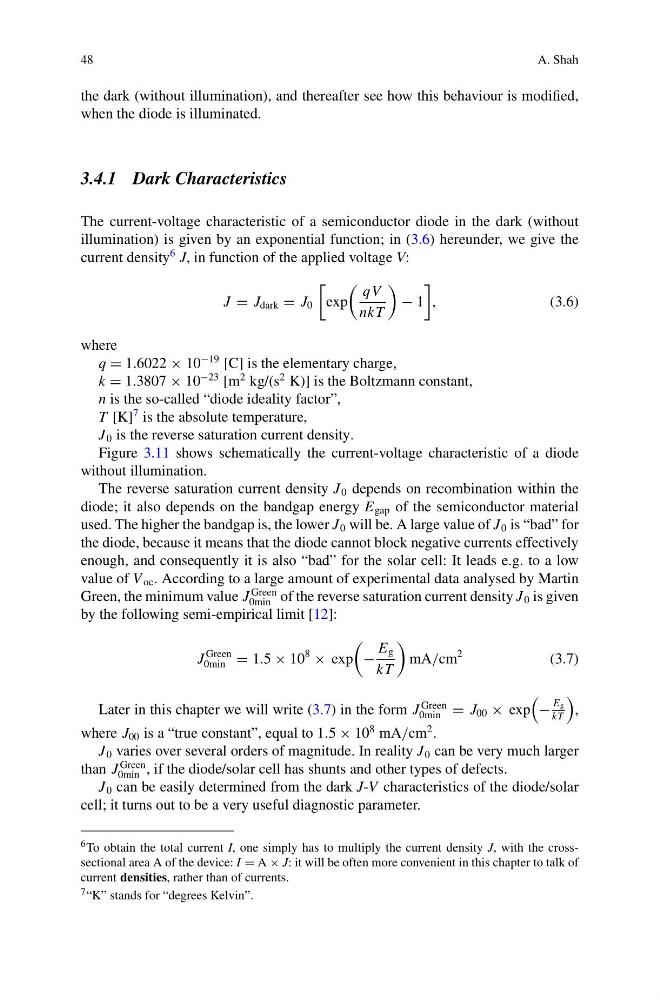
The current-voltage characteristic of a semiconductor diode in the dark (without
illumination) is given by an exponential function; in (3.6) hereunder, we give the
current density
6 J, in function of the applied voltage V:
J = J dark = J 0
exp
qV
nkT
− 1
,
(3.6)
where
q = 1.6022 × 10
−19 [C] is the elementary charge,
k = 1.3807 × 10
−23 [m
2 kg/(s
2 K)] is the Boltzmann constant,
n is the so-called “diode ideality factor”,
T [K]
7 is the absolute temperature,
J 0 is the reverse saturation current density.
Figure 3.11 shows schematically the current-voltage characteristic of a diode
without illumination.
The reverse saturation current density J 0 depends on recombination within the
diode; it also depends on the bandgap energy E gap of the semiconductor material
used. The higher the bandgap is, the lower J 0 will be. A large value of J 0 is “bad” for
the diode, because it means that the diode cannot block negative currents effectively
enough, and consequently it is also “bad” for the solar cell: It leads e.g. to a low
value of V oc . According to a large amount of experimental data analysed by Martin
Green, the minimum value J
Green
0min of the reverse saturation current density J 0 is given
by the following semi-empirical limit [12]:
J
Green
0min = 1.5 × 10
8
× exp
−
E g
kT
mA/cm
2
(3.7)
Later in this chapter we will write (3.7) in the form J
Green
0min = J 00 × exp
−
E g
kT
,
where J 00 is a “true constant”, equal to 1.5 × 10
8 mA/cm
2 .
J 0 varies over several orders of magnitude. In reality J 0 can be very much larger
than J
Green
0min , if the diode/solar cell has shunts and other types of defects.
J 0 can be easily determined from the dark J-V characteristics of the diode/solar
cell; it turns out to be a very useful diagnostic parameter.
6 To obtain the total current I, one simply has to multiply the current density J, with the crosssectional area A of the device: I = A × J: it will be often more convenient in this chapter to talk of
current densities, rather than of currents.
7 “K” stands for “degrees Kelvin”.
A. Shah
the dark (without illumination), and thereafter see how this behaviour is modified,
when the diode is illuminated.
3.4.1 Dark Characteristics
The current-voltage characteristic of a semiconductor diode in the dark (without
illumination) is given by an exponential function; in (3.6) hereunder, we give the
current density
6 J, in function of the applied voltage V:
J = J dark = J 0
exp
qV
nkT
− 1
,
(3.6)
where
q = 1.6022 × 10
−19 [C] is the elementary charge,
k = 1.3807 × 10
−23 [m
2 kg/(s
2 K)] is the Boltzmann constant,
n is the so-called “diode ideality factor”,
T [K]
7 is the absolute temperature,
J 0 is the reverse saturation current density.
Figure 3.11 shows schematically the current-voltage characteristic of a diode
without illumination.
The reverse saturation current density J 0 depends on recombination within the
diode; it also depends on the bandgap energy E gap of the semiconductor material
used. The higher the bandgap is, the lower J 0 will be. A large value of J 0 is “bad” for
the diode, because it means that the diode cannot block negative currents effectively
enough, and consequently it is also “bad” for the solar cell: It leads e.g. to a low
value of V oc . According to a large amount of experimental data analysed by Martin
Green, the minimum value J
Green
0min of the reverse saturation current density J 0 is given
by the following semi-empirical limit [12]:
J
Green
0min = 1.5 × 10
8
× exp
−
E g
kT
mA/cm
2
(3.7)
Later in this chapter we will write (3.7) in the form J
Green
0min = J 00 × exp
−
E g
kT
,
where J 00 is a “true constant”, equal to 1.5 × 10
8 mA/cm
2 .
J 0 varies over several orders of magnitude. In reality J 0 can be very much larger
than J
Green
0min , if the diode/solar cell has shunts and other types of defects.
J 0 can be easily determined from the dark J-V characteristics of the diode/solar
cell; it turns out to be a very useful diagnostic parameter.
6 To obtain the total current I, one simply has to multiply the current density J, with the crosssectional area A of the device: I = A × J: it will be often more convenient in this chapter to talk of
current densities, rather than of currents.
7 “K” stands for “degrees Kelvin”.