

50
A. Shah
V
J(V)
dark
illuminated
V
sc
J
m
J
J ph
m
oc
V
active
quadrant
MPP
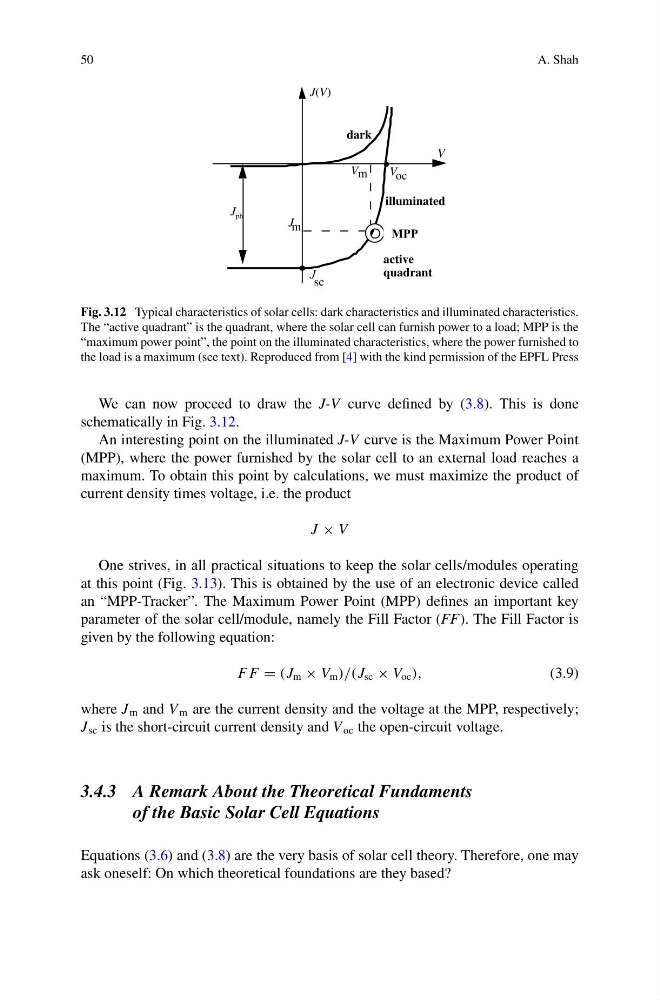
Fig. 3.12 Typical characteristics of solar cells: dark characteristics and illuminated characteristics.
The “active quadrant” is the quadrant, where the solar cell can furnish power to a load; MPP is the
“maximum power point”, the point on the illuminated characteristics, where the power furnished to
the load is a maximum (see text). Reproduced from [4] with the kind permission of the EPFL Press
We can now proceed to draw the J-V curve defined by (3.8). This is done
schematically in Fig. 3.12.
An interesting point on the illuminated J-V curve is the Maximum Power Point
(MPP), where the power furnished by the solar cell to an external load reaches a
maximum. To obtain this point by calculations, we must maximize the product of
current density times voltage, i.e. the product
J × V
One strives, in all practical situations to keep the solar cells/modules operating
at this point (Fig. 3.13). This is obtained by the use of an electronic device called
an “MPP-Tracker”. The Maximum Power Point (MPP) defines an important key
parameter of the solar cell/module, namely the Fill Factor (FF). The Fill Factor is
given by the following equation:
F F = (J m × V m )/(J sc × V oc ),
(3.9)
where J m and V m are the current density and the voltage at the MPP, respectively;
J sc is the short-circuit current density and V oc the open-circuit voltage.
3.4.3 A Remark About the Theoretical Fundaments
of the Basic Solar Cell Equations
Equations (3.6) and (3.8) are the very basis of solar cell theory. Therefore, one may
ask oneself: On which theoretical foundations are they based?
A. Shah
V
J(V)
dark
illuminated
V
sc
J
m
J
J ph
m
oc
V
active
quadrant
MPP
Fig. 3.12 Typical characteristics of solar cells: dark characteristics and illuminated characteristics.
The “active quadrant” is the quadrant, where the solar cell can furnish power to a load; MPP is the
“maximum power point”, the point on the illuminated characteristics, where the power furnished to
the load is a maximum (see text). Reproduced from [4] with the kind permission of the EPFL Press
We can now proceed to draw the J-V curve defined by (3.8). This is done
schematically in Fig. 3.12.
An interesting point on the illuminated J-V curve is the Maximum Power Point
(MPP), where the power furnished by the solar cell to an external load reaches a
maximum. To obtain this point by calculations, we must maximize the product of
current density times voltage, i.e. the product
J × V
One strives, in all practical situations to keep the solar cells/modules operating
at this point (Fig. 3.13). This is obtained by the use of an electronic device called
an “MPP-Tracker”. The Maximum Power Point (MPP) defines an important key
parameter of the solar cell/module, namely the Fill Factor (FF). The Fill Factor is
given by the following equation:
F F = (J m × V m )/(J sc × V oc ),
(3.9)
where J m and V m are the current density and the voltage at the MPP, respectively;
J sc is the short-circuit current density and V oc the open-circuit voltage.
3.4.3 A Remark About the Theoretical Fundaments
of the Basic Solar Cell Equations
Equations (3.6) and (3.8) are the very basis of solar cell theory. Therefore, one may
ask oneself: On which theoretical foundations are they based?