

13 Photovoltaics in the Future Energy System
325
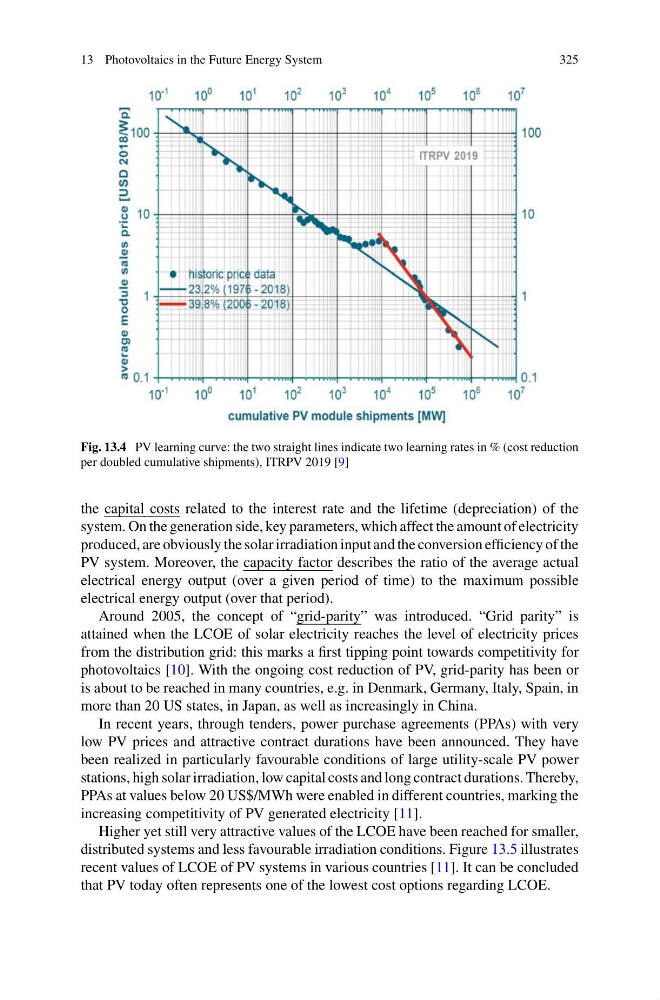
Fig. 13.4 PV learning curve: the two straight lines indicate two learning rates in % (cost reduction
per doubled cumulative shipments), ITRPV 2019 [9]
the capital costs related to the interest rate and the lifetime (depreciation) of the
system. On the generation side, key parameters, which affect the amount of electricity
produced, are obviously the solar irradiation input and the conversion efficiency of the
PV system. Moreover, the capacity factor describes the ratio of the average actual
electrical energy output (over a given period of time) to the maximum possible
electrical energy output (over that period).
Around 2005, the concept of “grid-parity” was introduced. “Grid parity” is
attained when the LCOE of solar electricity reaches the level of electricity prices
from the distribution grid: this marks a first tipping point towards competitivity for
photovoltaics [10]. With the ongoing cost reduction of PV, grid-parity has been or
is about to be reached in many countries, e.g. in Denmark, Germany, Italy, Spain, in
more than 20 US states, in Japan, as well as increasingly in China.
In recent years, through tenders, power purchase agreements (PPAs) with very
low PV prices and attractive contract durations have been announced. They have
been realized in particularly favourable conditions of large utility-scale PV power
stations, high solar irradiation, low capital costs and long contract durations. Thereby,
PPAs at values below 20 US$/MWh were enabled in different countries, marking the
increasing competitivity of PV generated electricity [11].
Higher yet still very attractive values of the LCOE have been reached for smaller,
distributed systems and less favourable irradiation conditions. Figure 13.5 illustrates
recent values of LCOE of PV systems in various countries [11]. It can be concluded
that PV today often represents one of the lowest cost options regarding LCOE.
325
Fig. 13.4 PV learning curve: the two straight lines indicate two learning rates in % (cost reduction
per doubled cumulative shipments), ITRPV 2019 [9]
the capital costs related to the interest rate and the lifetime (depreciation) of the
system. On the generation side, key parameters, which affect the amount of electricity
produced, are obviously the solar irradiation input and the conversion efficiency of the
PV system. Moreover, the capacity factor describes the ratio of the average actual
electrical energy output (over a given period of time) to the maximum possible
electrical energy output (over that period).
Around 2005, the concept of “grid-parity” was introduced. “Grid parity” is
attained when the LCOE of solar electricity reaches the level of electricity prices
from the distribution grid: this marks a first tipping point towards competitivity for
photovoltaics [10]. With the ongoing cost reduction of PV, grid-parity has been or
is about to be reached in many countries, e.g. in Denmark, Germany, Italy, Spain, in
more than 20 US states, in Japan, as well as increasingly in China.
In recent years, through tenders, power purchase agreements (PPAs) with very
low PV prices and attractive contract durations have been announced. They have
been realized in particularly favourable conditions of large utility-scale PV power
stations, high solar irradiation, low capital costs and long contract durations. Thereby,
PPAs at values below 20 US$/MWh were enabled in different countries, marking the
increasing competitivity of PV generated electricity [11].
Higher yet still very attractive values of the LCOE have been reached for smaller,
distributed systems and less favourable irradiation conditions. Figure 13.5 illustrates
recent values of LCOE of PV systems in various countries [11]. It can be concluded
that PV today often represents one of the lowest cost options regarding LCOE.