

324
S. Nowak
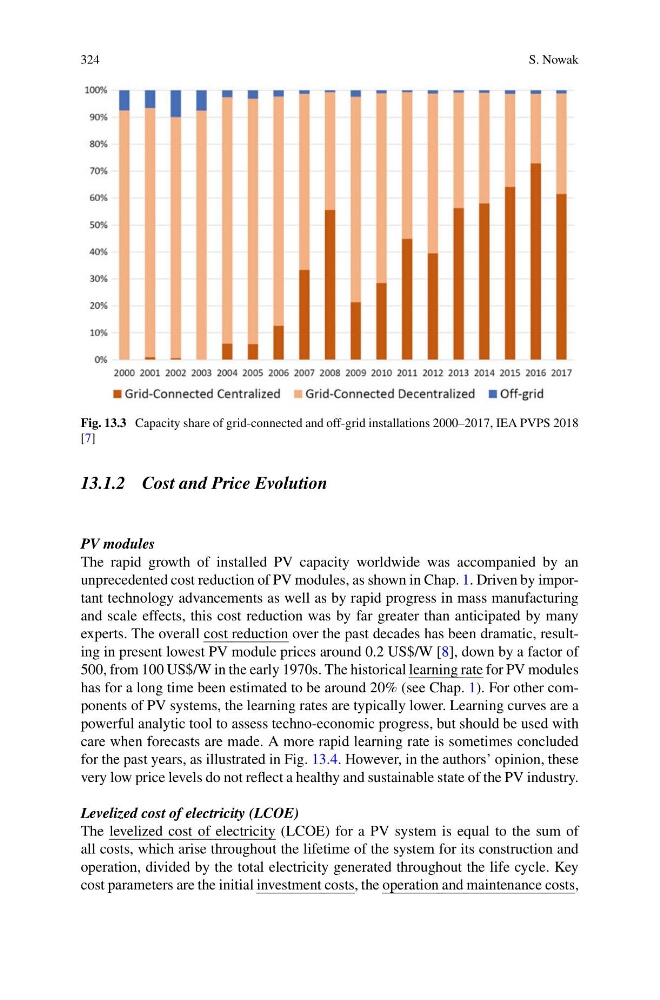
Fig. 13.3 Capacity share of grid-connected and off-grid installations 2000–2017, IEA PVPS 2018
[7]
13.1.2 Cost and Price Evolution
PV modules
The rapid growth of installed PV capacity worldwide was accompanied by an
unprecedented cost reduction of PV modules, as shown in Chap. 1. Driven by important technology advancements as well as by rapid progress in mass manufacturing
and scale effects, this cost reduction was by far greater than anticipated by many
experts. The overall cost reduction over the past decades has been dramatic, resulting in present lowest PV module prices around 0.2 US$/W [8], down by a factor of
500, from 100 US$/W in the early 1970s. The historical learning rate for PV modules
has for a long time been estimated to be around 20% (see Chap. 1). For other components of PV systems, the learning rates are typically lower. Learning curves are a
powerful analytic tool to assess techno-economic progress, but should be used with
care when forecasts are made. A more rapid learning rate is sometimes concluded
for the past years, as illustrated in Fig. 13.4. However, in the authors’ opinion, these
very low price levels do not reflect a healthy and sustainable state of the PV industry.
Levelized cost of electricity (LCOE)
The levelized cost of electricity (LCOE) for a PV system is equal to the sum of
all costs, which arise throughout the lifetime of the system for its construction and
operation, divided by the total electricity generated throughout the life cycle. Key
cost parameters are the initial investment costs, the operation and maintenance costs,
S. Nowak
Fig. 13.3 Capacity share of grid-connected and off-grid installations 2000–2017, IEA PVPS 2018
[7]
13.1.2 Cost and Price Evolution
PV modules
The rapid growth of installed PV capacity worldwide was accompanied by an
unprecedented cost reduction of PV modules, as shown in Chap. 1. Driven by important technology advancements as well as by rapid progress in mass manufacturing
and scale effects, this cost reduction was by far greater than anticipated by many
experts. The overall cost reduction over the past decades has been dramatic, resulting in present lowest PV module prices around 0.2 US$/W [8], down by a factor of
500, from 100 US$/W in the early 1970s. The historical learning rate for PV modules
has for a long time been estimated to be around 20% (see Chap. 1). For other components of PV systems, the learning rates are typically lower. Learning curves are a
powerful analytic tool to assess techno-economic progress, but should be used with
care when forecasts are made. A more rapid learning rate is sometimes concluded
for the past years, as illustrated in Fig. 13.4. However, in the authors’ opinion, these
very low price levels do not reflect a healthy and sustainable state of the PV industry.
Levelized cost of electricity (LCOE)
The levelized cost of electricity (LCOE) for a PV system is equal to the sum of
all costs, which arise throughout the lifetime of the system for its construction and
operation, divided by the total electricity generated throughout the life cycle. Key
cost parameters are the initial investment costs, the operation and maintenance costs,