

326
S. Nowak
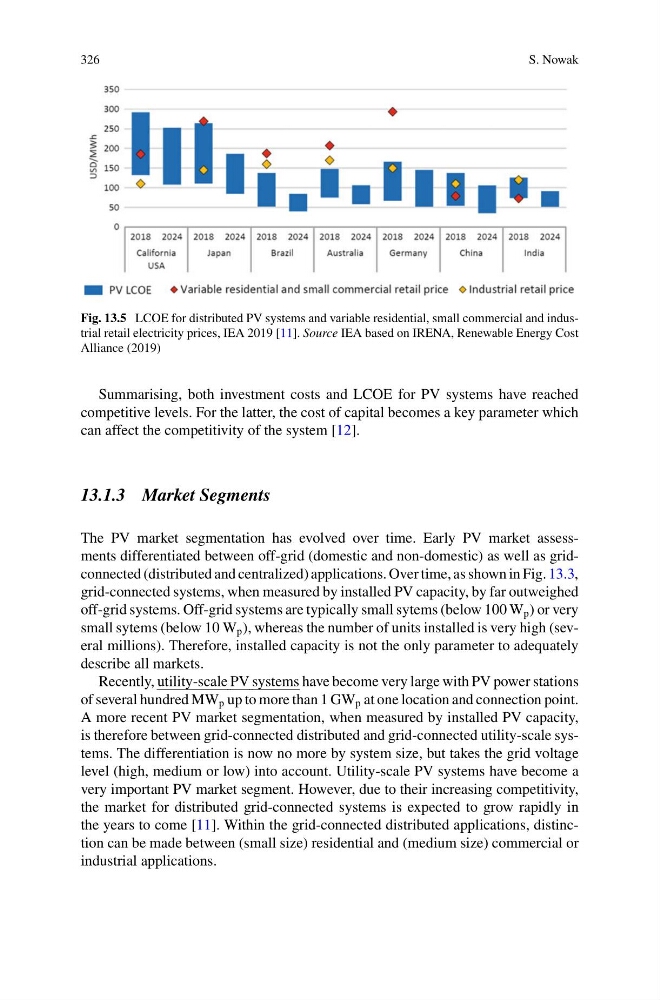
Fig. 13.5 LCOE for distributed PV systems and variable residential, small commercial and industrial retail electricity prices, IEA 2019 [11]. Source IEA based on IRENA, Renewable Energy Cost
Alliance (2019)
Summarising, both investment costs and LCOE for PV systems have reached
competitive levels. For the latter, the cost of capital becomes a key parameter which
can affect the competitivity of the system [12].
13.1.3 Market Segments
The PV market segmentation has evolved over time. Early PV market assessments differentiated between off-grid (domestic and non-domestic) as well as gridconnected (distributed and centralized) applications. Over time, as shown in Fig. 13.3,
grid-connected systems, when measured by installed PV capacity, by far outweighed
off-grid systems. Off-grid systems are typically small sytems (below 100 W p ) or very
small sytems (below 10 W p ), whereas the number of units installed is very high (several millions). Therefore, installed capacity is not the only parameter to adequately
describe all markets.
Recently, utility-scale PV systems have become very large with PV power stations
of several hundred MW p up to more than 1 GW p at one location and connection point.
A more recent PV market segmentation, when measured by installed PV capacity,
is therefore between grid-connected distributed and grid-connected utility-scale systems. The differentiation is now no more by system size, but takes the grid voltage
level (high, medium or low) into account. Utility-scale PV systems have become a
very important PV market segment. However, due to their increasing competitivity,
the market for distributed grid-connected systems is expected to grow rapidly in
the years to come [11]. Within the grid-connected distributed applications, distinction can be made between (small size) residential and (medium size) commercial or
industrial applications.
S. Nowak
Fig. 13.5 LCOE for distributed PV systems and variable residential, small commercial and industrial retail electricity prices, IEA 2019 [11]. Source IEA based on IRENA, Renewable Energy Cost
Alliance (2019)
Summarising, both investment costs and LCOE for PV systems have reached
competitive levels. For the latter, the cost of capital becomes a key parameter which
can affect the competitivity of the system [12].
13.1.3 Market Segments
The PV market segmentation has evolved over time. Early PV market assessments differentiated between off-grid (domestic and non-domestic) as well as gridconnected (distributed and centralized) applications. Over time, as shown in Fig. 13.3,
grid-connected systems, when measured by installed PV capacity, by far outweighed
off-grid systems. Off-grid systems are typically small sytems (below 100 W p ) or very
small sytems (below 10 W p ), whereas the number of units installed is very high (several millions). Therefore, installed capacity is not the only parameter to adequately
describe all markets.
Recently, utility-scale PV systems have become very large with PV power stations
of several hundred MW p up to more than 1 GW p at one location and connection point.
A more recent PV market segmentation, when measured by installed PV capacity,
is therefore between grid-connected distributed and grid-connected utility-scale systems. The differentiation is now no more by system size, but takes the grid voltage
level (high, medium or low) into account. Utility-scale PV systems have become a
very important PV market segment. However, due to their increasing competitivity,
the market for distributed grid-connected systems is expected to grow rapidly in
the years to come [11]. Within the grid-connected distributed applications, distinction can be made between (small size) residential and (medium size) commercial or
industrial applications.