

264
M. Pravettoni
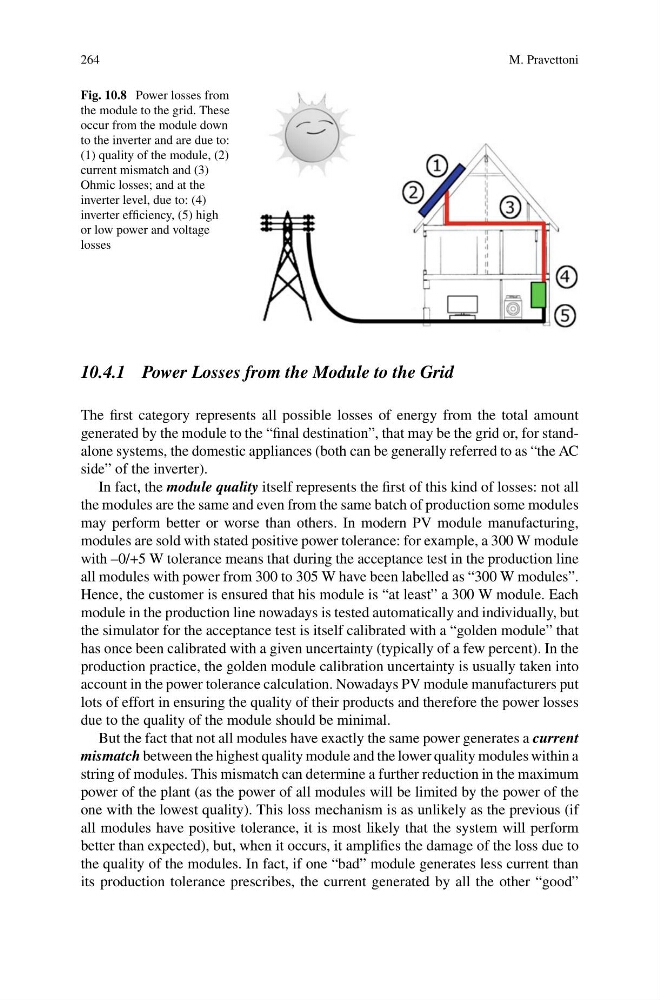
Fig. 10.8 Power losses from
the module to the grid. These
occur from the module down
to the inverter and are due to:
(1) quality of the module, (2)
current mismatch and (3)
Ohmic losses; and at the
inverter level, due to: (4)
inverter efficiency, (5) high
or low power and voltage
losses
10.4.1 Power Losses from the Module to the Grid
The first category represents all possible losses of energy from the total amount
generated by the module to the “final destination”, that may be the grid or, for standalone systems, the domestic appliances (both can be generally referred to as “the AC
side” of the inverter).
In fact, the module quality itself represents the first of this kind of losses: not all
the modules are the same and even from the same batch of production some modules
may perform better or worse than others. In modern PV module manufacturing,
modules are sold with stated positive power tolerance: for example, a 300 W module
with –0/+5 W tolerance means that during the acceptance test in the production line
all modules with power from 300 to 305 W have been labelled as “300 W modules”.
Hence, the customer is ensured that his module is “at least” a 300 W module. Each
module in the production line nowadays is tested automatically and individually, but
the simulator for the acceptance test is itself calibrated with a “golden module” that
has once been calibrated with a given uncertainty (typically of a few percent). In the
production practice, the golden module calibration uncertainty is usually taken into
account in the power tolerance calculation. Nowadays PV module manufacturers put
lots of effort in ensuring the quality of their products and therefore the power losses
due to the quality of the module should be minimal.
But the fact that not all modules have exactly the same power generates a current
mismatch between the highest quality module and the lower quality modules within a
string of modules. This mismatch can determine a further reduction in the maximum
power of the plant (as the power of all modules will be limited by the power of the
one with the lowest quality). This loss mechanism is as unlikely as the previous (if
all modules have positive tolerance, it is most likely that the system will perform
better than expected), but, when it occurs, it amplifies the damage of the loss due to
the quality of the modules. In fact, if one “bad” module generates less current than
its production tolerance prescribes, the current generated by all the other “good”
M. Pravettoni
Fig. 10.8 Power losses from
the module to the grid. These
occur from the module down
to the inverter and are due to:
(1) quality of the module, (2)
current mismatch and (3)
Ohmic losses; and at the
inverter level, due to: (4)
inverter efficiency, (5) high
or low power and voltage
losses
10.4.1 Power Losses from the Module to the Grid
The first category represents all possible losses of energy from the total amount
generated by the module to the “final destination”, that may be the grid or, for standalone systems, the domestic appliances (both can be generally referred to as “the AC
side” of the inverter).
In fact, the module quality itself represents the first of this kind of losses: not all
the modules are the same and even from the same batch of production some modules
may perform better or worse than others. In modern PV module manufacturing,
modules are sold with stated positive power tolerance: for example, a 300 W module
with –0/+5 W tolerance means that during the acceptance test in the production line
all modules with power from 300 to 305 W have been labelled as “300 W modules”.
Hence, the customer is ensured that his module is “at least” a 300 W module. Each
module in the production line nowadays is tested automatically and individually, but
the simulator for the acceptance test is itself calibrated with a “golden module” that
has once been calibrated with a given uncertainty (typically of a few percent). In the
production practice, the golden module calibration uncertainty is usually taken into
account in the power tolerance calculation. Nowadays PV module manufacturers put
lots of effort in ensuring the quality of their products and therefore the power losses
due to the quality of the module should be minimal.
But the fact that not all modules have exactly the same power generates a current
mismatch between the highest quality module and the lower quality modules within a
string of modules. This mismatch can determine a further reduction in the maximum
power of the plant (as the power of all modules will be limited by the power of the
one with the lowest quality). This loss mechanism is as unlikely as the previous (if
all modules have positive tolerance, it is most likely that the system will perform
better than expected), but, when it occurs, it amplifies the damage of the loss due to
the quality of the modules. In fact, if one “bad” module generates less current than
its production tolerance prescribes, the current generated by all the other “good”