

10 Module Deployment and Energy Rating
263
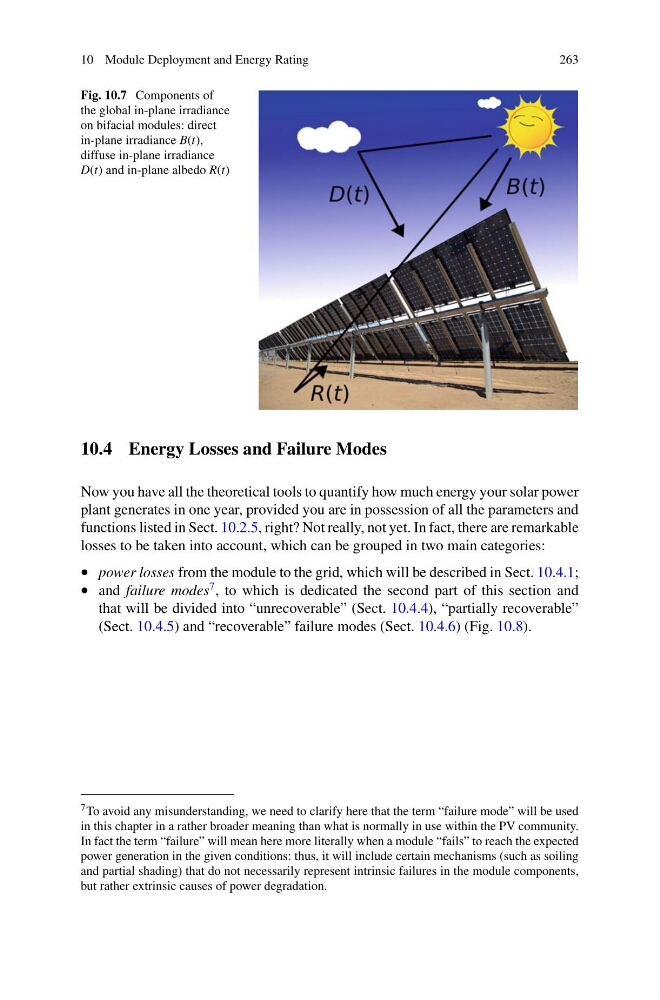
Fig. 10.7 Components of
the global in-plane irradiance
on bifacial modules: direct
in-plane irradiance B(t),
diffuse in-plane irradiance
D(t) and in-plane albedo R(t)
10.4 Energy Losses and Failure Modes
Now you have all the theoretical tools to quantify how much energy your solar power
plant generates in one year, provided you are in possession of all the parameters and
functions listed in Sect. 10.2.5, right? Not really, not yet. In fact, there are remarkable
losses to be taken into account, which can be grouped in two main categories:
• power losses from the module to the grid, which will be described in Sect. 10.4.1;
• and failure modes
7 , to which is dedicated the second part of this section and
that will be divided into “unrecoverable” (Sect. 10.4.4), “partially recoverable”
(Sect. 10.4.5) and “recoverable” failure modes (Sect. 10.4.6) (Fig. 10.8).
7 To avoid any misunderstanding, we need to clarify here that the term “failure mode” will be used
in this chapter in a rather broader meaning than what is normally in use within the PV community.
In fact the term “failure” will mean here more literally when a module “fails” to reach the expected
power generation in the given conditions: thus, it will include certain mechanisms (such as soiling
and partial shading) that do not necessarily represent intrinsic failures in the module components,
but rather extrinsic causes of power degradation.
263
Fig. 10.7 Components of
the global in-plane irradiance
on bifacial modules: direct
in-plane irradiance B(t),
diffuse in-plane irradiance
D(t) and in-plane albedo R(t)
10.4 Energy Losses and Failure Modes
Now you have all the theoretical tools to quantify how much energy your solar power
plant generates in one year, provided you are in possession of all the parameters and
functions listed in Sect. 10.2.5, right? Not really, not yet. In fact, there are remarkable
losses to be taken into account, which can be grouped in two main categories:
• power losses from the module to the grid, which will be described in Sect. 10.4.1;
• and failure modes
7 , to which is dedicated the second part of this section and
that will be divided into “unrecoverable” (Sect. 10.4.4), “partially recoverable”
(Sect. 10.4.5) and “recoverable” failure modes (Sect. 10.4.6) (Fig. 10.8).
7 To avoid any misunderstanding, we need to clarify here that the term “failure mode” will be used
in this chapter in a rather broader meaning than what is normally in use within the PV community.
In fact the term “failure” will mean here more literally when a module “fails” to reach the expected
power generation in the given conditions: thus, it will include certain mechanisms (such as soiling
and partial shading) that do not necessarily represent intrinsic failures in the module components,
but rather extrinsic causes of power degradation.